


 Home /
Lithium Battery Industry Chain: From Mining Resources to End-Use Markets


Table of Contents
- What Is the Lithium Battery Industry Chain?
- Upstream: Lithium, Cobalt, and Nickel Shape the Cost Base
- Midstream: Four Key Materials Drive Battery Performance
- Cell Manufacturing and Pack Integration
- Downstream Applications: EVs, Energy Storage, and Consumer Electronics
- Technology Trends in the Battery Market
- What This Means for OEM Battery Buyers
- Final Thoughts
- FAQ
The lithium battery industry has become one of the most important growth engines in the global energy transition. From electric vehicles and energy storage systems to smartphones and wearable devices, lithium batteries now power a wide range of modern applications.
But behind every finished battery pack is a long and complex value chain. It starts with upstream mining resources, moves through material processing and cell manufacturing, and ends with battery pack integration and downstream applications. Understanding this industry chain is important not only for investors and manufacturers, but also for OEM buyers looking for reliable battery solutions.
This article provides a clear overview of the lithium battery industry chain, its key materials, major market drivers, and the trends shaping the future of battery development.
What Is the Lithium Battery Industry Chain?
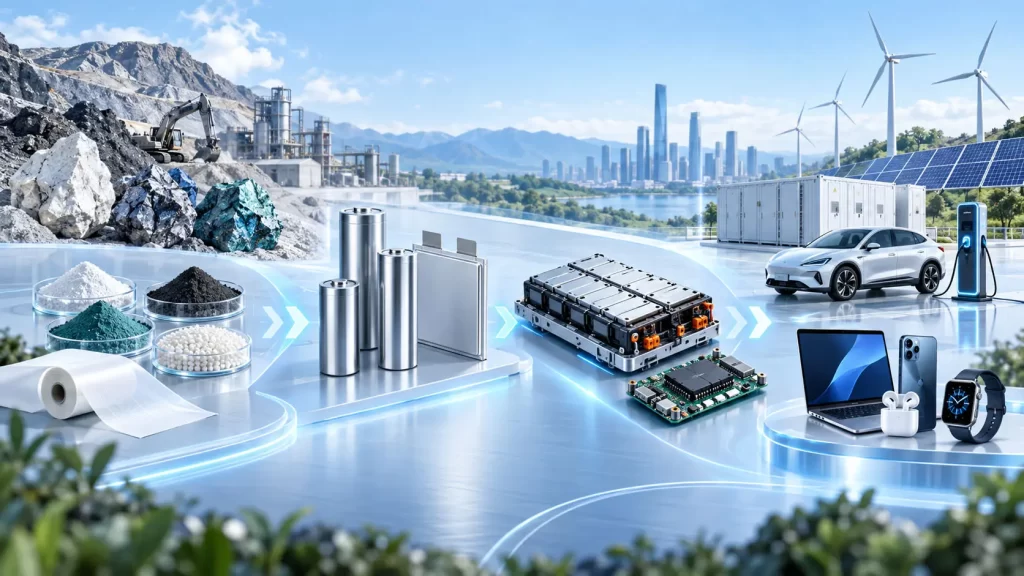
The lithium battery industry chain can be divided into four main parts:
- Upstream: mining resources and base raw materials
- Midstream: key battery materials such as cathodes, anodes, electrolytes, and separators
- Cell manufacturing: production of battery cells and system integration
- Downstream: end-use applications including EVs, energy storage, and consumer electronics
According to the infographic you shared, upstream resources account for the largest part of industry value, followed by midstream materials, cell manufacturing, and pack integration. This explains why raw material availability and pricing still have a major impact on the entire battery market.
Upstream: Lithium, Cobalt, and Nickel Shape the Cost Base
The upstream segment is the foundation of the whole battery business. Among all raw materials, lithium, cobalt, and nickel are the most influential.
Lithium
Lithium is the core metal of lithium-ion batteries. It mainly comes from:
- Salt lake brine, especially in South America
- Spodumene ore, mainly from Australia
- Lepidolite, with some supply from China
Lithium prices are known for strong cyclic fluctuations. When EV demand rises quickly, lithium supply often becomes tight, pushing costs up. When production expands, prices may fall again. This makes lithium one of the biggest variables in battery cost control.
Cobalt
Cobalt is widely used in ternary battery chemistries. A large share of global cobalt supply comes from the Democratic Republic of Congo, which means supply is relatively concentrated. Because of this concentration, cobalt is often considered the battery metal with the highest supply risk.
To reduce dependence on cobalt, many battery makers are developing high-nickel or low-cobalt chemistries.
Nickel
Nickel has become increasingly important for higher-energy-density batteries. Indonesia has emerged as a major nickel supplier, especially through laterite nickel ore development. Nickel processing routes such as HPAL and RKEF are now important to the battery-grade nickel supply chain.
For buyers, these upstream factors matter because they directly affect pricing, lead time, and sometimes the availability of specific battery chemistries.
Midstream: Four Key Materials Drive Battery Performance
The midstream section is where raw materials are transformed into the functional materials that determine battery performance.
Cathode Materials
Cathode materials usually represent the largest cost share in a lithium-ion battery. The two main routes are:
- LFP (Lithium Iron Phosphate): lower cost, strong safety, long cycle life
- NCM/NCA ternary materials: higher energy density, commonly used in higher-performance applications
LFP has gained strong momentum in both EV and energy storage markets due to its safety and cost advantages.
Anode Materials
Common anode materials include:
- Artificial graphite
- Natural graphite
- Silicon-carbon anode, an emerging route for higher energy density
Graphite remains the mainstream choice, while silicon-carbon materials are attracting attention for next-generation consumer electronics and high-performance cells.
Electrolytes
Electrolytes are made from:
- Lithium salt
- Solvents
- Additives
Among them, lithium hexafluorophosphate plays a key role in electrolyte cost. New electrolyte systems and additives are also helping improve safety, low-temperature performance, and fast-charging capability.
Separators
Separators are critical for battery safety and stability. The market mainly includes:
- Wet-process separators
- Dry-process separators
Separators are often seen as one of the more profitable segments among the four key materials because product quality and process barriers are relatively high.
Cell Manufacturing and Pack Integration
Once the four key materials are ready, they move into cell manufacturing. Battery cells are generally made in three major formats:
- Prismatic cells
- Cylindrical cells
- Pouch cells
These cells are then assembled into battery packs through module and system integration. This is where BMS (Battery Management System), thermal management, and structural design become essential.
For a battery pack manufacturer, the real value is not only in assembling cells, but also in delivering:
- Safe electrical design
- Stable thermal control
- Reliable protection circuits
- Smart BMS communication and monitoring
- Customized structure for the target device or equipment
This is especially important in applications such as medical devices, POS terminals, industrial equipment, heated clothing, robotics, and portable energy systems.
Downstream Applications: EVs, Energy Storage, and Consumer Electronics
The final stage of the lithium battery industry chain is the application market. Based on the chart you provided, the three biggest sectors are:
| Application Market | Approximate Share | Main Features |
|---|---|---|
| Power Batteries (EV) | 65% | Largest market, driven by electric vehicles |
| Energy Storage Batteries | 20% | Fast-growing segment for grid, C&I, and residential storage |
| Consumer Electronics | 15% | Stable demand for phones, laptops, wearables, and portable devices |
Electric Vehicles
EV batteries remain the biggest demand source. The market continues to push for:
- Longer driving range
- Faster charging
- Better safety
- Lower system cost
Energy Storage
Energy storage is one of the fastest-growing battery segments. Demand is expanding across:
- Grid-scale storage
- Commercial and industrial ESS
- Residential energy storage
Large-capacity cells, long cycle life, and strong thermal safety are the key purchasing factors here.
Consumer Electronics
Consumer electronics remain an important market, especially for compact and high-energy-density battery packs. Growth is steadier than EV or ESS, but the need for thinner, lighter, and more efficient batteries keeps innovation moving.
Technology Trends in the Battery Market
The battery industry is not standing still. Several major technology trends are shaping the next stage of competition.
Structural Innovation
Design routes such as CTP, CTC, and CTB are improving space utilization and helping reduce pack-level costs.
Material Innovation
Material development continues in areas such as:
- LFP optimization
- LMFP
- High-nickel ternary materials
- Silicon-carbon anodes
- Semi-solid and solid-state battery technologies
Although solid-state batteries attract a lot of attention, liquid lithium-ion technology is still expected to dominate the market in the near term.
Safety and System Intelligence
Battery safety is becoming more important across all sectors. This means more demand for:
- Smarter BMS design
- Better thermal management
- More accurate SOC monitoring
- Stronger pack-level protection
What This Means for OEM Battery Buyers
For OEMs and device brands, understanding the lithium battery industry chain helps improve sourcing decisions. It is not enough to compare price alone. A good battery supplier should also offer:
- Stable cell sourcing capability
- Knowledge of battery chemistry selection
- Custom pack design experience
- Reliable BMS integration
- Safety compliance support
- Long-term production consistency
In other words, the best battery solution is not always the cheapest one. It is the one that fits the application, meets safety needs, and remains stable across the product lifecycle.
Final Thoughts
The lithium battery industry chain is a complete ecosystem that connects global mining resources, advanced material science, cell production, and real-world applications. Upstream resources determine cost pressure, midstream materials define performance, manufacturing ensures quality, and downstream demand drives innovation.
As EVs, energy storage, and smart electronics continue to expand, the battery supply chain will remain one of the most important industries in the world. For businesses that rely on custom battery packs, understanding this chain is the first step toward making better product and sourcing decisions.
If your project requires a custom lithium battery solution, working with an experienced battery pack manufacturer can help you balance performance, safety, and cost more effectively.
FAQ
What are the main parts of the lithium battery industry chain?
The lithium battery industry chain includes upstream resources, midstream battery materials, cell manufacturing, pack integration, and downstream application markets.
Why are lithium, cobalt, and nickel so important?
These metals strongly influence battery chemistry, cost, and performance. Their global supply and pricing directly affect battery manufacturers and buyers.
What are the four key battery materials?
The four major materials are cathode materials, anode materials, electrolytes, and separators. They determine battery safety, energy density, cycle life, and cost.
Which market uses the most lithium batteries?
Electric vehicles currently represent the largest application market, followed by energy storage and consumer electronics.
Is LFP better than ternary battery chemistry?
It depends on the application. LFP offers better safety and lower cost, while ternary batteries usually provide higher energy density.
Why is BMS important in a battery pack?
A BMS helps monitor voltage, temperature, charging, and discharging conditions. It improves battery safety, reliability, and lifespan.
Talk to the Manufacturer
Resources & Insights
High Capacity Lithium Battery for Wearables: High-Voltage LiPo Cell Design
2026-10-19
Cylindrical Battery Packs for Laptops: 2S vs 3S vs 4S Battery Design
2026-10-19
Stage Lighting Battery Pack: Prevent Voltage Drop & LED Flicker
2026-10-19

Best Rechargeable Batteries for Smart Devices: Performance, Safety, and Selection Guide
2026-10-19


