


 Home /
How to Choose the Right BMS for a Lithium Battery Pack


Table of Contents
- What Does a BMS Do in a Lithium Battery Pack?
- How Do I Match the BMS Voltage to the Battery Pack?
- How Much Current Should the BMS Support?
- Should the BMS Have Cell Balancing?
- How Important Is Temperature Protection?
- Do I Need a Smart BMS?
- What Protection Parameters Should Be Checked?
- Can I Use a Standard BMS for a Custom Lithium Battery Pack?
- What Information Should I Provide to a Battery Manufacturer?
- Final Thoughts
-
FAQ
- What size BMS do I need for a lithium battery?
- Can I use a higher-current BMS than my battery requires?
- Does every lithium battery need a BMS?
- What is the difference between a BMS and a protection circuit?
- Do 1S lithium batteries need cell balancing?
- Can GLOFLUX customize the BMS for my battery pack?
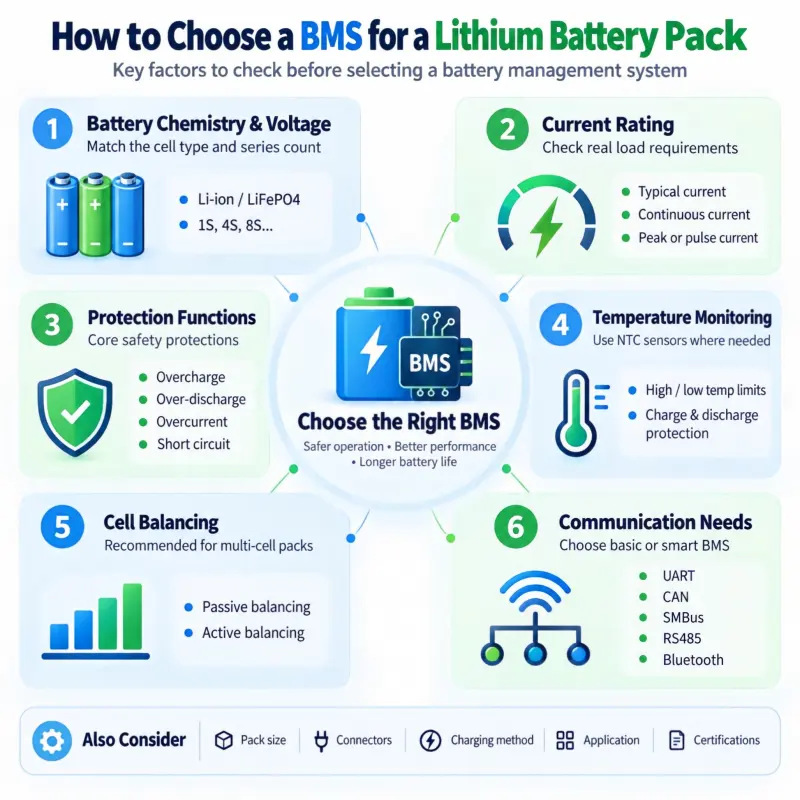
Choosing the right Battery Management System, or BMS, is one of the most important steps when designing a lithium battery pack. The cells may determine how much energy a battery can store, but the BMS determines how safely and reliably that energy can be used.
A suitable BMS monitors voltage, current, temperature, charging, discharging, and sometimes communication with the main device. Choosing the wrong one may cause unexpected shutdowns, poor battery performance, shortened service life, or even safety risks.
So, how do you choose the correct BMS for your lithium battery pack? Below are the main questions engineers and product developers should consider.
What Does a BMS Do in a Lithium Battery Pack?
A BMS protects lithium battery cells from operating outside their safe limits.
Its basic functions normally include:
- Overcharge protection
- Over-discharge protection
- Overcurrent protection
- Short-circuit protection
- Temperature monitoring
- Cell voltage monitoring
- Cell balancing
More advanced BMS designs may also support SOC calculation, cycle counting, CAN, RS485, UART, SMBus, Bluetooth, or other communication functions.
The required BMS depends heavily on the battery application. A small wearable battery and a 51.2V energy storage battery obviously need very different management systems.
How Do I Match the BMS Voltage to the Battery Pack?
The first thing to confirm is the battery chemistry and series configuration.
For example, a standard lithium-ion cell has a nominal voltage of approximately 3.6V or 3.7V and typically charges to 4.2V.
A 4S lithium battery pack therefore has approximately:
Nominal voltage:
3.7V × 4 = 14.8V
Maximum charging voltage:
4.2V × 4 = 16.8V
The BMS must be designed for the same number of cells connected in series.
If your battery pack is 4S, you need a 4S BMS. A 3S or 5S BMS should not be used as a substitute.
Battery chemistry is equally important. LiFePO4 cells, standard NMC lithium-ion cells, and high-voltage lithium cells have different charging and protection voltage requirements.
Always confirm the cell chemistry before selecting the BMS.
How Much Current Should the BMS Support?
BMS current rating should be selected according to the actual load rather than battery capacity alone.
You should normally know three values:
- Typical operating current
- Maximum continuous current
- Peak or pulse current
For example, a battery may normally supply 3A, operate continuously at up to 8A, but briefly reach 15A when a motor starts.
In this situation, choosing an 8A BMS simply because the continuous load is 8A may leave too little margin.
The BMS MOSFETs, PCB traces, connectors, nickel strips, wires, and battery cells must all be capable of handling the required current.
For high-power products such as power tools, robots, electric mobility devices, and energy storage systems, current capability becomes especially important.
Should the BMS Have Cell Balancing?
For multi-cell lithium battery packs, cell balancing is generally recommended.
Even cells from the same production batch will not remain perfectly identical over hundreds of charge and discharge cycles. Small differences in capacity, internal resistance, temperature, and self-discharge can gradually cause voltage imbalance.
If one cell reaches the charging limit earlier than the others, the BMS may stop charging the entire battery pack even though the other cells are not fully charged.
Balancing helps reduce this difference.
Basic battery packs often use passive balancing. More complex battery systems may use active balancing, especially when the battery capacity is large or the application requires tighter cell consistency.
The appropriate balancing strategy depends on pack voltage, capacity, cell consistency, operating conditions, and expected service life.
How Important Is Temperature Protection?
Temperature monitoring is very important for lithium battery safety.
A BMS can use one or multiple NTC temperature sensors to monitor the battery cells, PCB, MOSFETs, or other important areas.
For small battery packs, one NTC may be sufficient. Larger battery packs may require several temperature sensors because different areas of the pack can operate at different temperatures.
The BMS can stop charging or discharging if the temperature becomes too high or too low.
When developing a custom lithium battery pack, the exact temperature thresholds should be determined according to the selected cell specification and the application environment rather than using one universal value.
Do I Need a Smart BMS?
Not every battery needs a smart BMS.
Simple consumer products may only require basic protection functions.
However, applications such as medical equipment, industrial devices, robots, communication equipment, and energy storage systems often require communication between the battery and the main device.
A smart BMS may provide information such as:
- State of charge
- Battery voltage
- Current
- Cell voltage
- Temperature
- Remaining capacity
- Cycle count
- Battery health
- Fault status
Communication protocols may include UART, SMBus, I2C, CAN, RS485, or Bluetooth.
Before designing the BMS, engineers should confirm what information the host device needs and which communication protocol the system uses.
What Protection Parameters Should Be Checked?
Do not choose a BMS only by looking at voltage and current ratings.
Important parameters may include:
| Parameter | Why It Matters |
|---|---|
| Overcharge voltage | Prevents cells from exceeding their charging limit |
| Over-discharge voltage | Prevents excessive cell discharge |
| Overcurrent protection | Protects the pack under abnormal load |
| Short-circuit protection | Helps protect against severe fault conditions |
| Charge temperature limit | Controls charging under unsuitable temperatures |
| Discharge temperature limit | Protects cells during extreme operating conditions |
| Recovery conditions | Determines how the battery resumes operation |
| Balance voltage | Determines when cell balancing begins |
These values should match the battery cell specification and real operating conditions.
Can I Use a Standard BMS for a Custom Lithium Battery Pack?
Sometimes yes, but not always.
A standard BMS may work well for simple projects where voltage, current, dimensions, connectors, and protection parameters are already compatible.
For more specialized products, a custom BMS may be required.
Customization can include PCB dimensions, connector position, NTC quantity, communication protocols, firmware, protection thresholds, fuel-gauge ICs, FPC connections, and mechanical layout.
This is especially common in medical devices, POS terminals, smart wearables, robotics, industrial equipment, and other products where space is limited.
What Information Should I Provide to a Battery Manufacturer?
If you are developing a custom battery pack, providing clear technical information at the beginning can save a lot of development time.
The most useful information includes:
- Battery voltage
- Required capacity
- Cell chemistry
- Maximum battery dimensions
- Typical current
- Maximum continuous current
- Peak current and pulse duration
- Charging method
- Operating temperature
- Connector requirements
- Communication requirements
- Target certifications
- Application information
At GLOFLUX, our engineering team can evaluate the cell, protection circuit, BMS, connector, mechanical structure, and application requirements together rather than treating the BMS as an independent component.
Final Thoughts
Choosing the right BMS for a lithium battery pack is not simply a matter of matching voltage and current.
A reliable BMS needs to match the battery chemistry, series configuration, load profile, temperature range, charging system, communication requirements, mechanical design, and safety requirements.
For simple battery packs, a standard protection board may be enough. For higher-power or more specialized applications, a customized BMS can provide better control, monitoring, protection, and system integration.
If you are developing a custom lithium battery pack and are unsure which BMS configuration is suitable, GLOFLUX can help evaluate your application requirements and develop a battery solution based on the actual operating conditions.
FAQ
What size BMS do I need for a lithium battery?
The BMS should match the battery's series configuration and support the required continuous and peak current. Battery chemistry and maximum charging voltage must also be compatible.
Can I use a higher-current BMS than my battery requires?
Generally, a BMS with a somewhat higher current capability can provide additional operating margin, but the battery cells, wires, connectors, and PCB must still support the actual current.
Does every lithium battery need a BMS?
Most rechargeable lithium battery packs require protection against overcharge, over-discharge, overcurrent, and short circuit. The complexity of the BMS depends on the application.
What is the difference between a BMS and a protection circuit?
A simple protection circuit mainly provides basic safety protection, while a BMS may also provide cell monitoring, balancing, SOC calculation, communication, data logging, and other intelligent functions.
Do 1S lithium batteries need cell balancing?
No. A 1S battery contains only one series cell group, so there are no multiple series groups to balance. However, protection against overcharge, over-discharge, and overcurrent is still important.
Can GLOFLUX customize the BMS for my battery pack?
Yes. Depending on the project requirements, GLOFLUX can support customized battery protection and BMS solutions including voltage, current, connectors, NTC sensors, communication functions, PCB dimensions, and other application-specific requirements.
Talk to the Manufacturer
Resources & Insights

High Capacity Lithium Battery for Wearables: High-Voltage LiPo Cell Design
2026-10-19
Cylindrical Battery Packs for Laptops: 2S vs 3S vs 4S Battery Design
2026-10-19

Stage Lighting Battery Pack: Prevent Voltage Drop & LED Flicker
2026-10-19

Best Rechargeable Batteries for Smart Devices: Performance, Safety, and Selection Guide
2026-10-19


