


 Home /
Cylindrical Battery Packs for Laptops: 2S vs 3S vs 4S Battery Design


Table of Contents
- Understanding 2S, 3S and 4S Battery Configurations
- How Series Configuration Affects Runtime and Thermal Losses
- Matching Laptop Battery Voltage to Motherboard Architecture
- 18650 vs 21700: Cell Selection and Mechanical Integration
- BMS Design, Cell Balancing, and Temperature Control
- GLOFLUX Manufacturing Precision and Pack Reliability
- Safety Verification and OEM Purchasing Criteria
The system voltage window determines the starting point when selecting cylindrical battery packs for laptops. Architectures such as 2S, 3S and 4S impact battery current, charging requirements and the protection system and motherboard compatibility.
OEMs and Industrial Computer Manufacturers need the right balance of usable energy, power delivery and thermal management along with consistency in production.
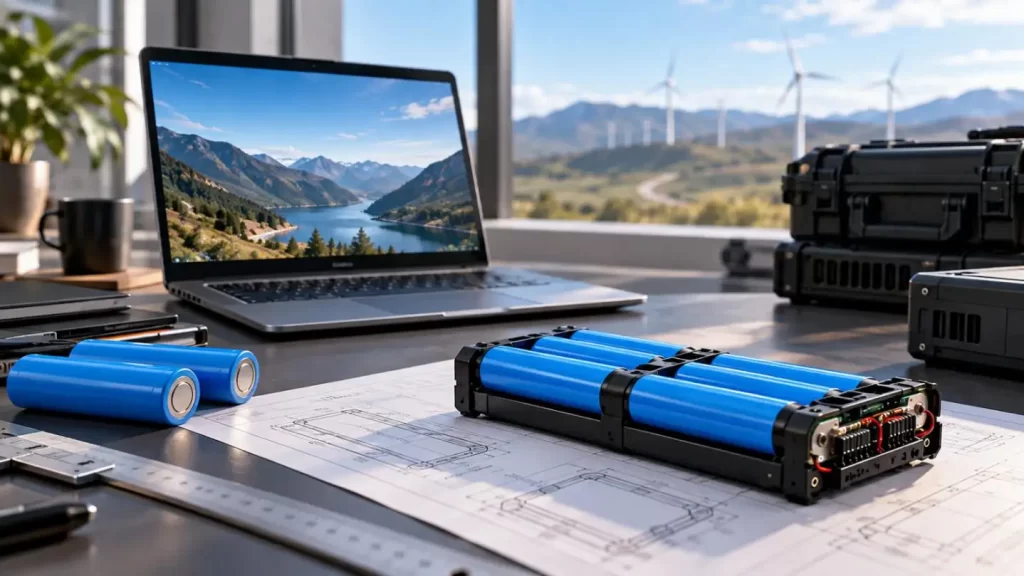
Understanding 2S, 3S and 4S Battery Configurations
In a lithium-ion battery the S and P denote series and parallel connections respectively.
• In a series connection, the Ah capacity of a parallel group remains same. The voltage of the series group increases.
• In a parallel connection the voltage of a series group remains the same. The Ah capacity and current of a parallel group increases.
• Total energy: Depends on the nominal voltage of the battery multiplied by the capacity.
Electrical Comparison of 2S, 3S, and 4S
Using conventional 3.7V nominal, 4.2V maximum-charge lithium-ion cells:
| Parameter | 2S | 3S | 4S |
| Nominal voltage | 7.4V | 11.1V | 14.8V |
| Maximum charge voltage | 8.4V | 12.6V | 16.8V |
| Capacity with 3Ah cells, 1P | 3Ah | 3Ah | 3Ah |
| Nominal energy, 1P | 22.2Wh | 33.3Wh | 44.4Wh |
| Primary consideration | Higher pack current | Intermediate voltage | Higher voltage compatibility |
Some commercial cells use 3.6V nominal ratings, producing 7.2V, 10.8V, and 14.4V packs.
How Series Configuration Affects Runtime and Thermal Losses
Battery Voltage vs Usable Energy
A common misconception is that 4S automatically provides longer runtime than 2S.
Consider four identical 3.7V, 3Ah cells:
• 2S2P: 7.4V × 6Ah = 44.4Wh
• 4S1P: 14.8V × 3Ah = 44.4Wh
Both contain the same nominal energy.
Actual runtime depends on discharge cutoff voltage, operating temperature, load profile, and DC-DC conversion losses.
Current Demand and I²R Heating
At a constant 60W battery load:
| Configuration | Approximate Current |
| 2S | 8.1A |
| 3S | 5.4A |
| 4S | 4.1A |
Battery current approximately follows I = P/V, while resistive losses follow P(loss) = I²R.
Higher voltage reduces current for equivalent power. However, increasing series count also increases cell-string resistance.
For equal cell count and identical cells, changing between 2S2P and 4S1P does not inherently reduce total cell heating at equal power. Differences arise from interconnect resistance, current distribution, and converter operation.
Therefore, for Laptop battery packs, we need to perform pack-level thermal measurements instead of making assumptions based on voltage.
Matching Laptop Battery Voltage to Motherboard Architecture
Battery choice is constrained by the input-voltage range and charging topology of the motherboard.
Three Important Compatibility Considerations
• Conversion: Check if DC-DC conversion works within battery voltage range by buck, boost or buck-boost conversion.
• Charging: Check charging IC for CC-CV profile, current limits and series-cell count.
• Delivery: Check CPU/GPU peak demand and evaluate voltage sag. Understand battery interface with the system power path.
Battery configuration is unrelated to USB-C Power Delivery. An example is 20V adaptor. A charging circuit may be required to support a 2S, 3S or 4S pack.
Replacing the battery with the same nominal voltage does not guarantee compatibility. Other factors such as the communication protocol, protection thresholds or pinout may influence compatibility.
18650 vs 21700: Cell Selection and Mechanical Integration
Cell format determines more than nominal capacity.
| Engineering Factor | 18650 | 21700 |
| Nominal dimensions | 18 × 65mm | 21 × 70mm |
| Packaging | Smaller diameter | Greater individual volume |
| Capacity | Cell-dependent | Often higher per cell |
| Discharge capability | Grade-dependent | Grade-dependent |
| Selection priority | Restricted layouts | Higher energy per cell where space permits |
For rugged laptops and industrial computers, we evaluate enclosure clearance, cell orientation, insulation thickness, connector placement, and vibration resistance.
Ultra-thin laptops may favor pouch cells when flat packaging provides better space utilization.
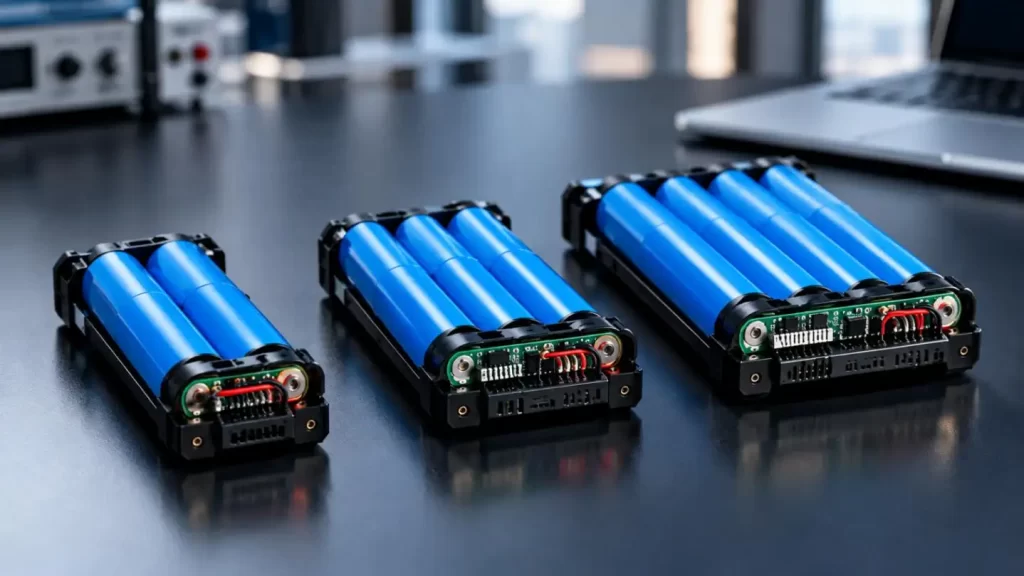
BMS Design, Cell Balancing, and Temperature Control
Laptop battery packs contain numerous cells arranged in groups and packs. Therefore, Multicell Cylindrical Battery Packs for Laptops require cell-group and pack-level protections.
Essential BMS Functions
• To perform voltage monitoring, detect series-group overvoltage and undervoltage.
• For cell balancing, reduce the charge imbalance among the series groups.
• Provide overcurrent and short-circuit protection.
• Use an NTC to measure cell temperature and implement charging limits that are dependent on cell temperature.
• Support smart communication via SMBus, and, if required, provide SOC/SOH reporting and/or diagnostics.
Why Cell Matching is Important
Unmatched cells can lead to early shutoff, uneven aging and temperature differences.
At GLOFLUX, our custom battery engineering includes cell selection and BMS integration along with electrical and mechanical engineering.
Matching cannot compensate for severely unmatched cells. DC Internal resistance and open circuit voltage measurements are still critical prior to assembly.
GLOFLUX Manufacturing Precision and Pack Reliability
At GLOFLUX, we support customized cylindrical battery packs through cell selection, electrical configuration, BMS design, prototyping, and production validation.
Our industrial smart-battery specifications provide measurable dimensional references:
| Specification | 3S3P Smart Battery | 4S2P Smart Battery |
| Nominal voltage | 10.8V | 14.4V |
| Rated capacity | 9000mAh | 6600mAh |
| Dimensions (L × W × T) | 148.8 × 88.9 × 20.1mm | 150.5 × 77.4 × 22.7mm |
| Dimensional tolerance | ±0.3mm per dimension | ±0.3mm per dimension |
| Specified AC resistance | <200mΩ | <200mΩ |
The resistance figures are specified at 1kHz and 25°C; they should not be substituted directly for DC resistance in thermal calculations. These product-specific specifications do not establish universal tolerances for all custom laptop batteries.
Manufacturing Controls That Affect Reliability
Our quality system comprises of more than 60 inspection procedures. The top OEM verification priorities are:
• Inspection and grading of cells.
• Evaluation of joints and seams, and welds.
• Assessment of insulation and seals.
• Enclosure dimensions and polarity.
• Connector alignment and function.
• Functional testing of BMS and production traceability.
Safety Verification and OEM Purchasing Criteria
Before approving Cylindrical Battery Packs for Laptops, OEM buyers should request documented pack-level validation.
| Verification | Required Evidence |
| Electrical performance | Capacity, voltage sag, peak current |
| Thermal performance | Temperature rise under defined loads |
| Protection | OVP, UVP, OCP, short-circuit tests |
| Mechanical reliability | Dimensional and vibration testing |
| Communication | SMBus, SOC, fault reporting |
| Compliance | IEC 62133-2 and UN 38.3 documentation |
IEC 62133-2 addresses portable lithium battery safety; UN 38.3 concerns transport testing. Neither alone confirms laptop compatibility.
Procurement specifications should include enclosure drawings, operating voltage range, power profile, charging requirements, communication protocol, temperature limits, and target-market certification requirements.
Custom Cylindrical Battery Pack Development With GLOFLUX
The appropriate 2S, 3S, or 4S design must satisfy the complete electrical, thermal, mechanical, and safety specification.
At GLOFLUX, we have cells architectured in a cylindrical format with configurable sizes. Our BMS and manufacturing quality control help support OEM/ODM battery design and development.
Get in touch to talk about your specific battery design needs for your laptop or industrial computing devices.
FAQs
Q1. Does GLOFLUX manufacture custom cylindrical battery packs for laptops?
Yes. We provide OEM/ODM cylindrical lithium-ion battery solutions with customized voltage, capacity, BMS, connectors, and mechanical structures. Laptop compatibility requires project-specific validation.
Q2. Can GLOFLUX customize 2S, 3S, and 4S battery configurations?
Yes. We support customized series-parallel configurations based on device voltage, energy requirements, discharge current, and available installation space.
Q3. Does GLOFLUX support both 18650 and 21700 cylindrical cells?
Yes. We offer 18650 and 21700 cell options, selected according to capacity, discharge performance, thermal requirements, and mechanical constraints.
Q4. What manufacturing tolerances does GLOFLUX provide?
Our published 3S3P and 4S2P smart battery specifications list dimensional tolerances of ±0.3 mm. Custom project tolerances require engineering confirmation.
Q5. Can GLOFLUX integrate a BMS into custom laptop battery packs?
Yes. We provide BMS integration with voltage, current, and temperature protection. Cell balancing and communication functions depend on project requirements.
Talk to the Manufacturer
Resources & Insights
High Capacity Lithium Battery for Wearables: High-Voltage LiPo Cell Design
2026-10-19
Cylindrical Battery Packs for Laptops: 2S vs 3S vs 4S Battery Design
2026-10-19
Stage Lighting Battery Pack: Prevent Voltage Drop & LED Flicker
2026-10-19

Best Rechargeable Batteries for Smart Devices: Performance, Safety, and Selection Guide
2026-10-19


