


 Home /
 Custom Lithium Battery for Video Doorbells: Runtime and Weather Design


Table of Contents
- What Determines Video Doorbell Battery Runtime?
- How to Specify the Battery Pack for a Video Doorbell
- Choosing the Right Chemistry and Form Factor
- Weather Design: Cold-Weather Discharge and Charging
- BMS, Charger, and Outdoor Mechanical Design
- Testing, Documentation, and Transport Compliance
- What to Include in a Video Doorbell Battery RFQ
- Frequently Asked Questions
- Designing the Right Pack for Your Doorbell
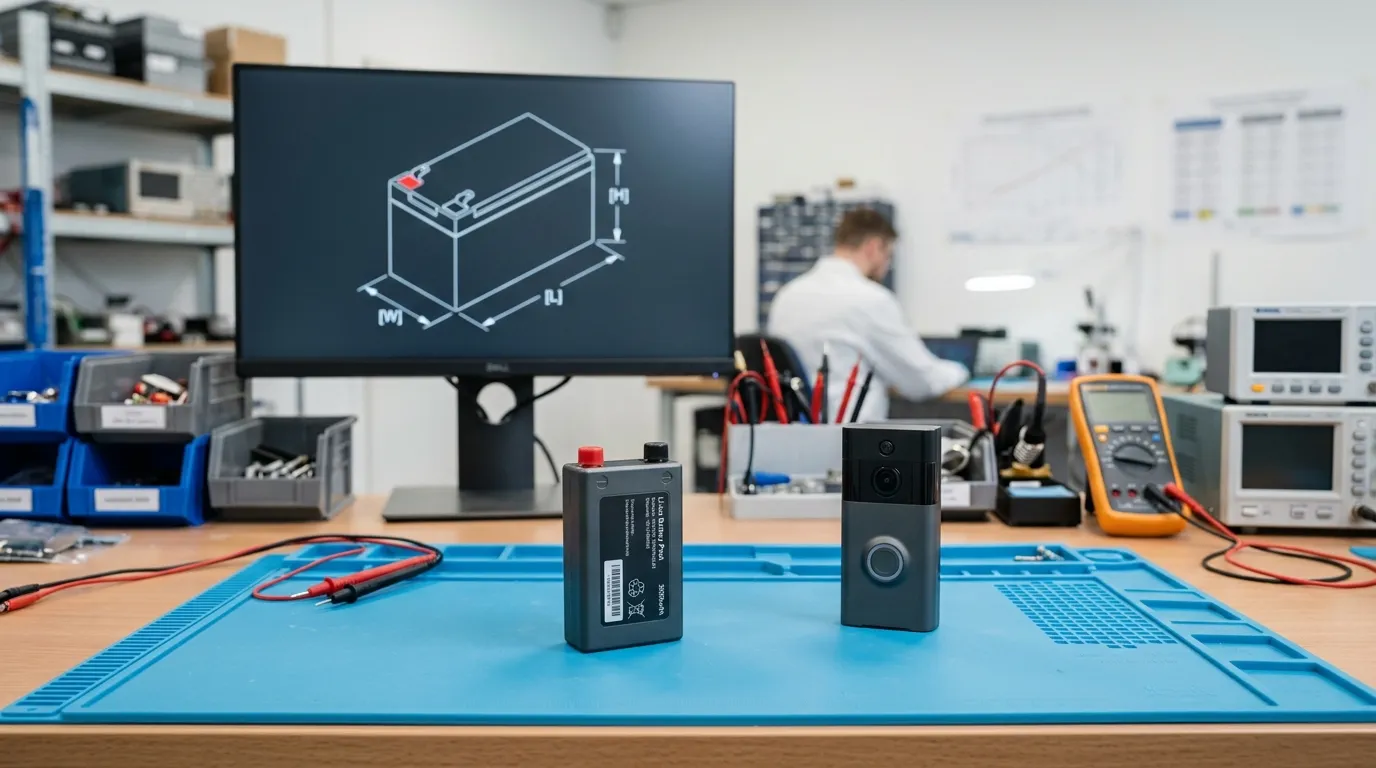
A custom lithium battery for a video doorbell must be designed from the device's actual load profile and runtime target, then matched to the required voltage, peak current, charger, battery management system, enclosure, and operating and charging temperatures. Capacity alone does not determine compatibility or runtime — the pack must be engineered for how the doorbell actually uses power throughout the day and across seasons.
Battery-powered video doorbells typically use rechargeable lithium battery packs rather than a universal cell size. Because each doorbell has a different enclosure, camera, wireless radio, and feature set, there is no standard battery that fits every model. This guide explains how to specify a custom pack that meets your runtime and weather requirements, and what to demand from a battery supplier before approving a design.
What Determines Video Doorbell Battery Runtime?
Video doorbell battery runtime is determined by the device's load profile — not just by the battery's milliamp-hour rating. A doorbell that triggers 20 motion events per day with live view and two-way audio will consume significantly more energy than one that sits in standby for most of the day.
The main power consumers in a battery-powered video doorbell are:
- Camera sensor and image processing
- Wi-Fi radio for video upload and push notifications
- PIR motion sensor
- Night vision / IR LEDs
- Two-way audio speaker and microphone
- Status LED indicators
Each of these components draws current only when active. The combination of how often each component operates and how much current it draws defines the doorbell's average energy demand — its duty cycle.
Energy (Wh) = nominal voltage (V) × capacity (Ah)
Runtime depends on the usable energy in the battery and the average power draw of the device under real conditions. A higher mAh rating does not automatically mean longer runtime if the nominal voltage is lower, or if the device's peak current causes voltage sag that shuts the doorbell down before the battery is fully drained.
For example, a doorbell that uses its camera, Wi-Fi, and audio only during short motion-triggered events will consume far less energy over a day than one continuously streaming video. Any runtime estimate must be built from the device's actual event frequency, video length, and standby current — not from a generic "battery lasts X months" claim.
This load-profile approach also explains why power management differs so much between smart-home devices. A lithium battery for smart lock supports brief motor-driven locking events with long idle periods, whereas a video doorbell must sustain camera, radio, and audio loads on demand. Similarly, a rechargeable battery for iot sensors typically powers low-duty-cycle sensing, not continuous video processing — so the doorbell's energy and peak-current demands are fundamentally different from those of simpler connected devices.
How to Specify the Battery Pack for a Video Doorbell
Specifying a custom lithium battery pack requires translating the doorbell's mechanical, electrical, environmental, and commercial requirements into a clear engineering brief. The process follows a structured sequence:
1. Capture mechanical requirements. Measure the available enclosure space, weight limit, connector type, polarity orientation, mounting method, and any constraints on cell shape. The pack must fit the doorbell's existing cavity or the product design must accommodate the pack.
2. Define electrical requirements. Specify the nominal voltage, maximum charge voltage, required capacity (mAh or Ah), energy (Wh), continuous current, peak current, and acceptable internal resistance. The doorbell's power architecture determines the nominal voltage — typically 3.6 V to 7.4 V depending on the circuit design and series cell configuration.
3. Select chemistry and cell format. Choose between Li-ion cylindrical cells, Li-polymer pouch cells, or LiFePO4 based on voltage compatibility, energy density, size constraints, temperature behavior, and supply considerations. The correct chemistry depends on the application, not on universal preference.
4. Design the series/parallel (S/P) configuration. Series cells (S) determine pack voltage; parallel cells (P) determine capacity and available current. A 2S pack has a higher nominal voltage than a 1S pack, while a 2P pack doubles capacity but keeps the same voltage.
5. Specify protection electronics (PCM/BMS). A basic PCM provides overcharge, over-discharge, overcurrent, short-circuit, and temperature protection. A smart BMS may add cell balancing, fuel gauge, state-of-charge and state-of-health estimation, data logging, or communication protocols such as SMBus, I2C, UART, CAN, RS485, or Bluetooth — but only if the doorbell can actually use those features.
6. Define the charger interface. The charger must match the pack's chemistry, series count, charge voltage, and charge current. Most lithium packs use CC/CV (constant current / constant voltage) charging. The charge connector, polarity, and allowable charging temperature range must be specified.
7. Design mechanical and environmental integration. This includes the enclosure, connector, wiring, sealing, thermal path, vibration tolerance, and any IP (ingress protection) requirement. Weather resistance is not the same as a tested IP rating — an IP rating only applies to the specific assembly that was tested.
8. Plan verification and documentation. Define the capacity test, current test, thermal test, cycle test, environmental test, and charging test the pack must pass. Require a datasheet (TDS), test reports, and a UN38.3 test summary for transport compliance.
9. Issue the RFQ and evaluate suppliers. Provide the full requirements document to battery suppliers, compare engineering capability, documentation quality, and validation evidence, and approve samples before pilot production.
This process turns a vague "we need a longer-lasting doorbell battery" into a measurable specification a supplier can engineer against.
Voltage, Capacity, Current, and C-Rate for Video Doorbells
Four electrical parameters define most of the pack design:
Nominal voltage is the average voltage of the pack during discharge. It must match the doorbell's power architecture. The maximum charge voltage is always higher than the nominal voltage — for example, a nominal 3.7 V Li-ion cell charges to 4.2 V. Confusing the two is a common sourcing error.
Capacity (mAh or Ah) describes how much charge the battery stores. Energy (Wh) describes how much total work the battery can do. Runtime comparisons should be based on energy and real load, not capacity alone.
Continuous current is the current the pack must sustain during normal operation. Peak current is the short-duration current drawn during Wi-Fi transmission, camera recording, IR LED operation, or audio playback. A pack with enough capacity can still fail if its peak current capability is too low.
C-rate relates current to capacity. A 1C rate for a 2000 mAh cell means 2 A of current. Peak current capability depends on cell chemistry, internal resistance, temperature, and state of charge.
Voltage sag occurs when internal resistance causes the pack voltage to drop under load. If the sag is severe enough, the doorbell may reset or shut down even though the battery still holds charge. Selecting cells with appropriate internal resistance and sufficient parallel count reduces sag under peak loads.
For reference, a 7 4v 2600mah 18650 battery pack represents one common voltage-platform and cell-format combination that OEMs evaluate when their doorbell architecture supports a 7.4 V nominal design. Whether that configuration suits a specific doorbell depends on the device's actual voltage requirements, enclosure dimensions, and peak current demand.
Choosing the Right Chemistry and Form Factor
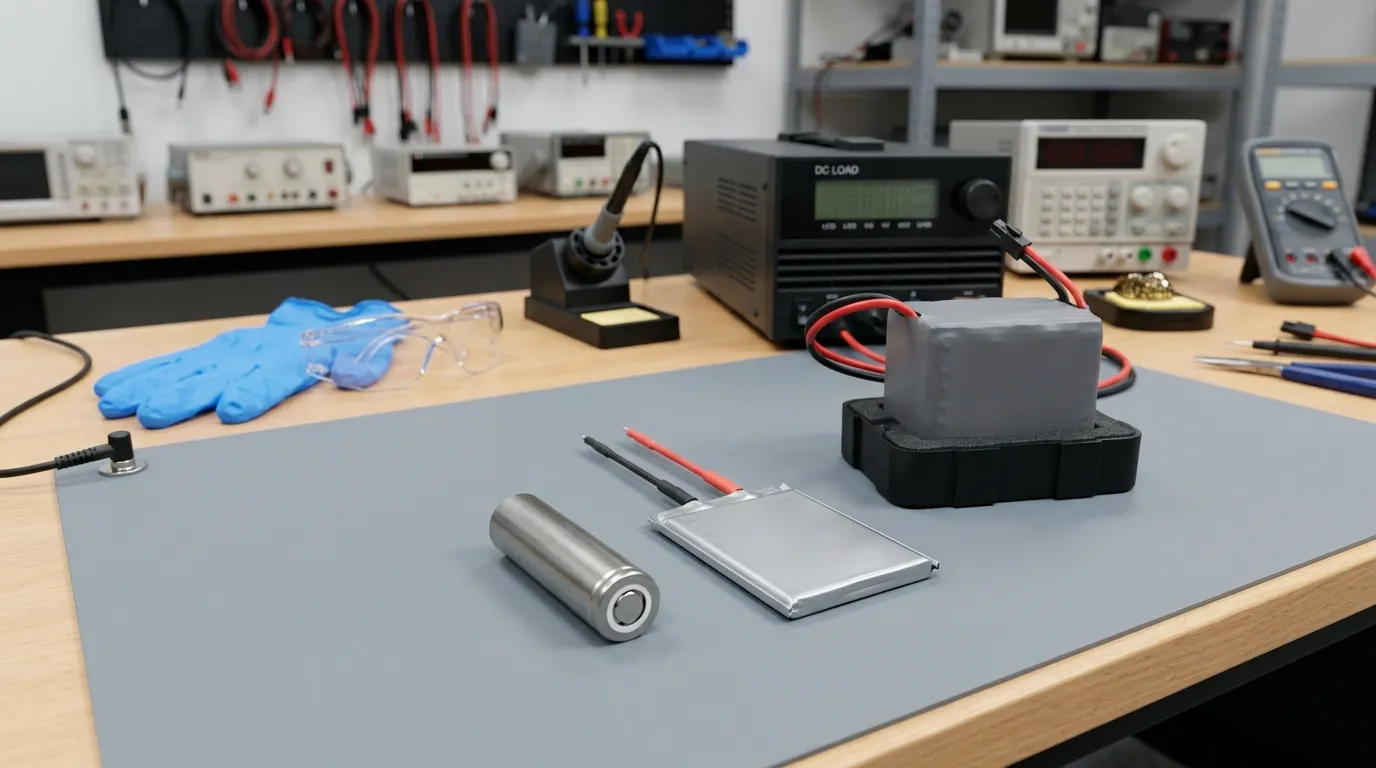
The chemistry and cell format should be selected from the doorbell's voltage, size, runtime, temperature, and sourcing requirements — not from a default preference.
Li-ion cylindrical cells (such as 18650 or 21700) are standardized, widely available, and cost-effective. They offer good energy density and reliability, but their rigid cylindrical shape may not fit thin or irregular doorbell enclosures.
Li-polymer (LiPo) pouch cells allow thin, custom-shaped designs that fit tight enclosures. They are often used in smart-home devices where space is limited. However, pouch cells require mechanical protection and can swell if overcharged, over-discharged, or physically damaged.
LiFePO4 offers a different voltage profile, lower energy density, and generally longer cycle life than standard Li-ion chemistries, but its nominal voltage (around 3.2 V per cell) may not match the doorbell's power design. LiFePO4 should only be selected when the voltage, size, and temperature trade-offs are confirmed compatible.
The form factor also affects cell balancing, thermal dissipation, enclosure design, and supply chain. Cylindrical cells are easier to source from multiple suppliers; pouch cells offer shape freedom but require more careful mechanical and thermal design.
For video doorbells, the chemistry and cell format must be evaluated together — the correct choice depends on the device's specific constraints, not on a generic best battery.
Weather Design: Cold-Weather Discharge and Charging
Cold weather affects video doorbell battery performance in two distinct ways: how much energy the pack can deliver (discharge), and whether the pack can be safely charged (charging). These are separate constraints and must be designed for independently.
At low temperatures, the electrolyte in a lithium cell becomes less conductive and internal resistance increases. The result is lower available capacity, higher voltage sag under load, and shorter runtime — even though the battery still holds charge. A doorbell that operates normally at 20°C may reset, shut down, or record fewer events at −10°C.
Charging a lithium battery below freezing is a separate safety concern. Charging a cold lithium cell can cause lithium plating on the anode, which reduces capacity and creates a safety risk. Many device manufacturers therefore restrict charging below a certain temperature. For example, Google states that lithium batteries in some Nest devices may not charge below freezing, and eufy publishes a device-specific operating range for its battery-powered doorbell models. These are brand-specific examples, not universal limits — the actual charging cutoff depends on the cell chemistry, BMS, and device design.
Design options for cold-weather reliability include:
- Selecting cells with wider operating temperature ranges
- Adding insulation or pack heaters for charging in cold environments
- Programming the device to delay charging until the pack warms above the charge threshold
- Designing the enclosure to manage heat dissipation without trapping condensation
- Setting realistic runtime expectations in the user interface based on temperature
Gloflux designs custom lithium battery packs with a focus on application-specific requirements. Its smart-home battery solutions include Li-polymer packs, high-capacity lithium-ion batteries, custom-shaped packs, and low-self-discharge designs. Wide-temperature operation and enhanced safety are listed among the considerations for smart-home battery development. However, any specific operating or charging temperature claim must be verified against the exact cell datasheet and pack design — there is no universal temperature range that applies to every lithium battery.
BMS, Charger, and Outdoor Mechanical Design
A custom video doorbell battery pack is more than cells in a housing. The protection electronics, charger compatibility, connector, and enclosure all determine whether the pack works reliably in an outdoor environment.
BMS and PCM. A basic protection circuit module (PCM) protects against overcharge, over-discharge, overcurrent, short-circuit, and excessive temperature. A smart BMS adds functions such as cell balancing, fuel gauging, state-of-charge and state-of-health estimation, data logging, and communication buses (SMBus, I2C, UART, CAN, RS485, or Bluetooth). The choice depends on whether the doorbell's firmware can use those features. A smart BMS is not automatically better if the device has no way to read its data.
Charger matching. The charger must match the pack's chemistry and series configuration. A Li-ion pack charged with the wrong voltage profile will not reach full capacity or may become unsafe. Specify the charge voltage, charge current, charge termination method, and maximum charging temperature range. CC/CV charging is the standard method for most lithium-based packs.
Connector and wiring. The connector must handle the continuous and peak current, maintain correct polarity, lock securely in outdoor use, and survive repeated mating cycles if the battery is removable. Wire gauge must be sized for the peak current to avoid voltage drop and heat.
Enclosure and outdoor protection. The enclosure must protect the cells from mechanical impact, moisture, and dust while also allowing heat to escape during charging and high-current operation. Sealing that keeps water out can also trap heat and condensation — a genuine design trade-off. An IP rating applies only to the exact assembly tested; it is not a general "waterproof" claim. The supplier should provide the specific IP test report for the relevant enclosure, not a generic water-resistance statement.
Gloflux offers custom battery pack design including BMS configuration, enclosure design, and mechanical integration for smart-home and other applications. The specific protection features and enclosure rating for any pack must be confirmed against the exact model design and test documentation. Similar power-management principles apply to other connected smart-home devices, which is why a Lithium battery for smart thermostats must also address recurring charge cycles, protection thresholds, and reliable long-term operation — though a thermostat's steady, low-current heating control demand differs from a doorbell's burst-heavy camera and radio loads.
Testing, Documentation, and Transport Compliance
Before a custom video doorbell battery pack is approved for production, the supplier should provide documented evidence that the pack meets its specification. The required documentation varies by product and market, and the difference between document types matters.
Datasheet (TDS) describes the pack's rated electrical, mechanical, and environmental specifications under stated conditions.
Test reports provide measured evidence from capacity tests, current tests, thermal tests, cycle tests, environmental tests, and mechanical tests. A datasheet states the design target; a test report proves the actual result.
UN38.3 test summary is required for transport of lithium cells and batteries. Under U.S. Department of Transportation regulations, lithium cells and batteries offered for transportation must have passed the applicable UN Manual of Tests and Criteria Section 38.3 design tests, and manufacturers must make test summaries available upon request. UN38.3 covers transport safety testing — it is not a product-safety certification.
IEC/UL product-safety reports apply to a defined model, construction, and standard scope. An IEC or UL report is not a company-wide certification and cannot be generalized across all products in a manufacturer's catalog.
Traceability and change control ensure that the cells, BMS, enclosure, and assembly process used in production match the approved design. Any change — a cell supplier, BMS component, or enclosure material — should require re-verification.
For worldwide shipping, the pack must also comply with IATA dangerous-goods rules for air transport, including state-of-charge limits and labeling requirements.
A responsible battery supplier should provide the datasheet, relevant test reports, and the UN38.3 test summary for the specific pack design. A company-level ISO 9001 quality-system certificate is useful, but it is not the same as product-level test evidence.
What to Include in a Video Doorbell Battery RFQ

A well-written request for quotation (RFQ) prevents miscommunication and gives suppliers the information they need to propose an accurate design. Include the following categories:
Electrical requirements
- Nominal voltage and maximum charge voltage
- Capacity (mAh or Ah) and energy (Wh)
- Continuous current and peak current with duration
- Acceptable internal resistance
- Charger profile (charge voltage, charge current, termination method)
Mechanical requirements
- Available enclosure dimensions and weight limit
- Connector type, pinout, polarity, and mating cycles
- Mounting method and vibration/drop expectations
- Whether the pack is removable or permanently installed
Environmental requirements
- Operating temperature range (discharge)
- Charging temperature range
- Storage temperature range
- IP rating requirement, with the specific assembly to be tested
- Condensation, humidity, and solar exposure considerations
BMS and protection requirements
- Protection thresholds (overcharge, over-discharge, overcurrent, short-circuit, temperature)
- Balancing requirement
- Fuel gauge, state-of-charge, or state-of-health reporting
- Communication protocol, if needed (SMBus, I2C, UART, CAN, RS485, Bluetooth)
Documentation requirements
- Datasheet (TDS)
- Test reports
- UN38.3 test summary
- SDS/MSDS
- Traceability records and change-control commitment
Commercial requirements
- Prototype and sample approval process
- MOQ and lead time
- NRE/tooling cost, if applicable
- Pilot-run and mass-production quality expectations
- Warranty and after-sales support
A clear RFQ allows the supplier to identify gaps, propose alternatives, and validate the design before committing to tooling or production.
Frequently Asked Questions
Does higher mAh always mean longer runtime?
No. Runtime depends on the pack's energy (Wh) and the device's real load profile, not just its mAh rating. A lower-voltage pack with a higher mAh can store less energy than a higher-voltage pack with fewer mAh. Temperature, peak current, voltage sag, and aging also affect actual runtime.
Can a video doorbell battery charge below freezing?
Some devices restrict charging below freezing because charging a cold lithium cell can cause lithium plating. Whether a specific doorbell can charge in cold weather depends on the cell chemistry, BMS, and device design. Refer to the device manufacturer's specifications.
Do video doorbells use rechargeable lithium batteries?
Most battery-powered video doorbells use a rechargeable lithium battery pack. There is no universal cell size; each doorbell uses a pack designed for its voltage, enclosure, and power requirements.
Should a doorbell use Li-ion, LiPo, or LiFePO4?
It depends on the doorbell's voltage architecture, enclosure size, runtime target, temperature conditions, and supply considerations. Li-ion cylindrical cells are common and cost-effective; LiPo pouch cells offer thin custom shapes; LiFePO4 has a different voltage profile and is only suitable when the device can accommodate its voltage and size trade-offs.
Designing the Right Pack for Your Doorbell
A custom lithium battery for a video doorbell is not a commodity purchase — it is an engineering decision. The pack must match the device's electrical load, fit its enclosure, survive outdoor temperature swings, charge safely, and arrive with the documentation needed for transport and quality control.
If you are designing a battery-powered video doorbell, start by documenting your load profile, runtime target, mechanical envelope, and charging environment. That requirements sheet is the foundation of every specification decision that follows — chemistry, cell format, voltage, capacity, BMS, connector, enclosure, and validation. Send that document to your battery supplier and ask for engineering review and test evidence, not just a quote.
Talk to the Manufacturer
Resources & Insights
High Capacity Lithium Battery for Wearables: High-Voltage LiPo Cell Design
2026-10-19
Cylindrical Battery Packs for Laptops: 2S vs 3S vs 4S Battery Design
2026-10-19
Stage Lighting Battery Pack: Prevent Voltage Drop & LED Flicker
2026-10-19
Best Rechargeable Batteries for Smart Devices: Performance, Safety, and Selection Guide
2026-10-19


