


 Home /
 UAV LiPo Battery Manufacturer Solutions for Cinewhoop, Freestyle and Racing Drones


Table of Contents
Although FPV electronics can be similar for cinewhoop, freestyle and racing drones, their battery requirements are not. Cinewhoop drones rely on stable power delivery for controlled flight, freestyle drones require repeated high-current responses, and racing drones prioritize acceleration, low weight and low voltage sag.
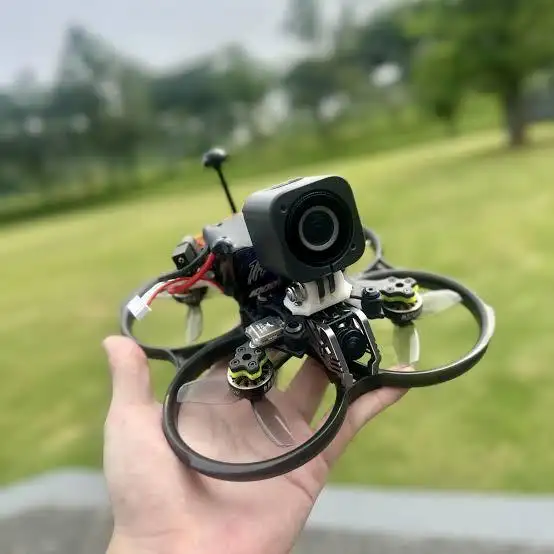
When choosing an FPV battery, there is more to consider than capacity. You need to look at battery voltage, discharge, resistance, cell uniformity, thermal properties, dimensions, weight and connector design. A quality UAV LiPo battery manufacturer would consider all of these criteria to the real aircraft load profile, instead of suggesting a battery solely on its mAh.
How Battery Specifications Affect FPV Performance
6S Voltage Configuration
A 6S LiPo battery uses six cells connected in series. Because each LiPo cell has a nominal voltage of approximately 3.7V, the complete pack provides:
• Nominal voltage: 22.2V
• Maximum charging voltage: 25.2V
• Typical configuration: 6S1P
A higher-voltage system can deliver a given power level at a lower current than a lower-voltage system. This may reduce conductor losses, but only when the battery is correctly matched with the motor, ESC, flight controller, capacitor, connector, and power distribution system.
Before choosing a 6S battery, a UAV designer must confirm the following:
• Maximum ESC input voltage
• Motor KV and propeller combination
• Expected hover and peak current
• Connector and wire current capacity
• Total takeoff weight
• Available battery installation space
Capacity, Weight, and Flight Behavior
Battery capacity provides a charge, not a guaranteed flight time. A battery with high capacity increases the mass of the aircraft and increases the rotational inertia.
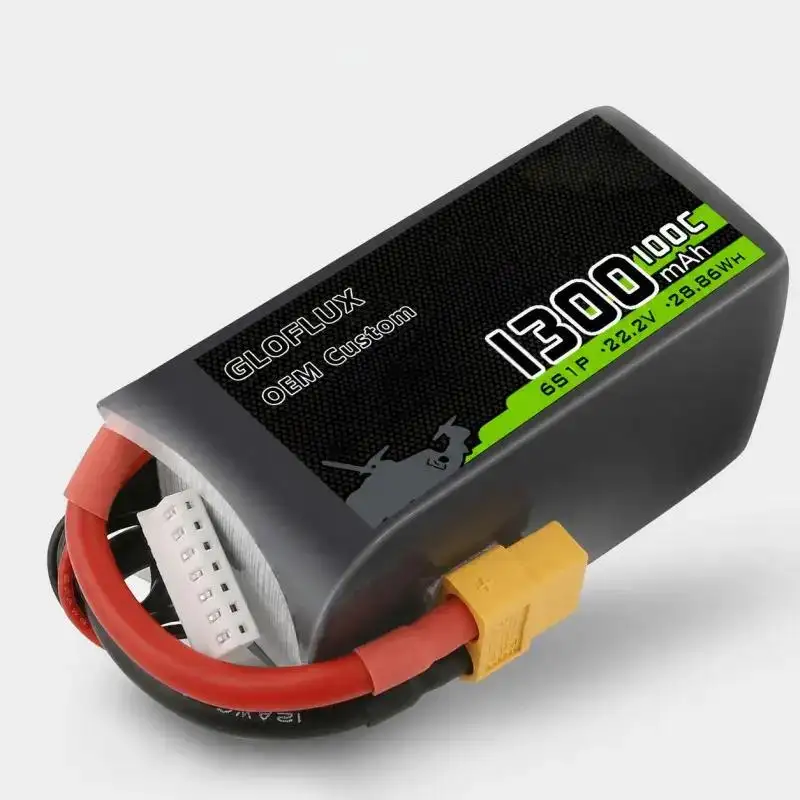
A 1300mAh battery supports a configuration that is light and responsive. Increases in battery capacity to 1800mAh can increase the energy reserve, but might cause a reduction in system acceleration or result in a reduction of the system's ability to make sharp, precise direction changes.
The appropriate capacity is determined by the entire propulsion system, payload, flying style, wind, and regulations on discharge depth.
Understanding the 100C Rating
The C rating describes discharge capability relative to battery capacity. However, the printed rating should not be treated as a guaranteed continuous current under every operating condition.
Actual discharge performance is affected by:
• Cell chemistry and electrode design
• Internal resistance
• Ambient and pack temperature
• State of charge
• Battery age and cycle history
• Connector and cable resistance
• Cell matching and assembly quality
A professional UAV LiPo Battery Manufacturer should verify high-rate performance through controlled discharge testing, temperature monitoring, voltage-sag analysis, and post-test cell inspection.
Battery Requirements by FPV Application
| FPV Platform | Main Power Requirement | Selection Priority | Common Engineering Risk |
| Cinewhoop | Smooth, predictable output | Runtime, dimensions, balance | Excess weight and poor center of gravity |
| Freestyle FPV | Repeated high-current response | Voltage recovery, low resistance | Voltage sag during rapid maneuvers |
| Racing Drone | Strong burst power | Low weight, acceleration, thermal control | Heat buildup and rapid energy depletion |
Cinewhoop Aircraft
Cinewhoops include cameras, propeller guards, transmitters, and mounts which result in added weight. This increases the average current required for flight.
Selecting the appropriate Cinewhoop battery involves:
• Stability of voltage under sustained throttle
• Having a small enough form factor for mounting
• Adequate power for the duration of the desired film
• Predictability of the output as the battery discharges
• Installing the battery to ensure that airflow is not restricted
Running the battery past its limits will increase the temperature of the motors and may increase the instability of control. An overly large battery will extend flight time, but may adversely affect flight control.
Freestyle FPV Drones
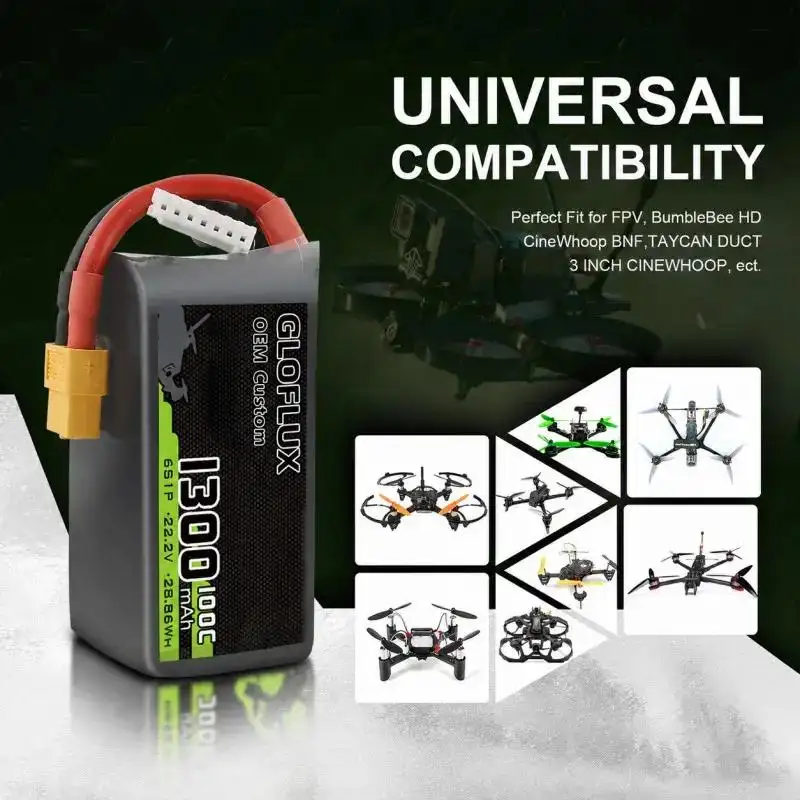
Freestyle maneuvers involve repeated throttle changes, flips, dives, power loops, and rapid climbs. These operating conditions require both high instantaneous current and fast voltage recovery.
When considering freestyle FPV batteries, the best options provide:
• Consistent low resistance
• Cell-to-cell matching
• Burst-current capability
• Temperature control
• Weight for responsive handling
Racing Drones
In racing battery packs, low weight is definitely helpful. Unfortunately, lower weight does carry lower pack capacity which results in greater voltage sag and shorter flight.
When racing, the best setup is the best compromise of burst power, usable capacity, internal resistance, and the total weight of the aircraft.
Comparing 1300mAh and 1800mAh FPV Batteries
| Factor of Comparison | 1300mAh FPV Battery | 1800mAh FPV Battery |
| Pack Weight | Lighter | Heavier |
| Response of Aircraft | Quicker, more maneuverable | More stable, but less responsive |
| Energy Reserve | Capacity runs out faster | Capacity runs out slower |
| Typical Usage | Best for racing and aggressive freestyling | Best for consistent and calmer operation like Cinewhoops |
| Main Limitation | Usable time of flight is shorter | Usable time of flight is longer but increased drag |
From battery characteristics, a 1300mAh pack is quicker and more responsive with a lower usable flight time. An 1800mAh pack is longer with a flight time and drag, but quicker and more responsive.
An experienced UAV Lipo battery pack manufacturer should analyze the characteristics of the motor, using the proper Kv, propeller diameter and pitch, the electronic speed controller (ESC) rating, the take off weight, the desired payload, and which profile of flight they expect to be most useful in
Internal Resistance, Voltage Sag, and Heat
Discharge of a battery produces a resistance in the internal parts which generates heat. With increasing current the resistance, loss of voltage, and heat generation all increase dramatically.
This can be improved by:
• Retaining voltage better when rapidly accelerating.
• Responding better to changes in demand to accelerate.
• Less heat is generated.
• Discharge is better and used more efficiently.
• Cells don't reach lower limits of voltage faster than expected.
For the FPV battery configuration under consideration, an internal resistance of 9-24 mΩ allows for high power operation. Resistance, however, is determined by several factors including the age of the battery, the temperature, the state of charge, the equipment used, and the method of testing.
A qualified UAV LiPo Battery Manufacturer should control pack consistency through cell grading, capacity matching, resistance matching, welding control, balanced assembly, and finished-pack testing.
Gloflux Battery Design for FPV Platforms
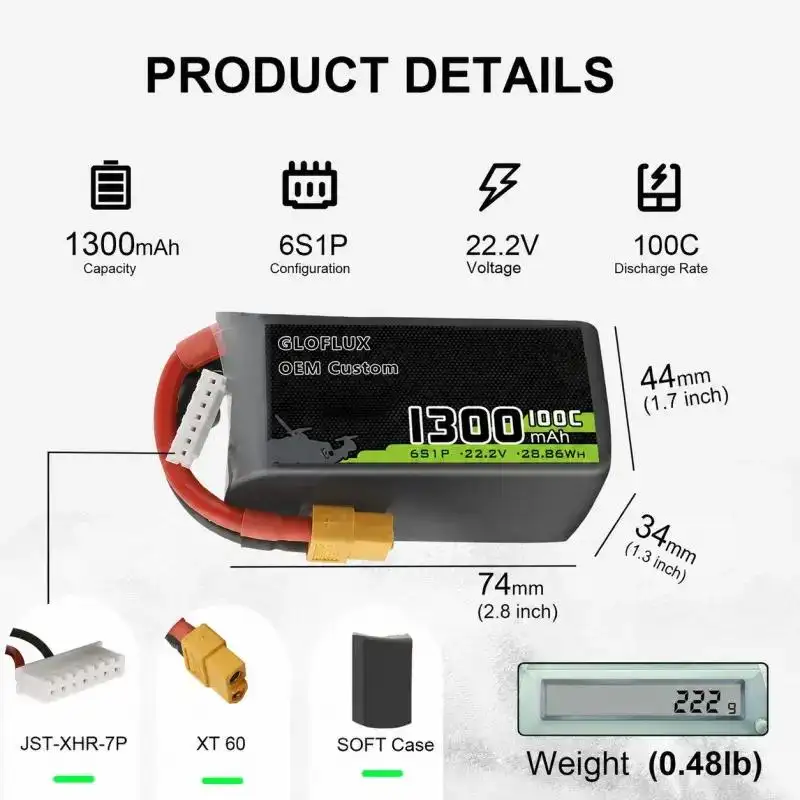
Gloflux offers a compact 6S 22.2V LiPo battery design for Cinewhoop, freestyle, racing, and custom UAV applications. Available 1300mAh and 1800mAh capacities allow aircraft developers to balance low weight against additional energy reserve.
The design includes:
• 100C high-discharge configuration
• 130–180A discharge-current range, depending on capacity
• Approximate dimensions of 34 × 44 × 74 mm
• Soft-case construction for weight-efficient installation
• Internal resistance of approximately 9–24 mΩ
• Balanced charging support
• Standard 25.2V maximum charging voltage
Actual performance should be validated against the aircraft's peak current, installation position, cooling conditions, connector rating, and flight duty cycle.
Manufacturing and Customization Support
As a UAV LiPo Battery Manufacturer, Gloflux supports projects from battery specification and sample validation to pilot production and volume manufacturing.
Its manufacturing capabilities include:
• A 30,000 m² intelligent production facility
• Daily capacity of approximately 350,000 battery units
• More than 60 inspection procedures
• In-house safety and performance testing
• Custom capacity, dimensions, wiring, connectors, and labeling
• Engineering support for high-rate and high-voltage applications
The internal laboratory can perform extrusion, needle penetration, thermal shock, overcharge, over-discharge, drop, impact, and short-circuit testing.
Safe Charging and Storage
FPV LiPo batteries must be charged with a compatible 6S balance charger. The charging voltage must not exceed 25.2V.
For safer operation:
• Charge in a ventilated and fire-resistant area.
• Allow the battery to cool before recharging.
• Avoid deep discharge and long-term full-charge storage.
• Do not use swollen, punctured, leaking, or damaged packs.
• Store batteries at the manufacturer's recommended storage voltage.
• Confirm UN38.3 and carrier requirements before transportation.
Selecting the Right FPV Battery Solution
There is no single battery specification that is ideal for every Cinewhoop, freestyle, or racing drone. Selection should be based on voltage compatibility, current demand, capacity, weight, internal resistance, thermal performance, dimensions, and real flight conditions.
Gloflux combines high-discharge battery development, testing, customization, and scalable manufacturing support. Drone manufacturers can work with Gloflux to evaluate battery dimensions, electrical requirements, connector configurations, and production specifications for new or existing FPV platforms. Contact Gloflux to discuss a battery solution matched to your UAV application.
FAQs
Q1. Which safety tests can Gloflux carry out?
Gloflux has the ability to conduct numerous tests at its in-house laboratory, including extrusion, needle penetration, thermal shock, overcharge, over-discharge, drop, heavy-impact, and short-circuit tests. The specific tests conducted will depend on the design of the battery, the requirements of the customer, and the applicable regulations and standards in the target market.
Q2. What FPV drone battery packs can Gloflux offer?
Gloflux can offer high-performance 6S 22.2V LiPo battery packs available in 1300mAh and 1800mAh. These battery packs are ideal for applications in aircraft that demand high discharge and fast responsive power.
Q3. Will Gloflux modify or make custom batteries for different UAVs?
Absolutely. Gloflux's customization capabilities correspond directly to the UAV's power demand. Gloflux can modify or make custom batteries for various UAVs by changing battery capacity, size, cell configuration, connectors, wire length, discharge rates, as well as adding custom labels and packaging.
Q4. Where can Gloflux FPV drone batteries be used?
Gloflux FPV batteries can be used in various applications including Cinewhoop, freestyle FPV, and race drones, as well as in mini quadcopters, aerial shooting, and custom filming UAVs. The right battery needs to be chosen depending on the aircraft weight, prop/motor configuration, ESC rating, payload as well as the desired maneuverability.
Q5. What methods does Gloflux use to maintain battery consistency?
Gloflux implements a combination of more than 60 inspection methods to maintain battery consistency. Quality control is conducted during the grading and matching of cells, internal resistance measurements, voltage inspections, assembly inspections, and through the verification of the final product.
Talk to the Manufacturer
Resources & Insights
High Capacity Lithium Battery for Wearables: High-Voltage LiPo Cell Design
2026-10-19
Cylindrical Battery Packs for Laptops: 2S vs 3S vs 4S Battery Design
2026-10-19
Stage Lighting Battery Pack: Prevent Voltage Drop & LED Flicker
2026-10-19
Best Rechargeable Batteries for Smart Devices: Performance, Safety, and Selection Guide
2026-10-19


