


 Home /
Top 10 Custom LiPo Battery Manufacturers for OEM Projects


Table of Contents
- Custom LiPo Battery Manufacturers: Quick Comparison
- 1. Gloflux
- 2. GREPOW
- 3. EEMB
- 4. Jauch
- 5. Honcell
- 6. Padre Electronics
- 7. Ufine Battery
- 8. DNK Power
- 9. Hanery
- 10. LiPol Battery
- What Can a Custom LiPo Battery Manufacturer Customize?
- How to Compare Custom LiPo Battery Suppliers
- What to Send With a Custom LiPo Battery RFQ
-
Frequently Asked Questions
- What is a custom LiPo battery?
- Can I customize a LiPo battery without developing a new cell?
- What is the minimum order quantity for custom LiPo batteries?
- How long does custom LiPo battery development take?
- How should I compare custom LiPo battery prices?
- What is the difference between a cell manufacturer and a battery pack manufacturer?
- How do I choose the right custom LiPo battery manufacturer?
- Start Your Custom LiPo Battery Project With Gloflux
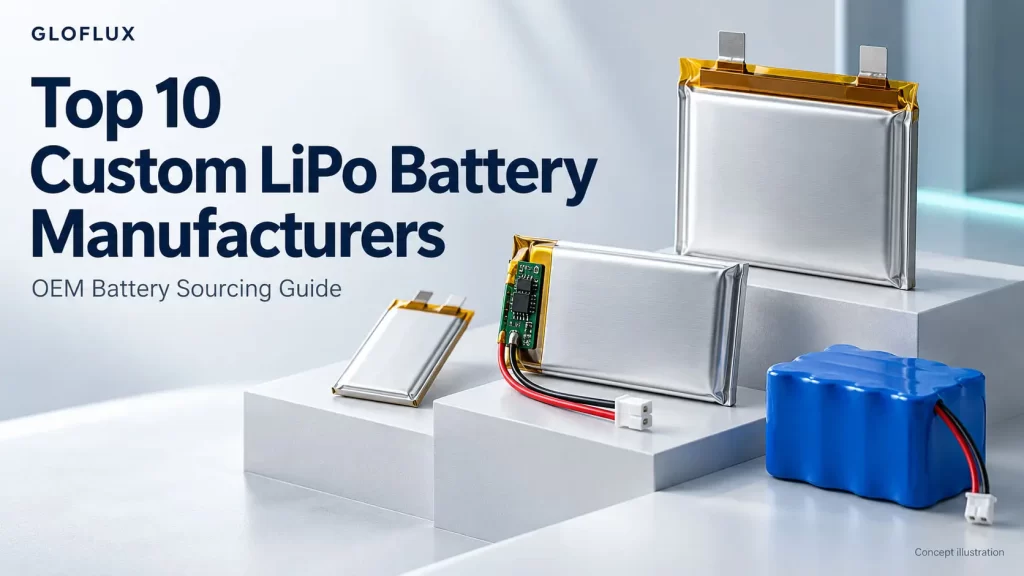
Choosing a custom LiPo battery manufacturer means finding a partner that can translate your product requirements into a battery suitable for production.
The right battery must fit the available space, support the device’s electrical load, work with its charging system, and deliver the required runtime. Procurement teams also need clear answers about samples, development costs, documentation, and repeat-order availability.
This guide introduces 10 manufacturers and battery solution providers to consider for custom lithium polymer battery projects. It also explains how to compare proposals before committing to a design.
This sourcing guide is published by Gloflux and includes our own services. Selection is based on publicly described LiPo products and customization capabilities. Numbering is for navigation and does not represent an independently tested ranking. Cell manufacturing and pack assembly capabilities vary by supplier.
Custom LiPo Battery Manufacturers: Quick Comparison
Use this table to build an initial shortlist. The suggested evaluation focus reflects the capabilities described on each company’s website; confirm project-specific availability directly.
| Manufacturer | Publicly described offering | Suggested evaluation focus |
|---|---|---|
| Gloflux | OEM lithium polymer batteries and custom battery development | Integration of cells, protection, wiring, and device requirements |
| GREPOW | LiPo manufacturing, cell customization, structural design, and BMS services | Projects combining demanding performance and mechanical requirements |
| EEMB | Lithium polymer cells, customized terminations, and battery packs | Standard-cell adaptation versus custom cell development |
| Jauch | Lithium polymer batteries and customized battery systems | Battery system engineering and pack integration |
| Honcell | OEM/ODM lithium-ion batteries, including curved LiPo options | Dimensions, geometry, and application-specific specifications |
| Padre Electronics | Lithium polymer cells, packs, and specialty formats | Custom cell dimensions and tooling requirements |
| Ufine Battery | Lithium polymer batteries and OEM/ODM customization | Development scope and sample-to-production planning |
| DNK Power | Lithium polymer products and custom battery pack design | Complete battery assembly requirements |
| Hanery | Custom LiPo batteries and engineering-to-manufacturing services | Prototype validation and production support |
| LiPol Battery | LiPo batteries in multiple formats with dimension and capacity customization | Existing models versus a newly developed cell |
1. Gloflux
Gloflux provides OEM lithium polymer battery solutions alongside broader custom lithium battery development. Its published services cover voltage configurations, dimensions, capacity requirements, and discharge performance for different applications. Gloflux LiPo battery OEM services.
The company also describes support for cell selection, PCM/BMS integration, wiring, connectors, enclosures, prototypes, testing, and scalable production. This makes Gloflux relevant to buyers who need to coordinate the battery with the complete product design. Gloflux custom battery development.
When evaluating Gloflux, start with the installation space and electrical load. These inputs help determine whether the project can use an existing LiPo cell with a customized assembly or requires further cell development.
Questions to discuss:
- Which cell options fit the available space?
- What protection circuit and connector arrangement are required?
- Which specifications should be validated before production approval?
Explore Gloflux’s custom lithium battery solutions to begin a technical discussion.
2. GREPOW
GREPOW manufactures LiPo batteries and describes customization services covering cells, battery structures, and battery management systems. Its published application areas include wearables, UAVs, RC products, medical equipment, and industrial devices. GREPOW battery customization.
Its range makes it a candidate for projects where discharge performance, battery geometry, and system integration need to be considered together.
Buyer focus: Ask for a proposed model with documented operating limits. Confirm that the requested capacity, discharge current, charging conditions, and dimensions are achievable in the same design.
3. EEMB
EEMB manufactures lithium batteries, including lithium polymer products, and offers customized cells, packs, terminations, and holders. Its custom LiPo pack offering includes engineering, prototypes, testing, and production services. EEMB lithium polymer battery packs.
Its published options provide a basis for comparing an existing cell with adapted wiring against a more extensive custom development project.
Buyer focus: Ask EEMB to distinguish between changes to the cell itself and changes to the finished assembly. Request separate specifications and quotations for each proposed approach.
4. Jauch
Jauch offers lithium polymer batteries and customized battery systems, ranging from individual cells to intelligent battery packs. Its website describes custom cell sizes and battery management system development. Jauch battery technology.
Jauch is a relevant option when the purchasing requirement includes battery system engineering and integration. Buyers should clarify which activities involve cell supply, pack manufacturing, and system development.
Buyer focus: Establish responsibility for cell selection, electronics, mechanical integration, testing, and ongoing supply before comparing the proposal with a cell-only quotation.
5. Honcell
Honcell describes OEM and ODM lithium-ion battery customization across cylindrical, flat, curved, and irregular formats. Its range includes custom curved LiPo batteries, with dimensions and specifications adapted to particular applications. Honcell custom battery solutions.
This makes Honcell worth evaluating when a product requires both mechanical customization and application-specific electrical performance.
Buyer focus: Provide the installation drawing, load profile, and environmental requirements together. Ask for confirmation of the complete battery dimensions, including protection components and connections.
6. Padre Electronics
Padre Electronics develops and manufactures lithium polymer cells, battery packs, and custom lithium-ion power packs. Its website describes an in-house mold workshop and specialty battery formats, including thin, narrow, curved, round, and crescent designs. Padre Electronics manufacturing capabilities.
These published capabilities make it a candidate when a project may require changes to the cell format rather than only a connector or wiring modification.
Buyer focus: Confirm whether the proposed design uses existing tooling. For new tooling, request details on cost, ownership, drawing approval, and sample revision procedures.
7. Ufine Battery
Ufine identifies lithium polymer batteries as part of its manufacturing offering and publishes a custom battery development service. Its FAQ confirms both OEM manufacturing to customer specifications and ODM support for battery design and development. Ufine custom batteries, Ufine OEM and ODM services.
Buyers can evaluate Ufine for projects that require a defined development process alongside the battery product itself.
Buyer focus: Agree on which requirements are fixed, which remain open to engineering recommendations, and what evidence will be provided with prototype samples.
8. DNK Power
DNK Power offers custom lithium battery pack design and lists lithium-ion polymer batteries among its product categories. Its battery solution service encourages engineering involvement from the early stages of device development. DNK Power battery solutions.
DNK Power is relevant when the requirement includes a complete assembly with connections and protection, rather than a bare pouch cell alone.
Buyer focus: Request a proposal covering the complete deliverable: cell model, protection circuit, wiring, connector, insulation, labeling, and any enclosure requirements.
9. Hanery
Hanery’s lithium polymer battery offering includes customization of dimensions and shapes. Its website also lists services covering design, pre-production samples, manufacturing, quality control, and OEM/ODM support. Hanery custom lithium polymer batteries.
These services make it a candidate for buyers seeking support across development and production.
Buyer focus: Ask how approved sample specifications become production acceptance criteria. Discuss traceability, inspection records, and notification of material or component changes.
10. LiPol Battery
LiPol Battery offers lithium polymer batteries in round, curved, cylindrical, and ultra-slim formats, with customization of dimensions and capacity. Its published product categories allow buyers to compare available models before requesting a new design. LiPol battery customization.
For projects with some flexibility in the enclosure, this comparison can help determine how much customization is actually needed.
Buyer focus: Request the closest existing model alongside the custom option. Compare fit, capacity, development work, and commercial terms before selecting a route.
What Can a Custom LiPo Battery Manufacturer Customize?
“Custom” can describe anything from changing a connector to developing a new cell. Define the scope clearly when requesting quotations.
Cell Dimensions and Geometry
Some projects require a particular thickness, width, or length. Others need a curved or irregular profile.
Ask whether the supplier can meet the requested dimensions using an existing model, modified tooling, or a new cell design. Include space requirements for tabs, seals, protection electronics, and wiring in the review.
Electrical Specifications
Discuss capacity, voltage, charge current, continuous discharge current, and peak load requirements as a combined specification.
For example, a device with short current bursts needs the supplier to understand both the peak current and its duration. A capacity figure by itself does not communicate that requirement.
Protection and Monitoring
Depending on the design, the assembly may require a protection circuit, temperature sensing, or additional monitoring functions.
Specify which functions belong inside the battery assembly and which are handled by the device. This avoids gaps or conflicting assumptions between engineering teams.
Wiring, Connectors, and Packaging
A custom LiPo battery pack may also require specific wire lengths, connector pinouts, insulation, labels, or an enclosure.
Include these details in the approved assembly drawing. A matching connector housing alone is insufficient to establish that two assemblies are interchangeable.
How to Compare Custom LiPo Battery Suppliers
The most useful comparison is based on each supplier’s response to the same specification.
1. Ask for a Complete Technical Proposal
Request a model-specific datasheet and drawing that identify the proposed cell, assembled dimensions, electrical limits, and protection functions.
Any unconfirmed requirement should be marked clearly. This helps prevent a preliminary quotation from being mistaken for an approved design.
2. Compare Performance Under Consistent Conditions
Ask suppliers to state the conditions used for capacity, cycle life, and current ratings. Compare the same temperature, charge method, discharge conditions, and end-of-life criteria where possible.
Treat product-family claims as a starting point. Request evidence for the model being offered.
3. Review Documentation for the Exact Configuration
Ask which supporting reports apply to the proposed cell and finished battery pack. Confirm model numbers and drawing revisions, and establish whether the planned customization changes the scope of existing documentation.
A supplier’s general certificate page does not answer every question about a particular design.
4. Separate Development Costs From Production Costs
A useful quotation should distinguish:
- Engineering and tooling charges.
- Prototype costs and quantities.
- Testing and documentation costs.
- Production unit prices at different volumes.
- Minimum order quantities.
- Sample and production schedules.
This makes the total project cost easier to compare.
5. Validate Samples in the Intended Product
Define acceptance criteria before sample production. Review mechanical fit, runtime, charging behavior, peak-load operation, and performance under the intended operating conditions.
Keep an approved sample, specification, and drawing as references for production.
6. Discuss Long-Term Supply
Ask how the supplier handles cell discontinuation, component substitutions, production changes, and repeat orders.
These questions matter when the battery must remain available throughout the product’s service life.
What to Send With a Custom LiPo Battery RFQ
A clear RFQ gives manufacturers the information needed to evaluate your project and reduces repeated clarification.
| Requirement | Information to include |
|---|---|
| Product | Device type and intended use |
| Installation space | Drawing with maximum dimensions and restricted areas |
| Voltage | Required operating range and charging architecture |
| Runtime | Target runtime and typical usage pattern |
| Capacity | Minimum capacity, if already established |
| Current | Average load, continuous maximum, and peak duration |
| Charging | Available charging current and target charging time |
| Environment | Operating and storage conditions |
| Connections | Connector, pinout, wire length, and exit direction |
| Protection | Required protection and monitoring functions |
| Documentation | Destination markets and requested supporting reports |
| Quantity | Samples, pilot order, and annual forecast |
| Schedule | Prototype and production milestones |
If some specifications are undecided, identify them as open questions. A useful engineering proposal should explain its assumptions and the trade-offs between available options.
Frequently Asked Questions
What is a custom LiPo battery?
A custom LiPo battery is a lithium polymer battery adapted to a product’s requirements. Customization can involve the cell dimensions, capacity, electrical characteristics, protection circuit, wiring, connector, or complete pack assembly.
Can I customize a LiPo battery without developing a new cell?
Yes. Some projects can use an existing cell with customized connections, protection, or packaging. Ask the supplier to compare this approach with a new cell design before deciding.
What is the minimum order quantity for custom LiPo batteries?
There is no single MOQ that applies to every project. It depends on the selected cell, customization scope, materials, and production requirements. Request separate quantities for samples, pilot production, and regular orders.
How long does custom LiPo battery development take?
Timing depends on engineering complexity, tooling, component availability, testing, and sample revisions. Request a milestone schedule covering feasibility review, drawing approval, sample delivery, validation, and production.
How should I compare custom LiPo battery prices?
Compare quotations against the same specification and scope. Include engineering, tooling, testing, shipping terms, and minimum quantities alongside the unit price.
What is the difference between a cell manufacturer and a battery pack manufacturer?
A cell manufacturer produces the electrochemical cell. A pack manufacturer integrates cells with components such as protection electronics, wiring, insulation, and an enclosure. Some companies perform both roles; clarify the responsibilities for your project.
How do I choose the right custom LiPo battery manufacturer?
Choose a supplier that can provide a clear technical proposal, acceptable samples, relevant documentation, and a credible production plan for your volume. Evaluate the proposed solution rather than relying only on general marketing claims.
Start Your Custom LiPo Battery Project With Gloflux
A well-defined battery specification helps move an OEM project from an initial concept toward a production-ready design.
Gloflux’s published customization process covers needs assessment, cell sourcing, engineering design, prototype testing, and mass production. Explore the Gloflux customization process.
Send us your installation drawing, voltage requirements, target runtime, load profile, and expected quantity. Our team can review the available options and discuss the next steps for your product.
Talk to the Manufacturer
Resources & Insights
High Capacity Lithium Battery for Wearables: High-Voltage LiPo Cell Design
2026-10-19
Cylindrical Battery Packs for Laptops: 2S vs 3S vs 4S Battery Design
2026-10-19
Stage Lighting Battery Pack: Prevent Voltage Drop & LED Flicker
2026-10-19

Best Rechargeable Batteries for Smart Devices: Performance, Safety, and Selection Guide
2026-10-19


