


 Home /
 Custom Battery for Pool Cleaning Robots: Waterproof Pack Design


Table of Contents
- What Makes a Pool-Cleaning Robot Battery Different
- Step 1 — Capture the Robot's Requirements Before Cell Selection
- Step 2 — Design the Electrical Architecture
- Step 3 — Meet the Load Profile Without Voltage Sag or Shutdown
- Step 4 — Design the Waterproof Enclosure and Sealing
- Step 5 — Specify BMS Protection and Charging Compatibility
- Step 6 — Validate and Document the Pack
- Build a Supplier RFQ With Clear Evidence Requirements
- Common Mistakes to Avoid When Specifying a Pool-Cleaner Battery
- FAQ
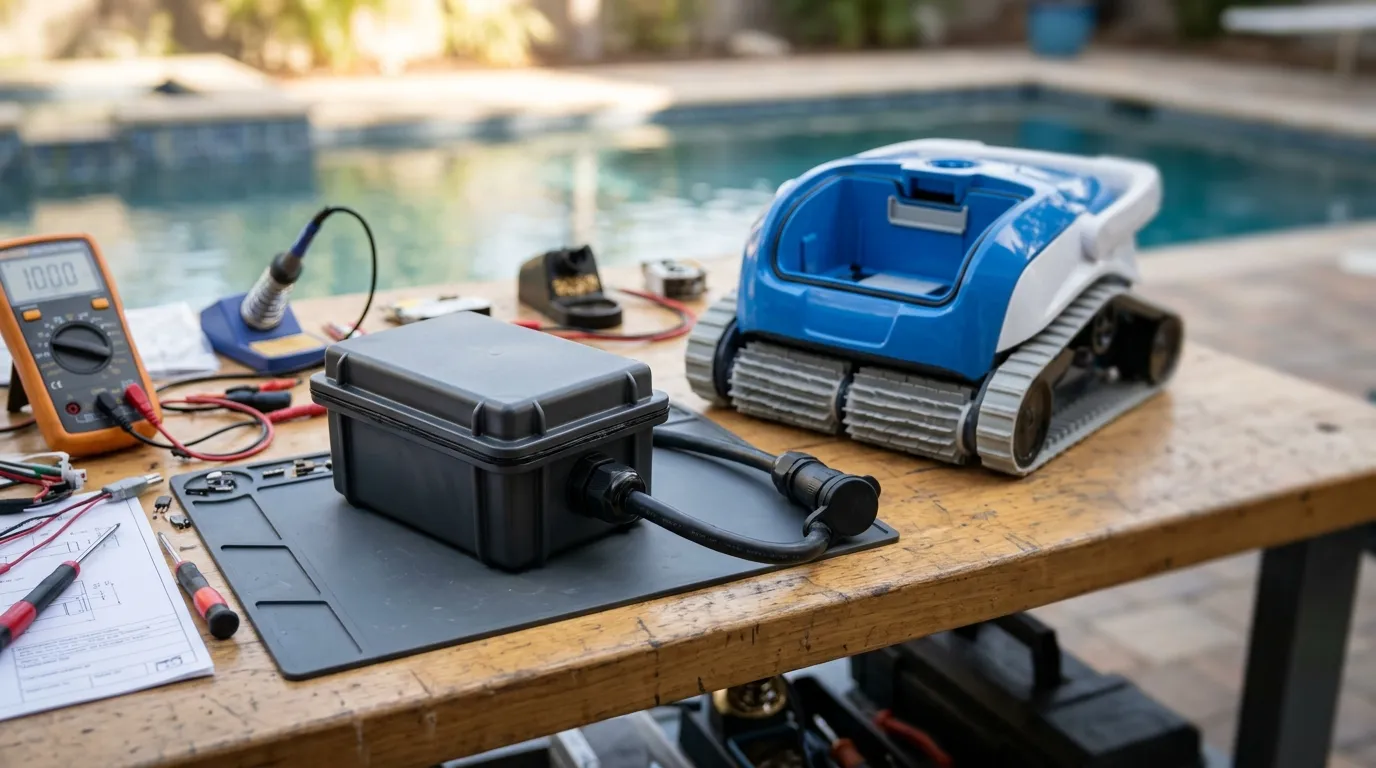
A custom battery for a pool cleaning robot is an application-specific rechargeable pack engineered to match the robot's voltage, runtime, continuous and peak motor loads, physical envelope, charging method, and wet-environment protection requirements. Waterproofing in this context must be validated for the specific enclosure and exposure conditions — not assumed from generic marketing language — because a pool robot operates in a fundamentally different environment than a typical consumer or industrial robot.
Most pool cleaning robots that need a custom battery are cordless or partially submerged units that navigate pools while filtering debris, scrubbing walls, and driving across floors. These tasks create a demanding electrical load profile, and the battery must survive humidity, chlorinated water, and potential submersion while maintaining consistent performance.
What Makes a Pool-Cleaning Robot Battery Different
A standard robot battery pack is not automatically suitable for pool cleaning equipment. The difference comes down to three factors:
- Water exposure. Pool robots work in or near water. The battery enclosure, connectors, and charging contacts must resist moisture ingress, chlorinated water, and in some designs saltwater.
- Load profile. Pool cleaning combines pump, brush, and drive motors that can draw high current during startup or when the robot encounters debris, climbs walls, or changes direction.
- Charging environment. Charging may occur through external contacts or a docked connection, often in a humid or wet area. The charging interface must be protected and compatible with the battery's chemistry and voltage.
A replacement battery may restore an existing robot, but a custom battery is designed around the robot's specific electrical, mechanical, and environmental requirements.
Step 1 — Capture the Robot's Requirements Before Cell Selection
Before contacting a battery manufacturer, document the robot's operating requirements. This information becomes the basis for every downstream decision, from cell chemistry to enclosure design.
Electrical Specifications to Define Before Sourcing
- Nominal voltage. The robot's operating voltage, typically determined by the existing battery or motor driver.
- Maximum charge voltage. The voltage the charger applies — this is different from nominal voltage and is set by the cell chemistry and series configuration.
- Capacity (Ah or mAh). The amount of charge the battery can store, which contributes to runtime.
- Energy (Wh). The total energy available, calculated as nominal voltage × capacity. Wh gives a more accurate comparison across different voltages than Ah alone.
- Continuous current. The sustained current the robot draws during normal operation.
- Peak current. The transient current during startup, brush loading, or stall events. Peak current can significantly exceed continuous current.
These specifications must be expressed correctly. Capacity in amp-hours (Ah) is not the same as energy in watt-hours (Wh), and nominal voltage is not the same as charge voltage.
Environmental Requirements to Specify for the Pool
- Water ingress. Define what "waterproof" means for your application: splash resistance, temporary submersion, or continuous submersion? Each requires a different enclosure and test method.
- Chlorinated or saltwater exposure. Pool water contains chlorine or salt, which accelerates corrosion of terminals, fasteners, and connectors.
- Humidity. Sealed enclosures can trap moisture; the internal environment must be managed.
- Temperature range. Specify operating, charging, and storage temperatures. Charging in cold conditions requires special consideration.
- Vibration and impact. The robot moves across pool surfaces, climbs walls, and may be dropped during handling. The pack must withstand mechanical shock.
Step 2 — Design the Electrical Architecture
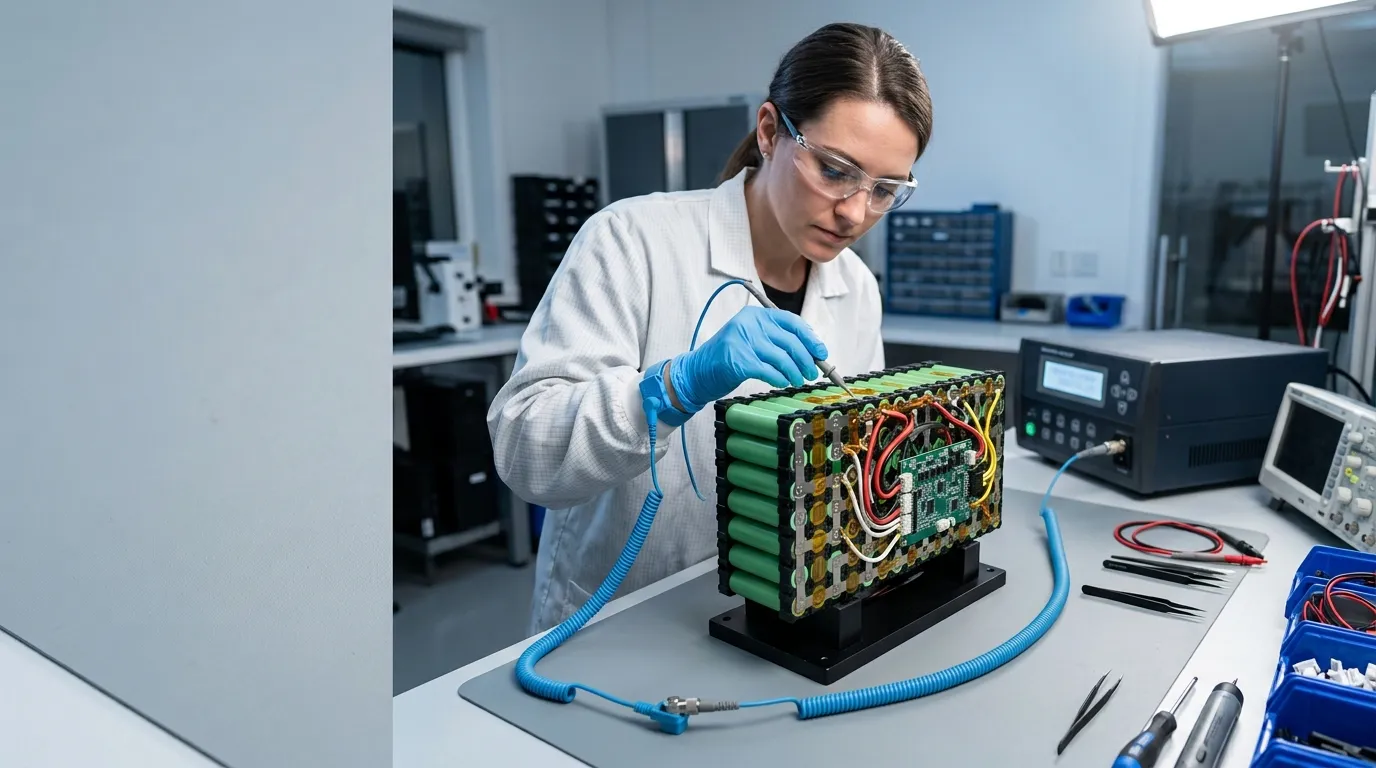
Once the electrical and environmental requirements are documented, the pack architecture can be defined. The two main decisions are cell chemistry and the series/parallel (S/P) configuration.
Cell Chemistry Comparison
| Chemistry | Nominal Voltage | Typical Energy Density | Cycle Life | Key Trade-Offs |
|---|---|---|---|---|
| Lithium-ion (Li-ion) | 3.6–3.7 V per cell | High | Good | Common in robotics; widely available in cylindrical formats |
| Lithium-polymer (LiPo) | 3.7 V per cell | High | Good | Flexible pouch format; useful for custom thin geometries |
| Lithium iron phosphate (LiFePO4) | 3.2 V per cell | Lower than Li-ion | Higher | Better cycle life and thermal stability, but lower energy density |
There is no universal "best" chemistry. The right choice depends on the robot's voltage requirement, available space, runtime target, charging method, and operating temperature.
Series and Parallel Configuration
The series count (S) determines the pack's nominal voltage. For example, a 3S pack uses three cells in series to produce approximately 11.1 V (for Li-ion cells at 3.7 V nominal per cell). The parallel count (P) increases capacity and available current. For example, a 3S2P pack has two cells in parallel in each series group.
| Configuration | Nominal Voltage (Li-ion) | Capacity Effect | Best For |
|---|---|---|---|
| 1S | 3.7 V | Base capacity | Low-voltage devices |
| 2S | 7.4 V | Base capacity | Small robots, portable equipment |
| 3S | 11.1 V | Base capacity | Common for mid-size robots |
| 4S | 14.8 V | Base capacity | Higher-voltage motor systems |
| Any S + P | Unchanged by P | Increased capacity and current | Extended runtime or higher current draw |
The series count directly determines the maximum charge voltage. A Li-ion cell charges to 4.2 V per cell, so a 3S pack charges to 12.6 V. The charger must match this voltage exactly, along with the correct charge-current limit.
For the physical layout, cylindrical cells such as 18650 and 21700 are common in robot battery packs because they offer high energy density, good current capability, and proven manufacturing consistency. LiPo pouch cells provide more design flexibility for thin or irregular compartments, but they require careful protection against swelling and puncture.
Step 3 — Meet the Load Profile Without Voltage Sag or Shutdown
A pool cleaning robot's battery must handle the combined demand of multiple motors. The pump circulates water and filters debris, the brushes scrub surfaces, and the drive system moves the robot horizontally and vertically. Each motor draws continuous current during operation and a higher peak current during startup, acceleration, or stall.
Voltage sag occurs when the pack's voltage drops under load, primarily due to internal resistance. If the voltage drops below the motor driver's cutoff, the robot may slow down, shut off, or restart unexpectedly. Voltage sag is influenced by:
- Internal resistance of the cells and pack interconnections.
- Current draw — the higher the current, the greater the sag.
- State of charge — sag becomes more pronounced as the battery discharges.
The C-rate expresses current relative to capacity. A 1C rate means the current equals the capacity in amp-hours. For example, a 5 Ah pack at 2C delivers 10 A. A pool robot with high motor loads may require a pack rated for continuous current at 1C–2C and peak current at 2C–3C or higher, depending on the design.
The battery must be sized so that the continuous and peak current requirements stay within the cell's rated limits. The BMS will enforce additional current limits, and if those limits are set too close to the normal operating range, the robot may shut down under load.
Step 4 — Design the Waterproof Enclosure and Sealing
The enclosure is where water protection is won or lost. A sealed housing is the first barrier, but it must be designed with the entire system in mind.
Key Design Steps for a Waterproof Pack
- Select an enclosure material compatible with pool water and UV exposure. Common options include ABS, polycarbonate, and specialty engineering plastics. Metal housings require corrosion-resistant coatings or anodizing.
- Design gaskets and seals for every opening. The cover seal, cable entries, and any external access points must be compressed correctly and remain stable across temperature cycles.
- Protect connector and cable entries. The point where wires exit the enclosure is the most common failure location. Use sealed connectors, strain relief, and potting compound where necessary.
- Choose corrosion-resistant terminals and fasteners. Stainless steel, gold-plated contacts, or nickel-plated terminals resist corrosion better than bare copper or steel.
- Address thermal management. A sealed enclosure traps heat. The pack's discharge and charging cycles generate heat, and if the enclosure prevents dissipation, the cells may degrade faster or trigger BMS temperature protection. Consider thermal interface materials, heat sinks, or design allowances for airflow where possible.
- Decide on serviceability. A fully sealed pack may be difficult to repair or recycle. A serviceable design requires gaskets that can be replaced and fasteners that remain accessible. A sealed-for-life design simplifies waterproofing but makes replacement the primary repair option.
- Evaluate pressure and venting. Temperature changes inside a sealed enclosure can create pressure differences. If the enclosure is completely sealed with no pressure equalization, mechanical stress may develop. Vented enclosures allow pressure equalization but must prevent water ingress, which is technically challenging.
Connector and Cable-Entry Protection
The connector is the bridge between the battery and the robot. It must carry the required current without overheating, maintain a secure mechanical connection despite vibration, and resist corrosion in a humid environment. Key considerations:
- Current rating. The connector must handle continuous and peak current with margin.
- Polarity. Permanent polarity protection prevents reversed installation.
- Sealing. A sealed connector with an integrated gasket protects both the battery side and the device side.
- Strain relief. A connector that can flex or pull during robot movement will eventually compromise the seal.
Pressure, Venting, and Thermal Management in a Sealed Pack
A completely sealed enclosure is difficult to achieve and maintain. Water molecules can penetrate seals over time, especially with temperature cycling and long-term submersion. This is why a waterproof claim should always be tied to a defined test method: specific depth, duration, and pressure conditions.
Heat is the other challenge. During charging and high-current discharge, the pack generates heat. In a sealed enclosure, that heat has limited escape paths. If the pack exceeds its operating temperature, the BMS may reduce current or stop operation entirely. The design must account for the thermal load of the application, not just the static capacity of the cells.
Step 5 — Specify BMS Protection and Charging Compatibility
The battery management system (BMS) protects the pack from electrical faults and manages safe operation. A basic protection circuit (PCM) typically includes overcharge, over-discharge, overcurrent, and short-circuit protection. A smart BMS can additionally provide cell balancing, state-of-charge estimation, temperature monitoring, and communication interfaces.
For a pool cleaning robot, the BMS must:
- Prevent overcharge. Charging beyond the cell's maximum voltage is unsafe and reduces cycle life.
- Prevent over-discharge. Discharging below the cell's minimum voltage can permanently damage Li-ion cells.
- Limit overcurrent. The BMS should allow normal motor surges but trip on genuine faults.
- Monitor temperature. Cut off charging below freezing and reduce current at high temperatures.
- Balance series cells. In a multi-series pack, small differences in cell capacity and internal resistance can cause one cell to reach its limit before the others. Balancing keeps all cells within their operating range.
The charger must match the pack's chemistry and series count. A 3S Li-ion pack requires a charger that delivers the correct charge voltage (12.6 V) and limits current according to the pack's rating. Using an incompatible charger can cause overcharge, overheating, or reduced battery life.
In a wet environment, the charging interface adds another layer of protection. The charging contacts must be sealed when not in use, or the charging dock must be designed to route power through protected terminals.
Step 6 — Validate and Document the Pack
A custom battery for a pool cleaning robot is not ready for production until it has been validated under conditions that match the real application. Validation goes beyond functional testing — it confirms that the pack can survive its operating environment.
Validation Plan for a Pool-Cleaning Robot Battery
| Test | What It Validates | Acceptance Criteria Example |
|---|---|---|
| Water immersion or IP rating test | Enclosure and connector sealing | No water ingress after defined depth and duration |
| Charge/discharge cycling | Capacity retention and BMS function | Capacity above specified threshold after N cycles |
| Stall load test | Peak current capability | No BMS trip during defined stall event |
| Vibration test | Mechanical integrity under robot operation | No loose connections, no performance degradation |
| Thermal cycling | Seal and material durability across temperature | No cracking, gasket failure, or capacity loss |
| Corrosion test | Terminal and fastener resistance to pool chemistry | No visible corrosion that affects function |
The specific acceptance criteria must be defined by the OEM and the battery manufacturer, based on the robot's actual operating conditions. There is no universal "waterproof" standard without a test method behind it.
Documentation to Request From a Battery Supplier
- Datasheet / Technical Data Sheet (TDS). Full specifications for the exact pack model, including voltage, capacity, current limits, temperature range, dimensions, and connector type.
- SDS / MSDS. Safety data for the chemistry and materials used.
- UN38.3 test summary. Evidence that the battery design has passed the United Nations transport tests for lithium batteries.
- IEC 62133 or UL report. Product-safety testing relevant to portable batteries — applicable to a defined model and construction, not to the entire company.
- Test reports. Evidence for the specific validation tests agreed in the plan above.
What "Waterproof" Actually Requires
The term "waterproof" only has meaning when tied to a test method. An IP67 rating, for example, means the enclosure passes specific tests for dust ingress and temporary immersion under defined conditions. The test must be performed on the exact enclosure, connector, and gasket combination — not on a component or a similar design.
When evaluating a supplier, ask for:
- The exact IP rating or immersion test method.
- The duration and depth of the immersion test.
- Whether the test was performed on the complete pack or only on the enclosure.
- Whether the pack was powered or charging during the test.
A sealed enclosure is the starting point, but the enclosure alone does not make the pack waterproof. The complete assembly — enclosure, gaskets, connectors, cable entries, and charging contacts — must pass the same test together.
Build a Supplier RFQ With Clear Evidence Requirements

A well-prepared RFQ gives a battery manufacturer everything needed to provide an accurate feasibility review and quotation. It also provides a basis for comparing suppliers on the same criteria.
RFQ Checklist for a Pool-Cleaning Robot Battery
Robot and application information:
- Robot dimensions and available battery compartment space
- Motor types (pump, brush, drive) and their continuous and peak current draw
- Runtime target per cleaning cycle
- Charging method (docked, external, or removable)
- Operating environment (chlorinated pool, saltwater pool, humidity level)
Electrical requirements:
- Nominal voltage
- Maximum charge voltage
- Capacity or energy target
- Continuous and peak current
- Charger voltage and current
- BMS requirements (protection thresholds, balancing, fuel gauge, communication)
Mechanical requirements:
- Maximum dimensions and weight
- Connector type and orientation
- Mounting method
- Servicing or replacement requirements
Environmental requirements:
- Water exposure and IP rating target
- Chlorine or saltwater concentration
- Operating, charging, and storage temperature ranges
- Vibration and impact conditions
Documentation and validation requirements:
- Datasheet and SDS
- UN38.3 test summary
- Product-safety test report (IEC 62133 or equivalent)
- Validation test plan with acceptance criteria
- Traceability and change-control requirements
A custom battery pack for a pool cleaning robot is a design exercise, not a catalog selection. The battery must be specified around the robot's real electrical load, its physical envelope, and the harsh wet environment it operates in. Custom robot battery pack engineering starts with requirements, proceeds through chemistry and architecture selection, and ends with enclosure design, validation, and documentation. For related application guidance, custom battery packs for underwater robots follow similar environmental logic, while industrial robot battery pack solutions focus on different load and operational demands.
Common Mistakes to Avoid When Specifying a Pool-Cleaner Battery
- Assuming all lithium packs are the same. A pack designed for a vacuum robot or an AGV lacks the water protection and load margin a pool cleaner needs.
- Confusing capacity with energy. Ah tells you charge, but Wh tells you usable energy. Comparing packs only by Ah can be misleading when voltages differ.
- Underestimating peak motor current. A pack that handles continuous current may trip its BMS during startup or stall events.
- Treating "waterproof" as a generic claim. Water resistance means nothing without a defined test method and result.
- Ignoring charger compatibility. A charger that does not match the pack's chemistry, series count, and voltage limits will damage the battery.
- Accepting a UN38.3 summary as proof of product safety. UN38.3 is a transport test, not a product-safety certification. A product-safety report such as IEC 62133 or UL covers different requirements.
- Choosing a cell before defining the load profile. Cell selection should follow the electrical and environmental requirements, not precede them.
FAQ
What is the difference between a custom battery and a replacement battery for a pool robot?
A replacement battery is designed to fit an existing robot model and restore its original performance. A custom battery is engineered around the robot's specific electrical, mechanical, and environmental requirements — including voltage, capacity, current draw, physical envelope, and water protection — and can be optimized for longer runtime, higher current, or a different charging method.
Does a sealed battery enclosure make a pack waterproof?
A sealed enclosure is the foundation of a waterproof design, but it is not sufficient. The connector, cable entries, gaskets, and charging contacts must all meet the same ingress-protection standard. The complete assembly must pass a defined test method — such as a specific IP rating — to establish a verified waterproof claim.
What does IP rating mean for a pool-robot battery?
An IP rating (Ingress Protection rating) defines how well an enclosure resists dust and water. The second digit indicates water protection. For example, IP67 means protection against temporary immersion under defined depth and duration conditions. The rating only applies to the exact configuration tested — enclosure, seals, and connectors together.
What is the difference between UN38.3 and IEC 62133?
UN38.3 is a United Nations transport test standard for lithium batteries. It ensures that batteries can be safely shipped without posing a fire or explosion risk during transport. IEC 62133 is a product-safety standard for portable sealed secondary cells and batteries, covering electrical and mechanical safety in normal use and under fault conditions. Both may be required, but they serve different purposes. A UN38.3 test summary supports transport documentation (UNECE Section 38.3), while product-safety testing addresses the battery's behavior in its intended application (Intertek UN 38.3 testing, TÜV SÜD on battery transportation safety).
Talk to the Manufacturer
Resources & Insights
High Capacity Lithium Battery for Wearables: High-Voltage LiPo Cell Design
2026-10-19
Cylindrical Battery Packs for Laptops: 2S vs 3S vs 4S Battery Design
2026-10-19
Stage Lighting Battery Pack: Prevent Voltage Drop & LED Flicker
2026-10-19
Best Rechargeable Batteries for Smart Devices: Performance, Safety, and Selection Guide
2026-10-19


