


 Home /
 LiPo Battery vs Lithium Ion Battery


Table of Contents
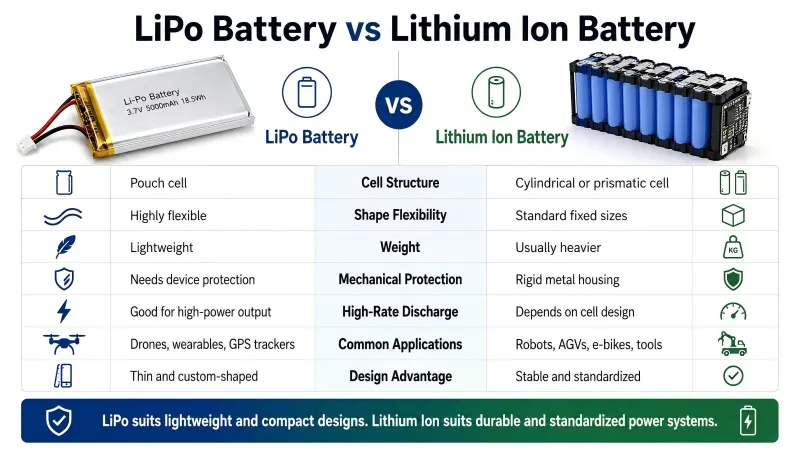
When selecting a rechargeable battery, buyers often compare a LiPo battery vs lithium ion battery as though they are two completely separate chemistries. In practice, lithium polymer batteries belong to the broader lithium-ion family. The main differences usually come from cell construction, electrolyte format, packaging, shape flexibility, energy density, discharge capability, and mechanical protection.
Neither battery type is automatically better. A thin wearable device, a high-power drone, a handheld scanner, and an industrial robot place very different demands on a battery. The right choice begins with the product’s available space, operating current, weight target, runtime, environment, and expected service life.
What Is a Lithium-Ion Battery?
The term “lithium-ion battery” commonly refers to rechargeable cells with a liquid electrolyte and a rigid cylindrical or prismatic housing. Popular cylindrical formats include 18650 and 21700 cells.
Their metal casing provides strong mechanical protection and makes the cells relatively easy to assemble into battery packs. Manufacturers can connect multiple cells in series and parallel to achieve the required voltage, capacity, and current.
Lithium-ion cells are widely used in electric bicycles, robots, power tools, medical equipment, energy storage systems, and industrial devices. Their standardized dimensions simplify sourcing, pack design, replacement, and production scaling.
However, cylindrical cells leave small spaces between individual cells. For products with extremely thin or irregular compartments, this structure may not use the available space as efficiently as a custom pouch cell.
What Is a LiPo Battery?
A lithium polymer battery, often called a LiPo battery, normally uses a soft aluminum-laminated pouch instead of a rigid metal can. This construction allows the cell to be manufactured in a wide range of thicknesses, lengths, and widths.
LiPo cells are commonly found in drones, wearable electronics, portable medical devices, GPS trackers, smart products, RC equipment, and compact consumer electronics.
The pouch structure can reduce packaging weight and make better use of limited internal space. It is especially valuable when the product designer needs a thin rectangular cell or a shape that cannot be achieved easily with cylindrical batteries.
The trade-off is that a pouch cell requires better external support. It can be more vulnerable to puncture, crushing, bending, or swelling if the device enclosure does not protect it correctly.
Shape and Product Design Flexibility
Shape is one of the clearest differences in the LiPo battery vs lithium ion battery comparison.
Cylindrical lithium-ion cells have fixed dimensions. The equipment must usually be designed around the chosen cell format. This is practical for larger battery compartments and modular packs, but less convenient for ultra-thin products.
LiPo cells offer much greater dimensional flexibility. A battery manufacturer can often adjust the cell length, width, and thickness to fit the available compartment.
This does not mean any shape is possible. The cell still needs space for tabs, sealing edges, insulation, a protection circuit, cables, and normal dimensional tolerance. Product engineers should involve the battery supplier before freezing the enclosure design.
Weight and Energy Density
Both battery types can provide good energy density, but the result depends on the cell chemistry, capacity, housing, protection components, and complete pack structure.
A LiPo pouch cell may provide a lighter solution because it does not use a heavy cylindrical metal shell. This is useful in drones, wearable equipment, and handheld devices where every gram matters.
Cylindrical lithium-ion cells may offer an excellent balance of capacity, mechanical strength, cost, and production consistency. In larger battery packs, standardized cells can make assembly and thermal management more predictable.
Buyers should compare the finished battery pack rather than only the bare-cell specification. Connectors, wiring, housings, padding, BMS components, and mounting parts all affect final weight and usable energy density.
Discharge Performance
High-current performance depends on the specific cell model rather than the name “LiPo” or “lithium-ion” alone.
Many LiPo batteries are designed for high discharge rates, which is why they are frequently used in drones, RC vehicles, and devices with strong short-term power demand. They can support rapid acceleration and motor peaks when correctly selected.
High-rate cylindrical lithium-ion cells can also deliver substantial current. They are commonly used in power tools, electric mobility products, robots, and other motor-driven equipment.
The battery supplier needs the continuous current and peak current, not just the device power rating. Cable size, connector type, cell configuration, welding design, and protection-board current must all support the load.
Safety and Mechanical Protection
Both battery types require protection against overcharge, over-discharge, overcurrent, short circuit, and unsuitable temperatures.
A cylindrical lithium-ion cell benefits from its rigid metal housing. It generally withstands mechanical handling better than an unprotected pouch cell.
A LiPo battery needs a carefully designed compartment that prevents bending, compression, puncture, and contact with sharp parts. The battery should not move freely inside the product. Enough clearance should also be provided to avoid excessive pressure on the pouch.
Safety depends on the complete design, including cell quality, protection circuit, charger compatibility, insulation, assembly process, enclosure, and quality testing. Choosing one format does not remove the need for correct system engineering.
Cycle Life and Swelling
Cycle life varies widely according to cell chemistry, charge voltage, depth of discharge, temperature, current, and storage conditions.
Lithium-ion cylindrical cells are often selected for applications that require predictable daily cycling and long-term pack durability. Their rigid housings also help maintain a consistent mechanical structure.
LiPo cells may experience visible swelling as they age or if exposed to unsuitable charging, excessive heat, over-discharge, or mechanical stress. The product enclosure should account for normal tolerances and should never place damaging pressure on the pouch.
A swollen battery should not continue to be used. It should be removed and handled according to appropriate battery disposal procedures.
Which Battery Is Better for Your Application?
Choose a LiPo battery when the product needs a thin profile, low weight, customized dimensions, or strong discharge performance within a compact space. Typical examples include drones, wearables, trackers, portable instruments, and slim medical devices.
Choose cylindrical lithium-ion cells when the project benefits from standardized formats, rigid mechanical protection, scalable pack configurations, and established supply options. Common applications include robots, AGVs, e-bikes, power tools, industrial equipment, and larger portable systems.
The final decision should be based on the operating load, available space, weight target, charging method, temperature range, protection requirements, expected cycle life, certification needs, and production quantity.
Conclusion
The LiPo battery vs lithium ion battery decision is not simply a choice between a modern battery and a traditional one. LiPo offers shape flexibility and lightweight packaging, while cylindrical lithium-ion cells provide standardized dimensions and strong mechanical protection.
A successful battery design matches the cell format to the product rather than forcing the product to accept an unsuitable battery. Early cooperation with a battery manufacturer helps confirm voltage, capacity, current, dimensions, connector, protection circuit, enclosure, and testing requirements.
Frequently Asked Questions
Is a LiPo battery a lithium-ion battery?
Yes. A LiPo battery is part of the rechargeable lithium-ion family, but it normally uses a pouch structure and a polymer-based or gel-like electrolyte system.
Which battery is lighter, LiPo or lithium-ion?
LiPo batteries are often lighter because their pouch packaging uses less structural material. The final comparison depends on the complete battery pack and enclosure.
Which battery is better for drones?
LiPo batteries are commonly chosen for drones because they can provide high discharge current in a lightweight package. The required capacity and discharge rate must match the drone’s motors and payload.
Do LiPo batteries swell more easily?
Pouch cells can show visible swelling as they age or experience unsuitable operating conditions. Proper charging, temperature control, mechanical protection, and storage help reduce the risk.
Can LiPo and lithium-ion batteries use the same charger?
Only when the charger matches the battery’s chemistry, series configuration, maximum charging voltage, and charging current. A charger should never be selected from the nominal voltage alone.
Talk to the Manufacturer
Resources & Insights
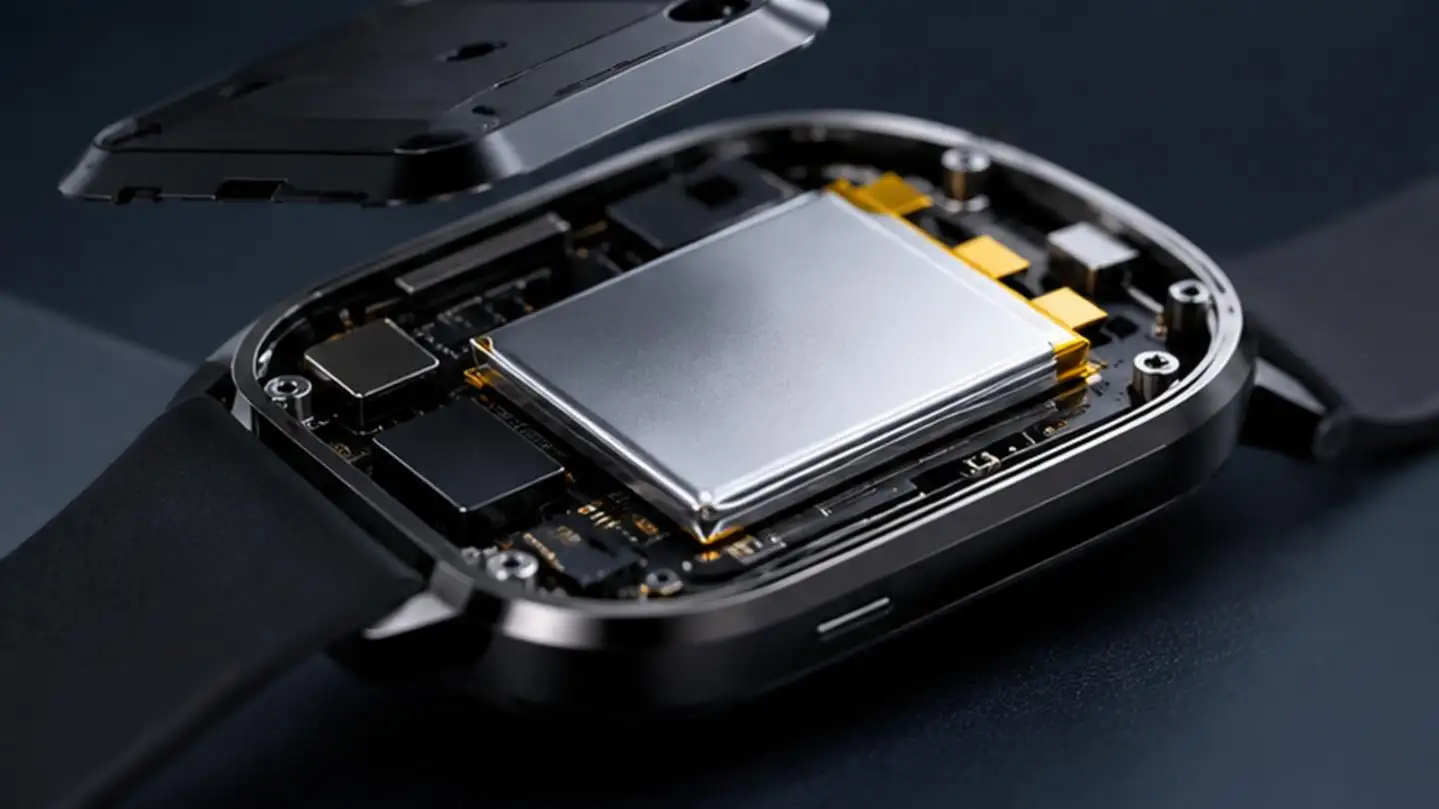
High Capacity Lithium Battery for Wearables: High-Voltage LiPo Cell Design
2026-10-19
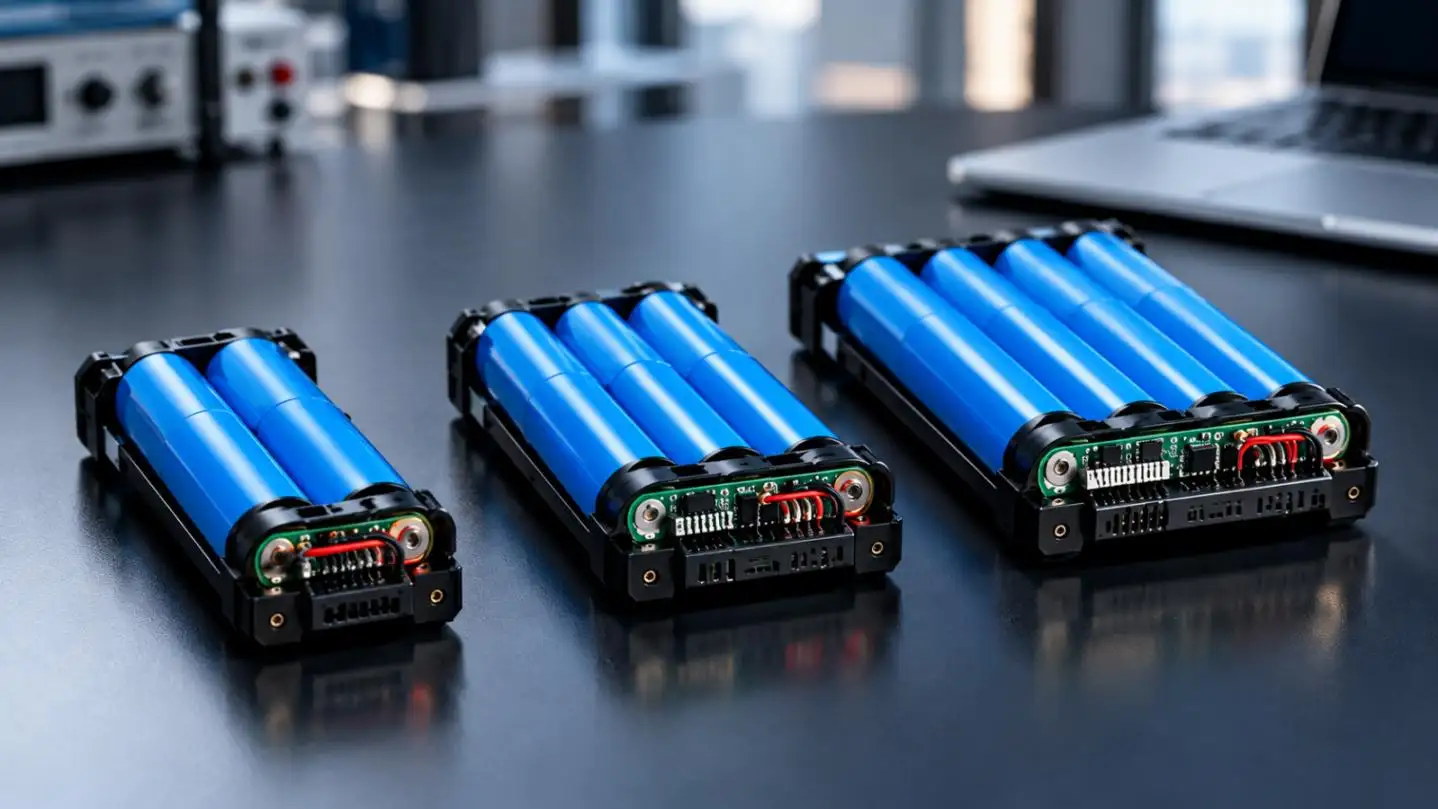
Cylindrical Battery Packs for Laptops: 2S vs 3S vs 4S Battery Design
2026-10-19

Stage Lighting Battery Pack: Prevent Voltage Drop & LED Flicker
2026-10-19
Best Rechargeable Batteries for Smart Devices: Performance, Safety, and Selection Guide
2026-10-19


