


 Home /
 Custom Battery Pack for LED Work Lights: Professional Lighting Power


Table of Contents
- What to Specify Before You Contact a Battery Manufacturer
- Voltage, Capacity, and Energy: Defining the Electrical Specification
- Cell Chemistry and Form Factor: Cylindrical Li-Ion or LiPo?
- Protection, Charging, and Integration: BMS, Charger, and Connector
- Prototype, Validation, and Documentation: What to Expect from a Reliable Supplier
- RFQ Checklist: Questions to Ask a Custom Battery Manufacturer
- Common Mistakes to Avoid When Specifying a Custom Work-Light Battery
- Custom Battery Pack Supply for Professional Lighting — Gloflux's Approach
- Frequently Asked Questions
- Get a Custom Pack Review for Your LED Work Light
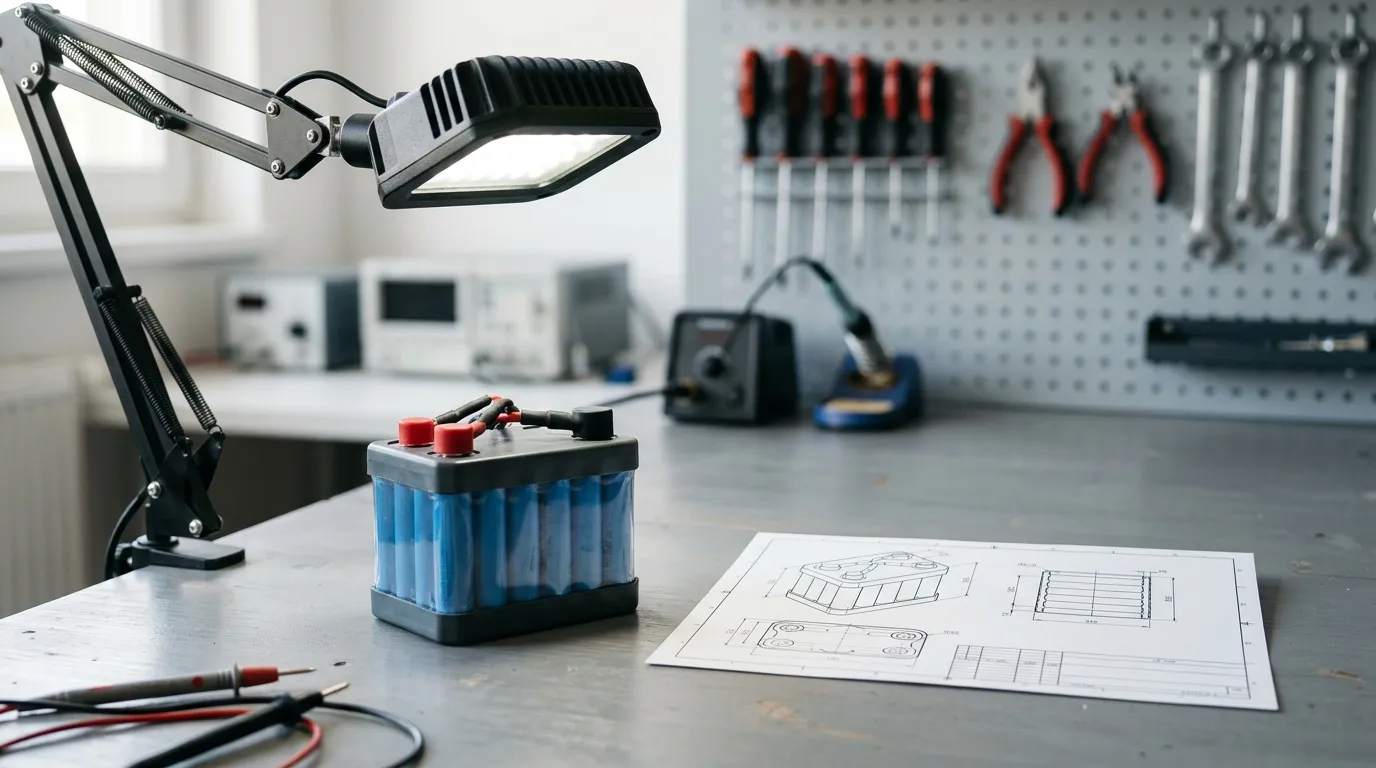
A custom battery pack for LED work lights is a rechargeable lithium battery assembly engineered specifically for a work light's voltage, energy, runtime, physical envelope, charging interface, protection requirements, and operating environment. Unlike an off-the-shelf pack, a custom design is specified around the light's actual load profile and mechanical constraints, which is why OEMs and professional buyers need a clear specification process before contacting a manufacturer.
This guide explains how to translate your LED work light's requirements into a correct battery pack specification—covering load calculations, electrical specifications, chemistry selection, protection and charging, mechanical integration, validation, and supplier documentation.
What to Specify Before You Contact a Battery Manufacturer
Before discussing a custom pack, define the requirements that will drive every design decision. A battery manufacturer needs more than a target runtime; they need the full operating context of your work light.
Start with the load. The LED light's power consumption—not just the LED wattage—determines current draw. Most LED work lights use a driver that converts battery voltage to the LED forward voltage, and the driver has an efficiency loss. If your LED module draws 10 W from the driver output but the driver is 85% efficient, the battery must supply approximately 10 W ÷ 0.85 = 11.8 W.
Define the operating modes and duty cycle. Does the light run continuously at full brightness, or does it have high, medium, and low modes? Will users run it intermittently or for hours at a time? The duty cycle affects both the energy requirement and the average versus peak current the pack must deliver.
Set a target runtime. Runtime is the primary user-facing specification. It directly determines required pack energy. The relationship is simple:
Runtime (hours) = Usable pack energy (Wh) ÷ Average load power (W)
Define the mechanical envelope. Provide available dimensions, weight limits, mounting requirements, connector type, and cable exit direction. The pack must fit within the handle or housing while leaving space for thermal management, wiring, and the BMS.
Describe the operating environment. Will the work light be used indoors, outdoors, in cold warehouses, or in dusty or wet conditions? Specify expected ambient temperature range, potential exposure to water or dust (IP rating), and any vibration or impact exposure. This determines enclosure requirements, cell selection, and BMS temperature limits.
Specify the charging method. Will users charge the pack inside the light with a wall adapter, via USB-C, or by removing the pack and placing it in a separate charger? The charging method affects connector selection, charge current, and BMS charge-management requirements.
State your documentation needs. If the finished light will be sold in specific markets, you may need transport documentation (UN38.3 test summary), product safety test reports (IEC/UL), and material declarations. Communicate this early so the pack design and testing plan align with your market requirements.
Voltage, Capacity, and Energy: Defining the Electrical Specification
The electrical specification is the core of the pack design. Three values are frequently confused: voltage, capacity, and energy. Getting them right prevents specification errors that lead to poor runtime, incorrect charging, or premature pack failure.
Voltage determines the pack's electrical platform. Lithium-ion cells have a nominal voltage—for most Li-ion and LiPo chemistries, approximately 3.6–3.7 V per cell. When cells are connected in series, the pack voltage increases. A 2S pack (two cells in series) has a nominal voltage around 7.2–7.4 V, a 3S pack around 10.8–11.1 V, and a 4S pack around 14.4–14.8 V.
Nominal voltage is not the same as maximum charge voltage. A 3.7 V nominal Li-ion cell charges to approximately 4.2 V. A 3S pack therefore charges to approximately 12.6 V, not 11.1 V. This distinction matters for charger selection and BMS cutoff settings.
Capacity is the amount of charge a pack can store, expressed in milliamp-hours (mAh) or amp-hours (Ah). However, capacity alone is misleading because it does not account for voltage. Energy, expressed in watt-hours (Wh), is the more meaningful value:
Energy (Wh) = Nominal voltage (V) × Capacity (Ah)
A 10 Ah pack at 7.4 V stores 74 Wh, while a 10 Ah pack at 14.8 V stores 148 Wh—twice the energy at the same capacity figure. When comparing pack options at different voltages, always use Wh for the energy comparison and mAh/Ah only when voltage is fixed.
Series and Parallel Configurations Explained
Battery cells are arranged in series (S) and parallel (P) groups to achieve the required voltage and capacity:
- Series (S) connections increase voltage. A 3S pack uses three cells in series to reach a nominal voltage of approximately 11.1 V (Li-ion).
- Parallel (P) connections increase capacity and available current. A 3S4P pack uses four cells in parallel within each series group, increasing capacity and current capability.
A 3S4P configuration means three series groups, each containing four parallel cells. This is not the same as 4S3P, which would have a higher voltage and different capacity. Reading S/P notation correctly is essential when comparing candidate pack designs.
Cell specification must not be confused with pack specification. A single 18650 cell might be rated for 2,500 mAh and 10 A continuous discharge. A 3S4P pack using those cells would have a nominal voltage of approximately 11.1 V, a rated capacity of approximately 10,000 mAh (10 Ah), and a higher pack-level current capability than a single cell—but the usable current also depends on the BMS, wiring, connector, and thermal design. Cell ratings are inputs to the pack design, not the finished pack's rating.
C-rate and current are related but not interchangeable. C-rate is the current relative to the cell's capacity. A 2,500 mAh cell discharged at 1C delivers 2.5 A. At 2C it delivers 5 A. The maximum continuous discharge current must be specified in amperes for the pack, while the C-rate describes how that current compares to the pack's capacity. If your work light draws 15 A continuous and a candidate pack has 10 Ah capacity, that represents a discharge rate of approximately 1.5C—a useful check on whether the pack's intended discharge capability is adequate.
Current also has a continuous-versus-peak distinction. LED drivers and boost circuits may draw higher current during startup, at maximum brightness, or under cold conditions. Specify both the continuous current the pack must sustain and the peak current it must support for a defined duration (for example, 18 A for 5 seconds at startup). The BMS must allow the peak without nuisance tripping, and the cells must not exceed their rated pulse current.
Voltage sag is an important real-world consideration. Every cell has internal resistance, which causes its voltage to drop under load. A pack with high internal resistance may sag below the LED driver's operating range during high current draw, causing flicker, reduced brightness, or premature low-voltage cutoff. This is one reason why cell quality, matching, and proper pack construction matter as much as nominal capacity.
Cell Chemistry and Form Factor: Cylindrical Li-Ion or LiPo?
The choice of cell chemistry and form factor affects the pack's size, weight, current capability, cycle life, and cost. There is no universal "best" option—the right choice depends on the work light's design constraints and operating demands.
| Cell Type | Typical Use | Advantages | Trade-offs |
|---|---|---|---|
| Cylindrical Li-ion (18650, 21700) | Portable tools, lighting, industrial devices | Mechanical robustness, broad supply chain, predictable performance, good energy density, established safety record | Requires space for cylindrical cells; needs proper cell matching; heavier than some alternatives |
| LiPo / pouch cell | Slim devices, wearables, compact lighting, custom-shaped enclosures | Thin, flexible form factors, can be shaped to unusual enclosures, good energy density | Requires mechanical protection, allowance for slight swelling, and careful thermal design |
| LiFePO4 | High-cycle-life or safety-sensitive applications | Long cycle life, stable chemistry, lower thermal runaway risk | Lower energy density, different voltage platform (3.2 V nominal per cell), larger and heavier for the same energy |
For many LED work lights, cylindrical Li-ion cells—particularly 18650 and 21700—are common choices because they balance energy, current capability, and mechanical robustness. Pouch cells are useful when the enclosure is thin or unusually shaped, but they require careful mechanical and thermal integration. LiFePO4 is less common for portable work lights because of its lower energy density, but it may be appropriate when cycle life and stability are prioritized over weight and size.
When Does a Pouch Cell Make Sense?
Pouch cells are a good fit when the work light's enclosure is slim, curved, or otherwise incompatible with cylindrical cells. Because the pouch format can be manufactured in custom dimensions, it can fill otherwise wasted space and improve the pack's volumetric efficiency.
However, pouch cells bring design obligations:
- Mechanical protection. The pouch is a soft package. It needs a rigid enclosure or support structure to prevent puncture, compression, or excessive flexing.
- Swelling allowance. Pouch cells can swell slightly over their life as they cycle. The enclosure must allow for this without crushing the cell or stressing the connections.
- Thermal management. Pouch cells can be sensitive to overheating and require adequate heat paths, especially at higher discharge rates.
If your work light's housing is deep enough for cylindrical cells, that is often the lower-risk choice. If space is the limiting factor, a custom pouch pack may be the right answer—provided the mechanical design accounts for the pouch's needs.
Cylindrical Cells: Why 18650 and 21700 Are Common Choices
The 18650 and 21700 formats dominate portable battery packs because they are widely produced, mechanically robust, and offer predictable electrical and thermal behavior when properly specified.
18650 cells are the industry workhorse. They are cylindrical cells measuring 18 mm in diameter and 65 mm in length. They offer a well-established supply chain, extensive datasheet availability, and a wide range of capacity and discharge options.
21700 cells are larger (21 mm in diameter, 70 mm in length) and generally offer higher capacity per cell, which can reduce the number of parallel cells needed for a given pack capacity. Their larger size also means more energy per cell, which can simplify the pack architecture.
For a work light, the choice between 18650 and 21700 depends on the available cavity space, target capacity, and pack architecture. Both formats require the enclosure to include a defined cylindrical cell cavity, proper insulation between cells, and adequate heat dissipation.
Cell matching matters. In a multi-cell pack, cells should be matched by capacity, internal resistance, and voltage before assembly. Mismatched cells in a series string can cause voltage imbalance, reduced usable capacity, and premature BMS cutoff. A responsible pack manufacturer will match cells and document the process as part of the quality system.
Protection, Charging, and Integration: BMS, Charger, and Connector
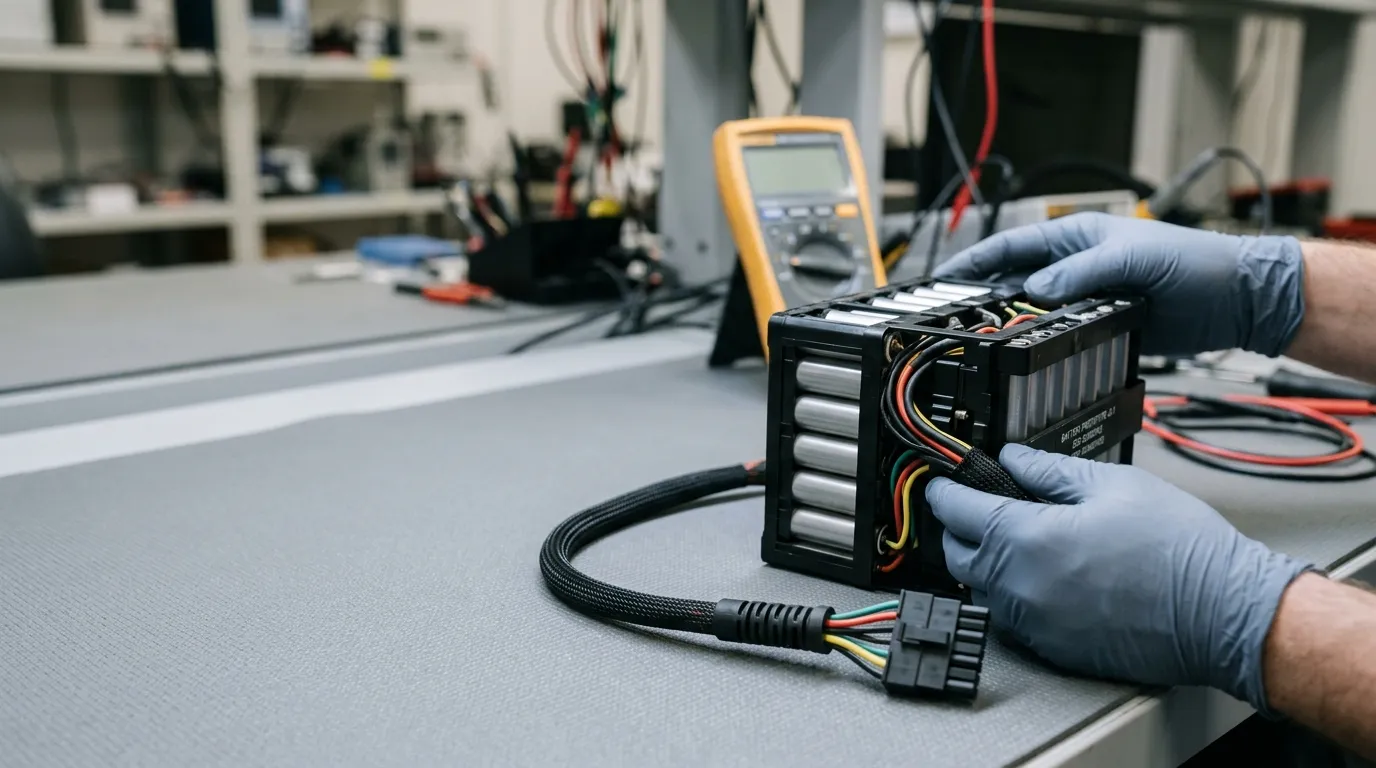
A battery pack is more than its cells. The protection circuit, charging interface, connector, and mechanical integration determine whether the pack is safe, reliable, and compatible with the work light.
PCM vs. BMS: What Protection Do You Need?
Battery packs typically include either a PCM (protection circuit module) or a BMS (battery management system). These terms are sometimes used interchangeably, but they are not identical.
A PCM provides essential protection functions:
- Overcharge protection
- Over-discharge protection
- Overcurrent protection
- Short-circuit protection
- Temperature protection (on better designs)
A BMS may include all PCM functions plus additional capabilities:
- Cell balancing (for multi-series packs)
- State-of-charge (SOC) estimation / fuel gauge
- State-of-health reporting
- Data logging
- Communication interfaces (SMBus, I2C, UART, CAN, RS485, Bluetooth)
Not every pack needs a full smart BMS. If the work light simply needs protected power, a well-designed PCM may be sufficient. If the light must report remaining runtime, balance its cells automatically, or communicate with a charging station or app, a smart BMS is required.
The protection board must match the pack design. Its overcharge and over-discharge voltage thresholds, overcurrent limits, and temperature cutoff points must align with the specific chemistry, series count, and load profile. A board designed for a 2S Li-ion pack at 7.4 V cannot be used on a 3S pack at 11.1 V.
Charger Compatibility
The charger must match the pack's chemistry, series count, and charge limits. Lithium-ion packs use a CC/CV (constant current / constant voltage) charging profile:
- The charger applies a constant current until the pack reaches its maximum charge voltage.
- It then holds the voltage constant while the current tapers down.
- Charging terminates when the current drops to a predefined threshold.
If a charger is set to the wrong voltage, it will either undercharge the pack (reducing runtime) or overcharge it (creating a safety hazard). If the charger current is too high, it may stress the cells and reduce service life.
Always specify the charger's output voltage and current limits—not just the connector type—when designing the pack. A USB-C interface, for example, can carry different power profiles, and the pack's charge-management circuit must accept the negotiated voltage and current.
Connector, Wiring, and Mechanical Integration
The connector is the physical and electrical interface between the pack and the work light. It must handle the expected current without excessive resistance or heating, maintain correct polarity, and withstand repeated connection cycles.
- Current rating. The connector's rated current must exceed the pack's maximum continuous current with margin.
- Polarity and keying. Use a connector that cannot be reversed. Keyed connectors prevent incorrect insertion.
- Strain relief. Cable exits should be strain-relieved so wires are not pulled from their terminations during assembly or use.
- Wire gauge. Wiring must be large enough to carry the load current without significant voltage drop or heat generation.
The enclosure is part of the safety design. The pack enclosure must protect cells from impact, prevent short circuits between cells and terminals, provide a defined thermal path, and—where required—offer a defined ingress protection (IP) rating. An IP rating is a specific environmental standard, not a general claim of waterproofing. If the work light will be used outdoors or in wet conditions, specify the required IP rating and verify the pack design against it.
Prototype, Validation, and Documentation: What to Expect from a Reliable Supplier
A custom battery pack should go through a defined development and validation process before mass production. A reliable supplier will document each stage.
Prototype Stage
The first working samples are used to verify:
- Mechanical fit. Does the pack fit the enclosure? Do connectors mate correctly?
- Electrical performance. Does the pack deliver the expected voltage and current?
- Thermal behavior. Does the pack stay within acceptable temperature limits under load?
- Charging behavior. Does the pack charge correctly with the intended charger?
Prototypes are also used to validate the BMS settings, test the connector and wiring under realistic conditions, and confirm that the pack works correctly with the LED driver.
Validation Testing
Validation should include capacity testing, charge/discharge cycling, aging, and performance verification under the intended operating conditions. Cell-level performance data must not be confused with pack-level results. A cell's datasheet capacity is not the finished pack's capacity; the pack's capacity depends on cell selection, assembly quality, BMS settings, wiring resistance, and temperature.
Documentation and Evidence
Professional buyers should request a defined documentation package:
| Document | What It Shows | When It Matters |
|---|---|---|
| Datasheet / TDS | Electrical, mechanical, and environmental specifications of the pack | Product specification and design reviews |
| SDS/MSDS | Material safety information for handling and transport | Shipping, customs, and workplace safety |
| UN38.3 test summary | Evidence that the battery design passed transport safety tests | Air, sea, and road transport of lithium batteries |
| IEC/UL test report | Product safety test evidence for a defined model and construction | Market access and customer safety requirements |
| CE/RoHS/REACH declarations | EU market compliance documentation where applicable | Selling into EU markets |
UN38.3 and IEC/UL cover different purposes. UN38.3 is a transport test requirement—it verifies that lithium batteries can withstand the vibration, shock, and thermal conditions of transport without presenting a safety hazard. The U.S. Department of Transportation's Pipeline and Hazardous Materials Safety Administration (PHMSA) provides official guidance on lithium battery test summaries, and Transport Canada's research summary notes that lithium batteries must pass UN38.3 tests before transport in the applicable context. The International Air Transport Association (IATA) also publishes lithium battery guidance for air transport.
IEC/UL test reports, by contrast, apply to product safety for a defined model, construction, and standard scope. A certification report must name the exact product model, legal entity, standard edition, and test configuration covered. A report for one model does not certify a different pack construction.
Company quality-system certificates—such as ISO 9001—are not product certifications. An ISO 9001 certificate says the company operates an audited quality-management system; it does not prove that a specific pack meets a specific product standard.
Tracing documentation and change control are also important. A professional supplier should maintain lot-level traceability of cells and components, and should notify the buyer of any material or design change before it affects production.
RFQ Checklist: Questions to Ask a Custom Battery Manufacturer

When you request a quotation for a custom work-light battery pack, the manufacturer's response should confirm that they understood your requirements and have a plan to meet them.
| Question | Why It Matters |
|---|---|
| What cell chemistries and form factors do you recommend for this load and envelope, and why? | Confirms the manufacturer is making an engineering choice, not just quoting a default design |
| Can you provide a proposed S/P configuration, nominal voltage, and capacity/energy estimate? | Confirms the architecture is appropriate for the load |
| What continuous and peak current can the pack deliver, and for how long? | Verifies the current capability meets the load, not just the capacity target |
| What BMS/PCM protection features do you propose, including overcharge, over-discharge, overcurrent, and temperature thresholds? | Confirms protection is matched to the pack and the application |
| How will the pack be charged, and what charger specifications are required? | Verifies charger compatibility |
| What connector, wire gauge, and mechanical integration do you recommend? | Confirms the interface is designed for the application |
| What validation tests will you perform, and which test report or certificate will be provided? | Clarifies the evidence you will receive |
| What is the prototype timeline, and how many samples will be provided? | Establishes the development path |
| What is the MOQ, and does it include any tooling or NRE (non-recurring engineering) costs? | Defines commercial feasibility |
| How do you manage change control and traceability during production? | Confirms supply continuity and quality assurance |
A supplier that can answer these questions specifically—rather than with generic promises—is more likely to deliver a pack that meets your work light's real requirements.
For more specific guidance on adjacent lighting applications, see our guides on custom lithium battery for headlamps and outdoor headlamp battery. For portable inspection lights, our Lithium battery for portable inspection lamps page covers that narrower use case.
Common Mistakes to Avoid When Specifying a Custom Work-Light Battery
Even experienced engineers make avoidable errors when specifying a custom battery pack. The most common mistakes are:
1. Confusing cell ratings with pack ratings. A cell's datasheet current, capacity, and internal resistance are inputs to the pack design, not the finished pack's specification. The pack's BMS, wiring, connector, and thermal design all affect its real-world performance.
2. Mixing up voltage definitions. Nominal voltage is not maximum charge voltage. A 3S pack at 11.1 V nominal charges to approximately 12.6 V. The charger and BMS must be specified against the correct voltage values.
3. Using mAh without stated voltage. Capacity alone is not energy. A 5 Ah pack at 7.4 V stores 37 Wh, while a 5 Ah pack at 14.8 V stores 74 Wh. State the voltage platform when comparing packs.
4. Underestimating continuous versus peak current. A work light that draws 12 A continuously but 18 A on startup needs a pack that can sustain both conditions. The BMS must not trip during the peak, and the cells must support the pulse.
5. Assuming every pack includes a smart BMS. Many packs include only a PCM with basic protection. A smart BMS with balancing, fuel gauge, or Bluetooth communication must be specified explicitly.
6. Confusing transport documentation with product safety reports. UN38.3 supports transport of the battery; IEC/UL reports address product safety of a defined model and construction. Neither replaces the other.
7. Ignoring thermal and mechanical integration. A pack that fits electrically but overheats in the enclosure is a reliability and safety failure. The enclosure, thermal path, and battery assembly must be designed together.
8. Changing requirements without change control. A request like "just use a bigger cell" or "can we raise the capacity by 20%?" can affect the BMS settings, charger, thermal behavior, and certification scope. All requirement changes should be formally reviewed.
Custom Battery Pack Supply for Professional Lighting — Gloflux's Approach
Gloflux is a lithium battery manufacturer based in Guangdong, China, operating under the legal entity Guangdong Gloflux Energy Co., Ltd. The company states on its website that it supports customizable form factors for flashlights, headlamps, lanterns, and industrial work lights, with options including cylindrical, rectangular LiPo, pouch, and custom-shaped designs. Gloflux also lists stated capacity and voltage ranges for its mobile-lighting battery solutions, along with protection features including overcharge, over-discharge, short-circuit, overcurrent, and temperature protection.
These are company-level product claims as presented on the Gloflux website. A custom pack for your specific work light must be engineered around your exact requirements—load profile, runtime target, mechanical envelope, charging method, environment, and market documentation needs. No two work-light designs are identical, and the pack specification must follow the requirements, not a standard catalog entry.
Gloflux's broader product scope includes lithium-ion cells, cylindrical and Li-polymer packs, LiFePO4 solutions, replaceable batteries, smart BMS-enabled packs, and OEM/ODM battery development across multiple applications, including mobile lighting. The company presents additional general quality claims on its Products page, including more than 10 years of lithium battery R&D and manufacturing experience, over 60 quality inspection procedures, daily capacity of 350,000 units, and a certifications list that includes ISO9001, IEC62133, UN38.3, and CE. These are broad company statements and should be interpreted as such—not as model-specific guarantees.
If you are evaluating custom battery pack options for LED work lights, see also our related guide on custom lithium battery for headlamps and the broader context of outdoor speaker battery pack solutions.
Frequently Asked Questions
What voltage battery does an LED work light need?
The voltage depends on your LED driver and LED module forward voltage. Common lithium-ion pack platforms include 1S (3.6–3.7 V), 2S (7.2–7.4 V), 3S (10.8–11.1 V), and 4S (14.4–14.8 V) nominal. The correct choice is driven by the driver's input range, the required power, and the current that the wiring and BMS must handle.
Can I use a standard off-the-shelf battery instead of a custom pack?
An off-the-shelf pack can work if it matches your voltage, current, capacity, charging, and mechanical interface exactly. In practice, work-light enclosures, load profiles, and charging configurations rarely align with standard packs, which is why OEMs typically choose a custom design.
What does UN38.3 cover?
UN38.3 is a transport test requirement for lithium batteries. It verifies that a defined battery design passes a series of environmental and mechanical tests—including vibration, shock, thermal cycling, and external short circuit—so it can be transported safely. A UN38.3 test summary is required for shipping lithium batteries by air and is part of the documentation package for other transport modes. The U.S. PHMSA and IATA provide official guidance on these requirements.
What documentation should a battery supplier provide?
At minimum: a pack datasheet or technical specification, SDS/MSDS, a UN38.3 test summary for transport, and any test reports or certificates applicable to your target market (for example, IEC/UL reports or CE/RoHS/REACH declarations). Always confirm the exact scope of each document—a certificate applies to the specific model and construction named in it.
Get a Custom Pack Review for Your LED Work Light
A custom battery pack is only as reliable as the specification behind it. If you are designing a work light and need help translating your requirements into a pack design—or if you already have a draft specification and want an engineering review—send your load profile, target runtime, mechanical envelope, charging method, and environmental conditions. Gloflux's engineering team evaluates each project against its actual requirements and responds with a proposed architecture and documentation plan.
Request a project review and put your LED work light on the right power foundation.
Talk to the Manufacturer
Resources & Insights
High Capacity Lithium Battery for Wearables: High-Voltage LiPo Cell Design
2026-10-19
Cylindrical Battery Packs for Laptops: 2S vs 3S vs 4S Battery Design
2026-10-19
Stage Lighting Battery Pack: Prevent Voltage Drop & LED Flicker
2026-10-19

Best Rechargeable Batteries for Smart Devices: Performance, Safety, and Selection Guide
2026-10-19


