


 Home /
 Industrial Robot Battery Pack: How to Design Reliable Power for Modern Automation


Table of Contents
- Why Industrial Robots Need Specialized Battery Packs
- Choosing the Right Battery Chemistry
- Voltage and Capacity Must Match the Complete System
- Intelligent BMS and Communication
- Charging Methods for Continuous Operation
- Mechanical and Thermal Design
- Reliability Testing Before Mass Production
- Custom Battery Development for Robot Manufacturers
- Conclusion
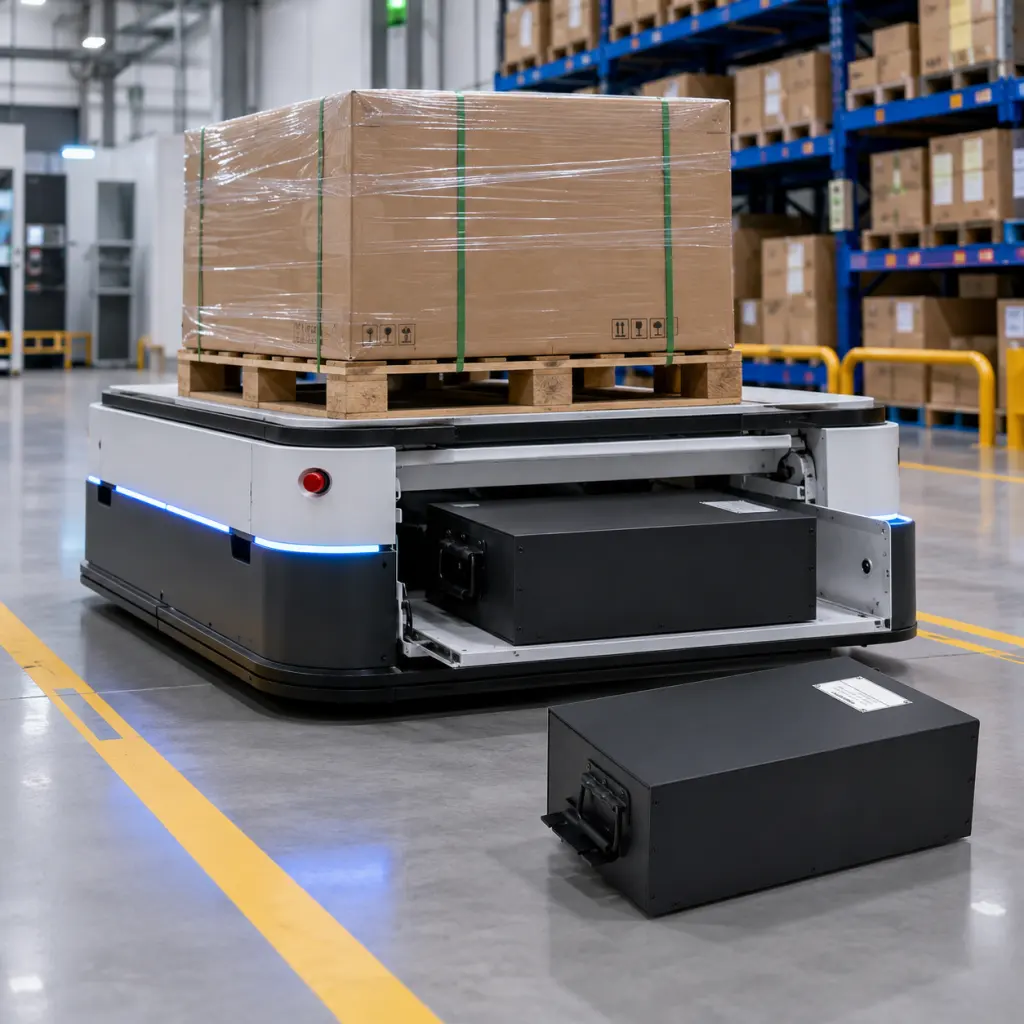
Industrial robots are no longer limited to fixed robotic arms installed behind safety fences. Modern factories now use autonomous mobile robots, warehouse robots, inspection robots, service robots, material-handling systems, and collaborative machines that move continuously between workstations.
All of these systems depend on a reliable industrial robot battery pack. When the battery is poorly matched to the robot, the result may be reduced runtime, unexpected shutdowns, slow charging, overheating, or shortened service life. A successful battery solution must therefore be designed around the robot’s actual workload rather than selected only by voltage and capacity.
Why Industrial Robots Need Specialized Battery Packs
Robots operate differently from ordinary consumer electronics. Their power demand can change rapidly as motors accelerate, robotic arms lift loads, wheels climb ramps, or sensors and computers process data.
A mobile robot may run steadily for long periods but require brief bursts of high current during startup or acceleration. A humanoid robot may use multiple motors simultaneously while also powering cameras, processors, communication modules, and safety systems.
The battery must support these changing loads without excessive voltage drop. It must also fit within a limited space, maintain safe operating temperatures, and communicate correctly with the robot controller and charger.
A purpose-built industrial robot battery pack may need to provide:
- Stable continuous power
- High peak discharge current
- Accurate state-of-charge monitoring
- Fast or opportunity charging
- Reliable communication with the robot
- Protection against electrical and thermal faults
- Resistance to vibration and mechanical impact
- Long cycle life under frequent use
These requirements make industrial robot batteries more complex than standard rechargeable battery packs.
Choosing the Right Battery Chemistry
Lithium-ion and lithium iron phosphate batteries are both widely used in industrial robotics, but they serve different priorities.
Lithium-ion batteries based on NMC chemistry usually offer higher energy density. They are suitable for robots where compact dimensions and lower weight are important. Examples include humanoid robots, inspection robots, delivery robots, and compact autonomous equipment.
LiFePO4 batteries generally provide excellent thermal stability and long cycle life. They are often selected for AGVs, AMRs, warehouse robots, heavy-duty transport robots, and machines that charge and discharge several times each day.
The correct chemistry depends on the application rather than a general rule. A robot manufacturer should consider available installation space, required operating time, total equipment weight, charging frequency, discharge current, operating temperature, and expected service life.
Voltage and Capacity Must Match the Complete System
Industrial robot battery packs can be developed in many voltage ranges, including 12V, 24V, 36V, 48V, 51.2V, and higher-voltage configurations.
Voltage must match the motor controller, onboard electronics, charging system, and power-conversion architecture. Capacity determines stored energy, but it should not be selected independently from weight and size.
A larger battery may extend runtime, but it also adds weight. Additional weight increases motor load, which can partially reduce the expected runtime improvement. For mobile robots, the correct battery size is often a balance between operating hours, charging opportunities, payload, and vehicle efficiency.
Battery development should begin with real operating data, including:
- Average working current
- Motor startup current
- Peak current and duration
- Required runtime
- Standby power consumption
- Available charging time
- Maximum battery dimensions
- Acceptable battery weight
Using actual power profiles produces a more reliable design than estimating capacity from motor ratings alone.
Intelligent BMS and Communication
The battery management system is central to an industrial robot battery pack. It monitors cell voltage, current, temperature, charging status, and battery health while providing protection against abnormal conditions.
Typical BMS protection functions include overcharge, over-discharge, overcurrent, short circuit, high temperature, low temperature, and cell imbalance protection.
Industrial robots often require more advanced functions. The BMS may communicate with the robot through CAN, RS485, UART, or another protocol. This allows the main controller to receive information such as:
- Remaining battery capacity
- Pack voltage and current
- Cell temperature
- Charging status
- Cycle count
- State of health
- Warning and fault codes
Accurate battery data helps the robot plan its work. An AMR can return to a charging station before the battery becomes critically low, while a warehouse system can schedule charging during periods of reduced activity.
Communication specifications should be confirmed early because different robot platforms use different message formats, addresses, and control logic.
Charging Methods for Continuous Operation
Charging strategy has a direct effect on robot availability.
Some robots are charged manually after a shift. Others use automatic charging docks and return to the station when the battery reaches a defined level. High-utilization robots may use opportunity charging during short breaks between tasks.
Common charging options include:
- Standard wired charging
- Automatic docking contacts
- Fast charging
- Wireless charging
- Removable battery replacement
- Dual-battery hot-swapping systems
Fast charging can reduce downtime, but it also generates more heat and may affect battery life if the cells and thermal design are not suitable. The charging current, cell chemistry, cooling conditions, and daily charging frequency must be evaluated together.
For wireless charging systems, alignment, charging efficiency, communication, foreign-object detection, and temperature monitoring should also be considered.
Mechanical and Thermal Design
An industrial battery must survive more than electrical testing. Mobile robots experience continuous vibration, floor impacts, sudden stops, and repeated movement. A battery installed near motors or processors may also be exposed to additional heat.
The pack structure should secure the cells and prevent movement inside the enclosure. Cell holders, insulation, busbars, wiring, connectors, fuses, and temperature sensors should be positioned for both safety and serviceability.
The enclosure may require:
- Reinforced metal or engineering-plastic construction
- Shock-absorbing internal materials
- Dust and moisture protection
- Secure mounting points
- Serviceable connectors
- Controlled ventilation or thermal conduction
- Emergency power isolation
Thermal performance should be evaluated during continuous operation, peak discharge, charging, and high-temperature use. A battery that performs normally on a test bench may heat differently after installation in an enclosed robot body.
Reliability Testing Before Mass Production
Prototype testing should reproduce the robot’s actual working conditions. Basic capacity testing is not enough.
A complete validation program may include charge and discharge cycling, peak-current testing, communication verification, temperature-rise testing, vibration testing, mechanical shock testing, connector durability, protection-function testing, and compatibility testing with the robot and charger.
Pilot production is also important. It allows engineers to verify cell consistency, assembly processes, welding quality, BMS calibration, cable routing, and enclosure fit before full-scale manufacturing begins.
Custom Battery Development for Robot Manufacturers
An industrial robot battery pack can be customized in voltage, capacity, chemistry, dimensions, enclosure, discharge current, communication protocol, connector, charging method, and mounting structure.
For a new project, the battery supplier should receive the robot’s electrical specifications, motor power, current profile, runtime target, installation drawings, charger information, communication requirements, environmental conditions, and expected production volume.
Close cooperation between battery engineers and robot developers helps reduce redesign work and improves the reliability of the finished machine.
Conclusion
The battery is not simply an accessory inside an industrial robot. It influences runtime, payload, charging efficiency, safety, maintenance, and overall system availability.
A well-designed industrial robot battery pack combines suitable cells, an intelligent BMS, reliable communication, effective thermal management, and a strong mechanical structure. When the battery is developed around the robot’s real operating profile, it can support stable performance, reduce downtime, and extend the useful life of the automation system.
What battery chemistry is best for industrial robots?
Lithium-ion batteries are suitable for compact and lightweight robots, while LiFePO4 batteries are often preferred for long cycle life and heavy daily use. The final choice depends on space, weight, runtime, current, and charging frequency.
What voltage is commonly used for robot battery packs?
Common options include 24V, 36V, 48V, and 51.2V, although higher or lower voltages can also be developed. The voltage must match the robot controller, motors, charger, and onboard electronics.
Can the battery communicate with the robot controller?
Yes. Custom BMS solutions can support CAN, RS485, UART, and other communication methods for transmitting battery capacity, voltage, current, temperature, warnings, and fault information.
Can an industrial robot battery support fast or wireless charging?
Yes, provided that the cells, BMS, charger, thermal design, and communication system are developed for the selected charging method. Charging performance should be verified on the complete robot system.
What information is needed to customize a robot battery pack?
The supplier normally needs the required voltage, capacity, motor power, continuous and peak current, runtime, dimensions, weight limit, connector, communication protocol, charging method, and operating environment.
Talk to the Manufacturer
Resources & Insights
High Capacity Lithium Battery for Wearables: High-Voltage LiPo Cell Design
2026-10-19
Cylindrical Battery Packs for Laptops: 2S vs 3S vs 4S Battery Design
2026-10-19
Stage Lighting Battery Pack: Prevent Voltage Drop & LED Flicker
2026-10-19

Best Rechargeable Batteries for Smart Devices: Performance, Safety, and Selection Guide
2026-10-19


