


 Home /
 Rechargeable 18650 Lithium-Ion Battery Pack for Heated Gloves and Heated Vests


Table of Contents
- Why Use 18650 Lithium-Ion Cells for Heated Apparel?
- Compact Power for Heated Gloves
- Reliable Energy for Heated Vests
- Multiple Heating Levels and Power Management
- Battery Protection and Safe Operation
- Choosing the Right Battery Capacity
- Applications Beyond Gloves and Vests
- Custom Battery Pack Options for Heated Clothing Brands
- Conclusion
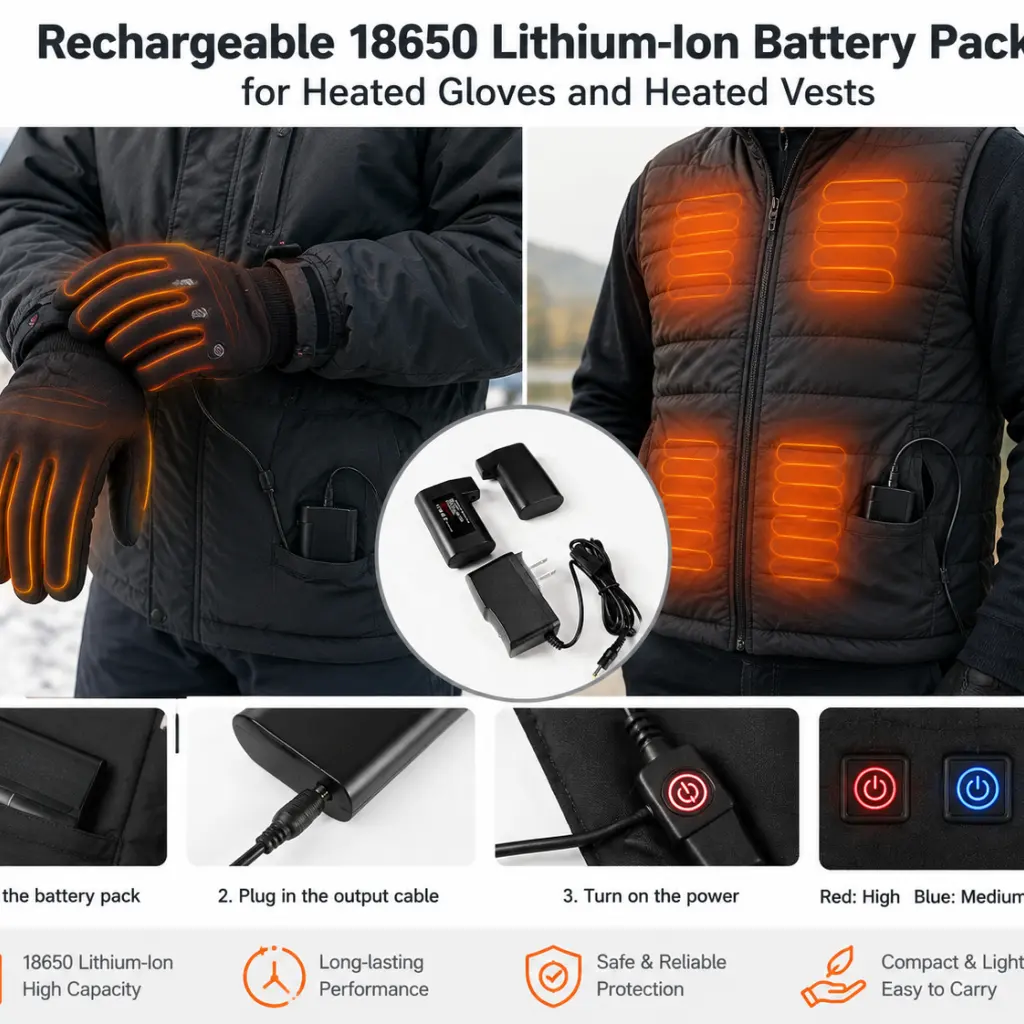
Cold weather can quickly make outdoor work, winter sports, commuting, and everyday activities uncomfortable. Heated gloves and heated vests solve this problem by delivering controlled warmth directly to the hands and upper body. However, the performance of heated apparel depends heavily on its power source. A rechargeable 18650 lithium-ion battery pack provides a practical combination of energy capacity, compact size, stable output, and reusability for modern heated clothing applications.
Designed for heated gloves, heated vests, heated jackets, and other wearable heating products, an 18650 battery pack can supply dependable power while remaining small enough to fit inside a garment pocket. With the correct voltage, capacity, connector, protection circuit, and enclosure design, it can support comfortable and consistent heating during winter activities.
Why Use 18650 Lithium-Ion Cells for Heated Apparel?
The 18650 is a cylindrical rechargeable lithium-ion cell widely used in portable electronic equipment. Its name refers to its approximate dimensions: 18 mm in diameter and 65 mm in length. These cells are popular because they offer a strong balance between energy density, discharge performance, service life, availability, and cost.
For heated gloves and heated vests, these characteristics are especially useful. Heating elements require continuous electrical power rather than short bursts of energy. A properly designed 18650 lithium-ion battery pack can provide a stable supply throughout the operating period, helping the garment maintain a more consistent temperature.
Compared with disposable batteries, rechargeable packs reduce ongoing replacement costs and waste. Users can recharge the battery after skiing, hiking, working outdoors, or commuting and use it again the following day.
Compact Power for Heated Gloves
Heated gloves require batteries that are compact, lightweight, and comfortable to wear. The pack is usually placed inside a small zippered pocket near the wrist or cuff. A battery that is too large or heavy may restrict movement and reduce comfort.
A compact rechargeable 18650 battery pack can be shaped and enclosed to match the glove design. Depending on the required voltage and runtime, the battery may use one or more cells arranged in a suitable series and parallel configuration.
Important design considerations for heated gloves include:
- Small enclosure dimensions
- Low overall weight
- Secure cable connection
- Flexible output lead
- Stable power delivery
- Protection against overcharging and short circuits
- A housing that can tolerate regular handling
The battery connector should also be selected carefully. A reliable connection helps prevent accidental disconnection when the user bends the wrist, adjusts the glove, or participates in active outdoor sports.
Reliable Energy for Heated Vests
Heated vests usually contain several heating zones positioned around the chest, back, waist, or abdomen. Because the heating area is larger than that of gloves, the vest may require greater power and a higher-capacity battery.
A rechargeable 18650 lithium-ion battery pack can be configured to provide the required voltage and operating time. The pack is commonly stored in an interior pocket, where it remains protected and does not interfere with normal movement.
For heated vests, the battery system should be designed around the garment’s actual power consumption. A vest with several heating zones or multiple temperature settings may use energy faster than a simple single-zone product. Battery capacity should therefore be selected according to the heating element resistance, output power, desired runtime, and available installation space.
A well-matched battery supports steady operation without making the garment unnecessarily bulky.
Multiple Heating Levels and Power Management
Many heated gloves and vests offer high, medium, and low temperature settings. These settings allow the wearer to adjust warmth according to the weather and activity level.
The highest setting usually consumes the most energy and produces the shortest runtime. Medium and low settings reduce power consumption and can extend the useful operating period. For example, a user may select high heat when first going outdoors and switch to a lower level after the garment becomes warm.
Battery performance should be evaluated across all heating modes. The power system must remain stable when the controller changes output levels, and the protection circuit should be appropriate for the maximum operating current.
Good power management improves comfort, energy efficiency, and overall user experience.
Battery Protection and Safe Operation
Safety is an essential consideration for any lithium-ion battery used close to the body. A rechargeable battery pack for heated apparel should include a suitable protection circuit designed for the selected cell configuration.
Depending on the battery design, protection functions may include:
- Overcharge protection
- Over-discharge protection
- Overcurrent protection
- Short-circuit protection
- Cell balancing for multi-cell packs
- Temperature monitoring
Reliable cells, correct insulation, secure welding, appropriate wire selection, and a durable enclosure are also important. The pack should be tested under realistic charging, discharging, vibration, temperature, and connection conditions before mass production.
Users should charge the battery only with a compatible charger and avoid using damaged cables, swollen packs, or unapproved replacement adapters. The battery should also be removed from the garment before washing unless the clothing manufacturer provides different instructions.
Choosing the Right Battery Capacity
Battery capacity affects runtime, size, weight, and cost. A larger-capacity pack can usually support longer heating periods, but it may also require more space inside the garment.
The correct capacity depends on several factors:
- Rated voltage of the heating system
- Power consumption of each heating zone
- Number of heating elements
- Temperature setting
- Expected outdoor temperature
- Required operating time
- Available battery pocket dimensions
Rather than choosing the largest possible battery, manufacturers should select a balanced solution that meets the actual application requirements. Sample testing with the final heating garment is one of the best ways to confirm performance.
Applications Beyond Gloves and Vests
Rechargeable 18650 battery packs can support many heated wearable products, including:
- Heated jackets
- Heated socks
- Heated trousers
- Heated insoles
- Heated scarves
- Heated waist belts
- Motorcycle heating gear
- Outdoor work clothing
These products are used by skiers, hikers, cyclists, motorcyclists, construction workers, warehouse employees, delivery personnel, hunters, and people who spend long periods in cold environments.
The battery design can be adjusted for different garment structures, heating powers, connectors, and runtime expectations.
Custom Battery Pack Options for Heated Clothing Brands
Heated apparel manufacturers often require more than a standard battery. Customization may include cell configuration, capacity, voltage, housing dimensions, cable length, connector type, charger specification, label design, and packaging.
An experienced battery manufacturer can work with the clothing designer to evaluate the heating element, control board, maximum current, available installation space, and target market. Prototype packs can then be produced for functional testing before full-scale manufacturing.
Certification and transportation requirements should also be considered early in the project. Depending on the destination and sales channel, the battery may need relevant safety, environmental, and transport documentation.
Conclusion
A rechargeable 18650 lithium-ion battery pack is a practical power solution for heated gloves, heated vests, and other winter clothing. It combines reusable energy, compact construction, stable output, and flexible customization for a wide range of wearable heating systems.
The best results come from matching the battery voltage, capacity, discharge capability, connector, protection circuit, and enclosure to the final garment. With careful engineering and thorough testing, an 18650 battery pack can provide dependable warmth for outdoor recreation, professional work, commuting, and everyday cold-weather use.
Talk to the Manufacturer
Resources & Insights
High Capacity Lithium Battery for Wearables: High-Voltage LiPo Cell Design
2026-10-19
Cylindrical Battery Packs for Laptops: 2S vs 3S vs 4S Battery Design
2026-10-19
Stage Lighting Battery Pack: Prevent Voltage Drop & LED Flicker
2026-10-19

Best Rechargeable Batteries for Smart Devices: Performance, Safety, and Selection Guide
2026-10-19


