


 Home /
Custom Shaped Battery Manufacturer: From Device Design to OEM Production


Table of Contents
- What Does a Custom Shaped Battery Manufacturer Do?
- When Should You Consider a Custom Shaped Battery?
- Common Custom Battery Shapes and Their Design Purpose
- What to Look for in a Custom Shaped Battery Manufacturer
- What Can Be Customized Beyond the Battery Shape?
- How to Prepare a Custom Battery RFQ
- Understanding MOQ, Tooling, and Development Cost
- A Suggested Development Process for OEM Buyers
- Discuss Your Custom Battery Project With Gloflux
-
Frequently Asked Questions
- What is a custom shaped battery?
- Can a battery be manufactured in any shape?
- Do I need a new cell for every custom battery project?
- Does a custom shape always increase capacity?
- Are custom shaped LiPo batteries flexible?
- What documentation should I request?
- Can Gloflux evaluate an irregular battery design?
- Request a Custom Battery Assessment
Choosing a custom shaped battery manufacturer starts with understanding the space and power requirements of your product.
A compact device may need a narrow battery beside its circuit board, a curved profile that follows its housing, or an irregular layout around internal components. In each case, the manufacturer must evaluate more than the battery’s outline. Capacity, current demand, charging, protection, assembly, and production requirements all influence the final solution.
This guide explains the available customization approaches, what to expect from a supplier, and how to prepare your project for a productive engineering discussion.
What Does a Custom Shaped Battery Manufacturer Do?
A custom shaped battery manufacturer evaluates how a battery can fit a product while meeting its electrical and mechanical requirements.
The scope may involve developing a new cell geometry, adapting the dimensions of an existing battery platform, or arranging cells and supporting components into a custom pack.
These approaches involve different development work. Before requesting quotations, identify which type of customization your device needs.
| Customization approach | What changes | Main question to resolve |
|---|---|---|
| Custom cell dimensions | Cell length, width, or thickness | Can an existing platform meet the available space? |
| Special-shaped cell | The cell’s outline or curvature | Is the proposed geometry practical to manufacture? |
| Custom battery pack | Cell arrangement, electronics, wiring, and enclosure | Can the complete assembly meet the installation requirements? |
| Assembly modification | Connectors, wires, insulation, or protection components | Can a standard cell satisfy the project with limited changes? |
Gloflux’s published services include custom LiPo dimensions and complete battery pack development, with options for protection electronics, wiring, connectors, and enclosures. Specific irregular cell geometries require an engineering assessment. Explore Gloflux’s custom battery services.
When Should You Consider a Custom Shaped Battery?
A Standard Battery Leaves Usable Space Empty
A rectangular battery may fit into a device but leave substantial space around a board, sensor, or mounting feature.
A shaped design can be worth investigating when that unused space could contribute to the product’s runtime target. Compare the finished battery assemblies within the same enclosure boundaries before deciding.
The Product Has a Fixed Mechanical Layout
Some projects have limited freedom to move the display, circuit board, connectors, or structural components.
In that situation, battery development begins with the remaining installation space. Provide the actual enclosure drawing rather than requesting a shape without showing its surroundings.
Runtime Requirements Exceed the Available Standard Options
If existing cells cannot meet the required runtime within the installation limits, ask the supplier to evaluate alternatives.
These might include a different cell size, a shaped cell, another pack arrangement, or adjustments to the device’s power consumption. Custom geometry is one option in that review.
The Complete Assembly Needs Customization
A project may need a specific connector position, protection circuit, wire route, or mounting arrangement even when the cell itself is standard.
Define the finished battery assembly early. This avoids developing a new cell when a simpler assembly change could solve the problem.
Common Custom Battery Shapes and Their Design Purpose
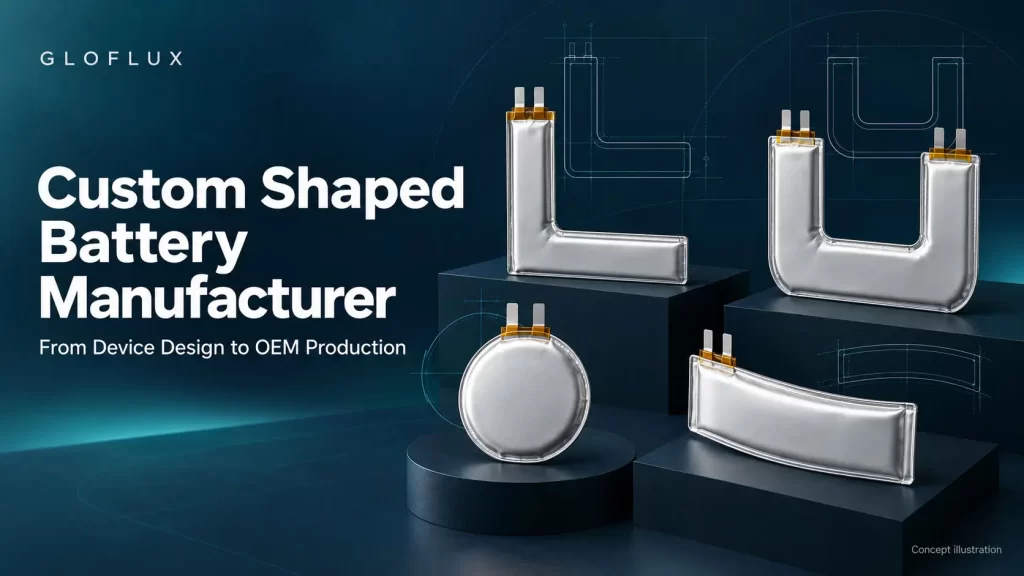
Special-shaped pouch batteries are commercially offered in formats including round, curved, L-shaped, U-shaped, and other irregular outlines. Availability and achievable specifications vary by manufacturer. Special-shaped battery formats.
| Shape or format | Layout to evaluate |
|---|---|
| Narrow rectangular | A long, restricted compartment beside other components |
| Round | A circular battery compartment |
| Curved | A housing with a defined curved profile |
| L-shaped | Available space around a corner obstruction |
| U-shaped | Space on both sides of a central component, connected across a base |
| Other irregular shapes | An enclosure that cannot be described by a standard footprint |
Treat these categories as starting points. A drawing is more useful than a shape name because it defines the actual dimensions, restricted areas, and connection locations.
Also distinguish a manufactured curved profile from a battery designed to flex during use. Movement or repeated bending is a separate requirement that needs explicit validation.
What to Look for in a Custom Shaped Battery Manufacturer
1. A Clear Feasibility Review
A useful supplier response should explain whether the requested outline, capacity, and current requirements can be achieved together.
Ask the manufacturer to identify:
- Which requirements are confirmed.
- Which require prototype testing.
- Which dimensions or specifications need adjustment.
- Whether existing tooling or cells are available.
- What development work is included in the quotation.
This makes the proposal easier to assess than a general statement that customization is available.
2. Defined Cell and Pack Responsibilities
Confirm whether the supplier manufactures the cell, assembles the pack, sources the cell from another manufacturer, or combines these activities.
Ask who controls the approved cell specification and how substitutions are handled. This matters when comparing a cell-only offer with a complete battery assembly.
3. Complete Mechanical Documentation
Request a drawing of the finished assembly, including seals, tabs, protection components, insulation, wires, and connectors.
For pouch cells, obtain the manufacturer’s requirements for support, mounting, and dimensional allowance. Designing the enclosure around nominal cell dimensions alone can overlook installation needs. Jauch lithium polymer battery technical guide.
4. Model-Specific Performance Information
Compare the proposed battery rather than broad claims about a supplier’s product range.
Request the conditions behind capacity, discharge current, charging, temperature, and cycle-life specifications. A manufacturer’s thinnest cell and highest-current cell may be different products.
Your quotation should identify which performance figures apply to the exact design being offered.
5. A Practical Sample Validation Plan
Agree on sample acceptance criteria before ordering prototypes.
Useful questions include:
- Does the complete battery fit the intended compartment?
- Can it be installed without stressing wires or connections?
- Does the product achieve the required runtime?
- Does it operate through expected peak loads?
- Does charging work as specified?
- What changes are needed before production approval?
Use the actual device wherever possible, alongside the supplier’s battery-level testing.
6. Production Traceability and Change Control
Ask how the manufacturer links production units to the approved design and inspection records.
Discuss how changes to cells, electronics, connectors, materials, or manufacturing processes will be communicated. Agree on which changes require customer approval or additional validation.
These details help preserve the design you approved through repeat orders.
What Can Be Customized Beyond the Battery Shape?
The outline is only part of the specification.
A complete custom battery project may also require decisions about voltage, capacity, discharge current, protection functions, temperature sensing, wiring, connectors, and packaging.
Gloflux lists these areas within its custom battery offering, including optional communication interfaces for suitable battery systems. Availability depends on the proposed configuration. Gloflux battery customization options.
For your RFQ, divide requirements into two groups:
Fixed requirements: Features the battery must satisfy, such as the maximum installation envelope or device operating voltage.
Negotiable requirements: Preferences that can change if the manufacturer proposes a practical improvement, such as connector location or a small enclosure adjustment.
This distinction helps the engineering team explore alternatives without losing sight of the product’s essential needs.
How to Prepare a Custom Battery RFQ
A detailed RFQ reduces repeated clarification and makes supplier proposals more comparable.
| Requirement | Information to provide |
|---|---|
| Application | Product type, intended use, and operating pattern |
| Mechanical space | Dimensioned drawing or CAD model |
| Restricted areas | Boards, sensors, fasteners, moving parts, and cable routes |
| Battery architecture | Single cell, multi-cell pack, or open to recommendations |
| Voltage | Device operating range and charging architecture |
| Runtime | Target runtime and representative usage cycle |
| Capacity | Minimum capacity, if already established |
| Current | Average load, continuous maximum, and peak duration |
| Environment | Operating and storage conditions |
| Connections | Connector, pinout, wire length, and exit direction |
| Protection | Required protection and monitoring functions |
| Documentation | Target markets and requested supporting reports |
| Quantity | Prototype, pilot, and annual production forecast |
| Schedule | Sample and production milestones |
If the battery shape is still undecided, provide the available space rather than choosing a geometry prematurely.
Understanding MOQ, Tooling, and Development Cost
There is no universal MOQ for custom shaped batteries.
A project using an existing cell with modified wiring has a different cost structure from a newly developed irregular cell. Gloflux’s guidance identifies established cells, standard components, and limited tooling as factors that can make smaller initial orders more practical. Gloflux low-MOQ battery project guidance.
Ask the supplier to separate:
- Engineering and design charges.
- Tooling costs and ownership.
- Prototype quantities and pricing.
- Sample revision costs.
- Testing and documentation.
- Production pricing at different volumes.
- Sample and repeat-order lead times.
Compare the total development and supply proposal, not only the unit price.
A Suggested Development Process for OEM Buyers
A staged process gives both teams clear approval points.
Step 1: Define the Requirements
Share the enclosure drawing, electrical load, runtime target, expected quantity, and launch schedule.
Step 2: Compare Feasible Approaches
Ask for an existing-cell option where practical, alongside any shaped-cell or custom-pack proposal.
Step 3: Approve the Proposed Design
Review the assembly drawing and specification. Record unresolved items and the tests needed to close them.
Step 4: Evaluate Prototypes
Check fit and performance in the intended product. Document issues and agree on revisions.
Step 5: Release the Production Specification
Finalize the drawing, electrical limits, components, labeling, supporting documentation, and acceptance criteria.
Step 6: Validate Production Readiness
Use the agreed pilot or initial production stage to confirm assembly consistency before increasing order volume.
Request a schedule for your project rather than assuming that a standard sample lead time applies to a newly developed cell.
Discuss Your Custom Battery Project With Gloflux
Gloflux’s published customization process covers requirements assessment, cell sourcing, engineering design, prototype testing, mass production, and after-sales service. Gloflux custom battery development.
The company lists application areas including smart wearables, medical devices, Bluetooth audio, beauty devices, smart home products, and portable lighting. These application categories provide context for an initial discussion; each design still requires project-specific review. Explore Gloflux battery applications.
For a custom shaped battery requirement, begin with a drawing-based assessment. Confirm the proposed geometry, achievable specifications, development work, and production terms before committing to a design.
Frequently Asked Questions
What is a custom shaped battery?
It is a battery designed with dimensions or geometry suited to a particular product. The customization may involve the cell itself or the arrangement of components in a complete battery pack.
Can a battery be manufactured in any shape?
A proposed shape needs an engineering review. Geometry, capacity, current requirements, materials, and production methods all affect feasibility. Submit a drawing and allow the supplier to identify any necessary changes.
Do I need a new cell for every custom battery project?
No. An existing cell with customized wiring, protection, or packaging may meet the requirements. Ask the manufacturer to evaluate that route before commissioning a new cell.
Does a custom shape always increase capacity?
No. It may allow better use of an irregular compartment, but the resulting capacity depends on the proposed design. Compare usable energy within the same installation space and validate runtime in the device.
Are custom shaped LiPo batteries flexible?
A custom outline or soft pouch does not mean the battery is suitable for repeated bending. If flexibility is required, specify the movement and operating conditions separately and request validation.
What documentation should I request?
Request the proposed model’s datasheet, assembly drawing, relevant test reports, and supporting transport or compliance documentation appropriate to the project. Confirm that model numbers and revisions match the battery being supplied.
Can Gloflux evaluate an irregular battery design?
Gloflux provides custom LiPo and battery pack engineering services. Submit the enclosure drawing, electrical requirements, and expected quantity for review. Specific shapes and production terms require confirmation.
Request a Custom Battery Assessment
Finding the right custom shaped battery manufacturer begins with a clear project specification.
Send Gloflux your available installation space, voltage range, runtime target, load profile, and expected order quantity. These details provide the basis for comparing feasible battery options and planning the next development step.
Talk to the Manufacturer
Resources & Insights
High Capacity Lithium Battery for Wearables: High-Voltage LiPo Cell Design
2026-10-19
Cylindrical Battery Packs for Laptops: 2S vs 3S vs 4S Battery Design
2026-10-19
Stage Lighting Battery Pack: Prevent Voltage Drop & LED Flicker
2026-10-19

Best Rechargeable Batteries for Smart Devices: Performance, Safety, and Selection Guide
2026-10-19


