


 Home /
Custom Lithium Battery for Robotics: 18650 vs 21700 Cell Selection


Table of Contents
- 1. 18650 vs 21700: Cell-Level Differences
- 2. Series-Parallel Configuration: Capacity Is Only Half the Calculation
- 3. Discharge Performance: Managing Robotic Motor Peak Loads
- 4. Thermal Management and Cycle-Life Constraints
- 5. Matching Battery Formats to Robotics Applications
- 6. Focus and Combination in Battery Pack Manufacturing at GLOFLUX
- 7. Verification and OEM Purchasing Criteria
A Custom Lithium Battery for Robotics has to be able to provide enough energy to power the device for the required operating time and enough discharge capability for motor loads to quickly change. Using 21700 cells to get a higher nominal capacity causes issues with current-sharing and packaging that 18650 cells would not cause.
At GLOFLUX, we look at cell-level considerations when designing battery packs, considering usable energy, resistance, series-parallel configuration, mechanical integration, and manufacturing before finalizing the design.
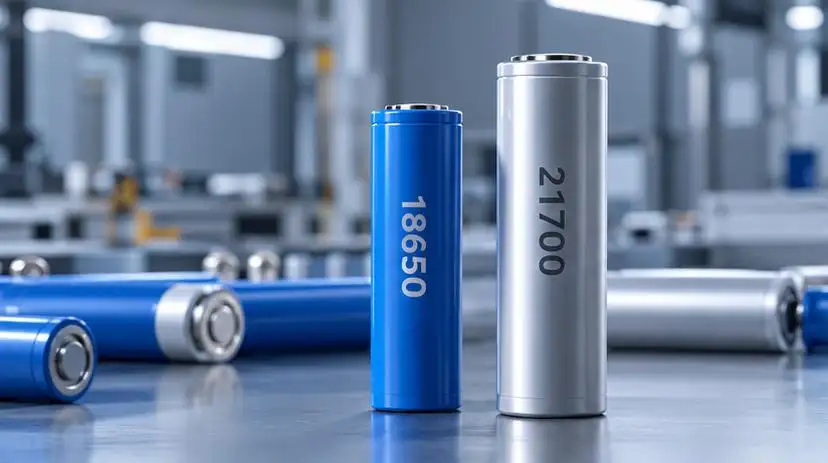
1. 18650 vs 21700: Cell-Level Differences
The difference between the two cells is mainly their shape. Both 18650 and 21700 cells share the same electrical and chemical characteristics.
| Technical Parameter | 18650 | 21700 |
| Nominal dimensions | 18 × 65 mm | 21 × 70 mm |
| Individual capacity | Model-dependent | Often higher per cell |
| Energy density | Depends on chemistry and design | Depends on chemistry and design |
| Discharge current | Energy/power variants | Energy/power variants |
| Pack integration | Flexible in narrow compartments | Potentially fewer cells |
| Thermal behavior | Resistance and cooling-dependent | Resistance and cooling-dependent |
Cell Energy Density vs Pack Energy Density
Two parameters determine whether a cell format benefits robotic equipment:
• Gravimetric energy density (Wh/kg): Affects battery mass, robot payload, and moving inertia.
• Volumetric energy density (Wh/L): Determines how much usable energy fits inside the battery compartment.
A smaller cell (e.g. 21700) takes up less space as fewer cells are required. A larger cell, however, might yield more space in a compact enclosure.
Energy density of a pack is a factor of not only the cell (i.e. the primary storage element), but also the cell holder, insulation, busbars, BMS circuitry and walls of the enclosure.
2. Series-Parallel Configuration: Capacity Is Only Half the Calculation
For a Custom Lithium Battery for Robotics, series connections provide a higher voltage, while parallel connections give higher capacity and split the load current.
The basic relationships are:
• Pack voltage: Vpack = Ns × Vcell
• Pack capacity: Cpack = Np × Ccell
• Nominal energy: E = Vpack × Cpack
• Approximate runtime: t = Usable Wh / Average Load W
Engineering Comparison: 18650 vs 21700 Packs
Consider two hypothetical configurations using 3.6V nominal cells.
| Specification | 18650 Design | 21700 Design |
| Cell capacity | 3,000mAh | 4,500mAh |
| Configuration | 4S3P | 4S2P |
| Cell count | 12 | 8 |
| Nominal voltage | 14.4V | 14.4V |
| Pack capacity | 9Ah | 9Ah |
| Nominal energy | 129.6Wh | 129.6Wh |
| Current per cell at 18A pack load | 6A | 9A |
Illustrative engineering values, not tested GLOFLUX product specifications.
Although both packs provide identical nominal energy, the 21700 arrangement places 50% more current through each parallel cell at the same 18A pack load.
This impacts cell temperature, voltage sag, and discharge capability. Engineers need to verify each selected cell supports the required current over the cell's operating temperature and SOC (state of charge) range.

3. Discharge Performance: Managing Robotic Motor Peak Loads
While robotic motors can operate at a somewhat-constant current, factors such as uneven terrain, and acceleration can introduce transient loads.
Internal Resistance and Voltage Sag
V voltage drop can be approximated by
ΔV = I × R
The effective resistance can be made up by cells, interconnections, protection devices, and wiring.
Excessive voltage sag can cause undervoltage protection on the motor driver, even when the battery has a high SOC.
For a Custom Lithium Battery for Robotics, we suggest evaluating:
• Continuous discharge current: The current the battery can supply continuously over the specified temperature and SOC.
• Pulse-current capability: Max current the battery can provide for a given time.
• DC internal resistance: Measured at a defined SOC and temperature.
• Minimum operating voltage: Tested under worst-case conditions.
• BMS overcurrent threshold: Coordinated with acceleration and stall protection.
Cell datasheets' current ratings should always be considered in the context of the complete pack's thermal and electrical limits.
4. Thermal Management and Cycle-Life Constraints
Battery heating occurs according to the relationship:
Pheat = I^2R
Therefore, doubling the current through the same resistance produces approximately four times the resistive heat.
Thermal Design Considerations
For enclosed robotic systems, critical factors include:
• Thermal gradients between cells
• Positioning of the NTC sensors in relation to thermal hot spots
• BMS charge/discharge thermal protection
• Heating and resistance losses in busbars
• Charging and SOC operating window
• Cycle aging and life
Thermal performance of a cell depends on current load, cell spacing, and design. A bigger cell doesn't always result in better thermal performance.
Battery lifetime should be considered at the same temperature and with the same charging and depth-of-discharge as compared cells.
5. Matching Battery Formats to Robotics Applications
Cell selection should be based on mechanical constraints and duty cycles rather than robot category alone.
| Application | Engineering Priority | Selection Consideration |
| Compact service robots | Space and weight | 18650 layout flexibility |
| AGV/AMR platforms | Runtime and peak power | 21700 capacity and current capability |
| Inspection robots | Continuous operation | Heat dissipation and enclosure geometry |
| Humanoid robots | Mass distribution | Energy-to-weight ratio and peak load |
| Industrial robotic systems | Service life | Replaceability and maintenance cost |
For mobile robots, the final comparison should include usable Wh, pack mass, installation volume, current capability, cooling requirements, and lifecycle cost.
6. Focus and Combination in Battery Pack Manufacturing at GLOFLUX
There are requirements for exact features in cells and mechanical assembly precision in custom Lithium battery manufacturing.
At GLOFLUX, we offer OEM/ODM services for selection of cylindrical cells, design of battery pack architecture and BMS, enclosure integration, and mechanical assembly. We also offer prototyping and production services.
Dimensional Accuracy and Assembly Control
Our published 14.4V smart battery specifications provide a documented example of dimensional control:
| Finished Battery Dimension | Specification |
| Length | 150.5 ± 0.3 mm |
| Width | 77.4 ± 0.3 mm |
| Thickness | 22.7 ± 0.3 mm |
| Weight | 445 ± 10 g |
These tolerances apply to that specific smart battery, not universally to all GLOFLUX robotics battery packs.
For robot applications, engineering drawings should separately define enclosure dimensions, mounting positions, connector alignment, insulation clearances, and allowable assembly variation.
Cell Matching and Quality Verification
We have over 60 inspection checkpoints in our quality system, beginning with incoming materials and concluding with finished goods inspection.
When considering the control of production, key factors include the following:
- Maintaining consistency of Cell capacity, Ohm's law balance, and Internal resistance.
- Weld integrity and interconnection resistance.
- Insulation, polarity of connectors, and wiring.
- Aging and protection functions of the BMS.
Where applicable to the design, we can configure BMS to incorporate protection and communication functions such as CAN, SMBus and I2C.
7. Verification and OEM Purchasing Criteria
Measurable acceptance criteria should be established by engineering teams prior to approving a Custom Lithium Battery for Robotics.
| Validation Area | Required Verification |
| Electrical | Capacity, voltage sag, continuous/pulse discharge |
| Thermal | Peak temperature and cell temperature spread |
| Mechanical | Vibration, shock, mounting integrity |
| BMS | Current limits, balancing, fault response |
| Compliance | Applicable UN38.3 and product safety requirements |
| Manufacturing | Dimensional inspection and batch traceability |
For industrial applications, IEC 62619 applicability should also be reviewed against the final battery system.
An OEM specification should include rated voltage, duty cycle, peak-current duration, compartment drawings, charging method, environmental conditions, communication interfaces, annual demand, and maintenance expectations.
Engineering Your Robotics Battery with GLOFLUX
When comparing 18650 and 21700 cells, it is important to validate the whole battery system and not just nominal cell capacity.
At GLOFLUX, we provide cell selection, BMS integration, and battery pack design and validation for robotics manufacturers. If you provide your electrical and installation drawings, our engineering team will evaluate battery configurations for your robot.
FAQs
Q1. Does GLOFLUX offer both 18650 and 21700 robot battery packs?
Yes. GLOFLUX offers customized 18650 and 21700 lithium-ion battery packs for AGVs, AMRs, service robots, and industrial robotic systems.
Q2. How does GLOFLUX select between 18650 and 21700 cells?
We evaluate required capacity, discharge current, energy density, installation space, thermal conditions, and pack configuration before selecting suitable cells.
Q3. Can GLOFLUX customize robot battery voltage and capacity?
Yes. We customize voltage, capacity, and series-parallel configurations according to the robot's electrical requirements and available installation space.
Q4. Can GLOFLUX design battery packs for high-current robotic motors?
Yes. We support high-discharge battery designs based on continuous current, peak-load duration, cell specifications, and BMS protection requirements.
Q5. What BMS protection functions does GLOFLUX provide?
Our customizable BMS solutions support overcharge, over-discharge, overcurrent, and short-circuit protection, with temperature monitoring where required.
Talk to the Manufacturer
Resources & Insights
High Capacity Lithium Battery for Wearables: High-Voltage LiPo Cell Design
2026-10-19
Cylindrical Battery Packs for Laptops: 2S vs 3S vs 4S Battery Design
2026-10-19
Stage Lighting Battery Pack: Prevent Voltage Drop & LED Flicker
2026-10-19
Best Rechargeable Batteries for Smart Devices: Performance, Safety, and Selection Guide
2026-10-19


