


 Home /
China Medical Battery OEM Factories Compared: Reliability Guide 2026


Table of Contents
- What Makes a Lithium Battery OEM Factory Reliable for Medical Device Packs?
- Key Certifications to Require from Any Medical Battery OEM Factory
- Design Control and Documentation: The Hidden Reliability Gap Between General and Medical OEM Factories
- Lot Traceability and Production Control: Why These Matter More Than Price Per Unit
- Evaluating Chemistry and Pack Design Fit for Medical Applications
- How to Compare Chinese OEM Battery Factories on Medical Reliability: A Decision Criteria Framework
- Common Pitfalls When Sourcing Medical Device Battery Packs from OEM Factories
- Use-Case Fit: Which Types of Medical Devices Are Best Matched to Chinese OEM Battery Factories?
- Frequently Asked Questions: Medical Device Battery OEM Factory Reliability
Sourcing a lithium battery pack for a medical device is a fundamentally different procurement exercise than buying batteries for an e-bike or a consumer gadget. The underlying electrochemistry may overlap, but the quality infrastructure, documentation requirements, and regulatory obligations that separate an acceptable medical supplier from an unacceptable one are distinct enough that standard OEM evaluation checklists simply don't apply. This guide walks through the criteria that actually predict reliability in a medical battery OEM relationship, certifications, design control maturity, traceability infrastructure, chemistry fit, and post-market capability, so procurement engineers and regulatory teams can make a defensible, auditable supplier selection.
What Makes a Lithium Battery OEM Factory Reliable for Medical Device Packs?
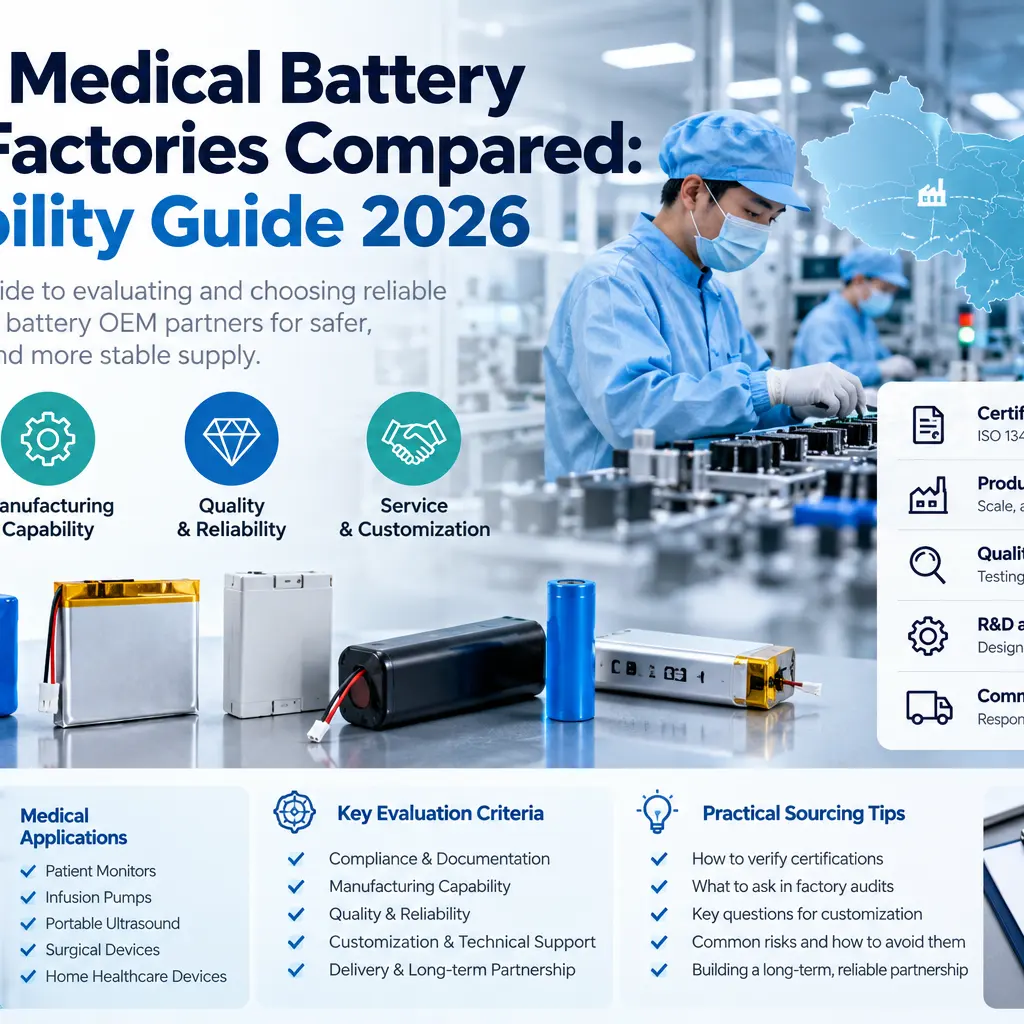
Reliability for a medical device battery OEM is defined by a specific cluster of criteria: quality system maturity, certification scope, traceability infrastructure, and post-market support. Factory size, daily output, and total SKU count are essentially irrelevant unless these foundations are in place.
This is where general-purpose battery OEM evaluation breaks down. A factory quoting a daily capacity of hundreds of thousands of cells, an extensive product catalogue, and a competitive per-unit price is describing its commercial scale, none of which tells you whether that factory can produce audit-ready lot records, respond to a field complaint with documented root cause analysis, or maintain process discipline across a multi-year supply relationship without silently substituting components.
For medical applications, the reliability pillars are:
- ISO 13485, the medical device quality management standard; its presence signals that the factory operates under documented procedures, change control, and corrective action processes designed specifically for regulated device industries, not adapted from consumer electronics practice.
- IEC 62133, electrochemical safety certification for portable sealed cells and packs; this covers the product-level test requirements that regulators and device OEMs look for.
- UN38.3, transport safety certification; required for international shipping of lithium batteries and a practical baseline any credible supplier should hold.
- Design history file (DHF) support, the factory's ability to generate and maintain structured design records that a device OEM can include in its regulatory submission.
- Lot-level traceability, cell sourcing, BMS components, formation data, and outgoing QC tied to specific production batches, retrievable on demand.
One distinction that often gets missed early in supplier selection: there is a meaningful difference between a cell manufacturer and a pack-level OEM assembler with medical-grade process controls. Companies like Panasonic and Samsung SDI produce cells used widely in medical applications, Panasonic's primary lithium cells serve AEDs, bio-monitors, ventilators, and infusion pumps; Samsung SDI supplies customizable cylindrical, prismatic, and pouch cells to medical device OEMs alongside other industries. But access to quality cells is not the same as having a pack assembly operation governed by medical-grade process controls. Medical device brands need pack assemblers who can document every step of the build process, freeze a design between orders, and support a regulatory audit, not just source from a reputable cell supplier.
'Reliable' in a medical context also means the factory can support regulatory submissions, respond to post-market field events, and produce audit-ready documentation on a timeline measured in days, not weeks.
Key Certifications to Require from Any Medical Battery OEM Factory
The minimum certification baseline for a credible medical device battery OEM is ISO 13485, IEC 62133, and UN38.3. FDA registration and CE marking are additional gates depending on where the finished device will be sold.
Each certification signals something specific about factory process maturity:
ISO 13485 is the most important quality system credential. It requires documented procedures for design control, production, corrective and preventive action (CAPA), and management review, the operational backbone of a medical supply chain. A factory holding ISO 9001 but not ISO 13485 has a general quality system that was not designed for the regulatory traceability requirements of medical devices.
IEC 62133 covers electrochemical safety testing for portable sealed lithium cells and packs. It tests for overcharge, forced discharge, short circuit, mechanical abuse, and thermal abuse, the failure modes that regulators and device OEMs care about most. This is a product-level certification, not a factory-level one, which means you need to verify it applies to the specific pack design you're sourcing, not a different product the factory happens to make.
UN38.3 governs the transport of lithium batteries and is required for international air and sea freight. Its absence is a practical supply chain problem as well as a compliance gap.
UL certification matters for the North American market; CE marking is required for European market access.
FDA registration is where many Chinese factories fall short in ways that create downstream regulatory risk. For Class I and II medical devices, the battery pack supplier may need to be identified in the device manufacturer's quality system and evaluated during FDA inspections. Factories without any familiarity with FDA 21 CFR Part 820 requirements, or without records structured to support that kind of audit, create gaps the device OEM cannot easily remediate. Inventus Power, for example, explicitly holds FDA-registered manufacturing and has 30+ years of focused medical device battery experience, which illustrates the standard a factory needs to meet for regulated US-market devices.
A practical distinction worth emphasizing: a factory that holds certifications is not the same as a factory that can assist clients in achieving certifications for their finished device. The latter is considerably more valuable in an OEM relationship. A pack supplier that can provide test reports, BMS specifications, and design records in a format usable for IEC 62133 client submissions, or that has navigated the UN38.3 process enough times to guide a new OEM customer through it, compresses timelines and reduces the device manufacturer's regulatory preparation burden. Gloflux, for instance, supports clients in pursuing IEC 62133, UN38.3, UL, and CE certification work as part of its OEM service scope, a concrete differentiator that buyers should verify against current project scope during qualification.
Documents to request during supplier qualification:
- Current ISO 13485 certificate (issuing body, certificate number, scope, expiry date)
- IEC 62133 test report for the specific cell or pack chemistry you're using
- UN38.3 test summary
- Any UL or CE certificates applicable to your target market
- A list of certification bodies used, independently verifiable through their public registries
A factory that cannot produce these documents promptly, or that supplies certificates with expired dates or scopes that don't match your product type, should be disqualified regardless of price.
Design Control and Documentation: The Hidden Reliability Gap Between General and Medical OEM Factories
Most general-purpose Chinese battery OEM factories lack formal design control processes, and this is the gap that separates factories that can produce a medical-grade battery pack from those that can sustain one through a regulated product lifecycle.
Design control, in practical terms, means the factory operates structured, documented engineering workflows: design inputs are formally captured, design outputs are verified against them, design verification and validation (V&V) protocols are executed before any design enters production, and every engineering change follows a documented change control procedure with approval authority and implementation verification. These requirements are codified in FDA 21 CFR Part 820 and ISO 13485, and their absence is not a paperwork inconvenience. It's a regulatory liability.
Here's why it matters operationally: if a factory swaps a BMS component between your second and third production orders, to manage cost or address a supply shortage, and does not document that change, notify you, and run a re-qualification protocol, you have an unvalidated design change in a regulated device supply chain. Depending on the device class, this may constitute a design change requiring regulatory reporting. The device OEM carries that liability even though the factory made the decision unilaterally.
A factory with genuine design control capability looks operationally different from one that does not. You'll find dedicated quality engineers who own the documentation processes (not just production engineers who also file paperwork), a formal engineering change order (ECO) system with records tied to specific part numbers and revision levels, sample qualification runs before any design modification enters full production, and archived design records, design history files. That are organized and retrievable within a reasonable timeframe rather than reconstructed from memory.
Consumer electronics OEM environments often operate with informal engineering adjustments: a BMS firmware update here, a cell vendor substitution there, all handled efficiently but without the structured change notification and re-validation cycle that medical sourcing requires. A factory accustomed exclusively to e-bike packs or consumer electronics runs may have an excellent production operation that simply was not built for this kind of discipline.
The most direct way to assess this during supplier evaluation: ask for a sample design history file from a previous medical or regulated-device project. A factory that can produce a real, structured DHF, showing design inputs, test protocols, V&V outcomes, and change history, demonstrates it understands the requirement. A factory that responds with confusion, a general product data sheet, or a promise to create one for your project is telling you it doesn't have this infrastructure yet.
Lot Traceability and Production Control: Why These Matter More Than Price Per Unit
Lot-level traceability is not a nice-to-have in medical battery OEM sourcing. It's a non-negotiable requirement, and its absence is a disqualifying reliability failure regardless of what else the factory gets right.
What robust traceability actually looks like in a pack manufacturing operation: every cell used in a production batch is tied to an incoming inspection record, including the cell manufacturer's lot data; BMS components are sourced and documented at the batch level; formation and aging cycle data are recorded per lot, not just per product type; and outgoing QC results, capacity, internal resistance, self-discharge measurements, are tied to specific serial or lot numbers that ship with the product.
The regulatory logic is straightforward. If a field complaint surfaces six months after a device ships, the device manufacturer must be able to identify which battery lots are involved, isolate affected units, and initiate a targeted recall or CAPA process. Without lot records, a "targeted" recall becomes a blanket recall of every unit that shipped in a time window, exponentially more expensive and more damaging to patient safety than a precise one. Traceability is what converts an adverse event from a crisis into a manageable quality event.
Beyond traceability itself, production control quality matters: incoming material inspection rates and acceptance criteria, in-process electrical testing at formation, capacity grading, and final pack-level safety testing should each be documented and tied to individual shipments. Gloflux's documented 60+ quality inspection procedures indicate the kind of structured QC infrastructure that supports this, though any buyer should verify specifically which of those procedures apply to their product type and request sample batch records to see the documentation format firsthand.
Practical advice for the RFQ and qualification stage: request a sample production batch record and a sample outgoing inspection report before approving the supplier. Review them for completeness, are they reconstructed summaries, or do they show data at the individual unit or batch level? Are they signed off by quality personnel with identified review authority? Then build traceability record retention requirements explicitly into the supply agreement. Standard commercial contracts rarely specify how long production records must be held; medical device supply agreements should require a minimum of seven to ten years, aligned with the device manufacturer's own post-market surveillance obligations.
Suppliers who push back on providing sample records, or who cannot answer clearly what data is retained and for how long, are telling you something important about their operational discipline.
Evaluating Chemistry and Pack Design Fit for Medical Applications
There is no universal chemistry answer for medical device battery packs. The right choice depends on device class, use environment, duty cycle, sterilization exposure risk, and the safety risk profile of the application, and a factory that doesn't ask these questions before recommending a configuration is not yet thinking like a medical OEM supplier.
The main chemistry options for medical device packs each carry distinct trade-offs:
Lithium-ion (NMC/NCA) delivers the highest energy density, making it the default choice for compact, portable diagnostic and patient monitoring devices where weight and runtime both matter. The trade-off is thermal sensitivity. These chemistries require robust BMS design and are less forgiving in high-temperature storage or abuse conditions.
Lithium iron phosphate (LFP) trades some energy density for significantly better thermal stability, longer cycle life, and a flatter discharge curve. For stationary medical equipment, home-use devices like CPAP machines or portable oxygen concentrators, and applications with high charge-discharge cycling demands, LFP is often the better engineering choice. Thermal runaway risk is substantially lower than NMC.
Lithium polymer (LiPo) packs offer form-factor flexibility, thin, custom-shaped cells, suited to wearable or space-constrained medical devices. They require careful handling and stringent BMS protection given the pouch cell construction.
BMS design for medical applications goes beyond the consumer baseline. Over-charge, over-discharge, over-temperature, and short-circuit protection are table stakes. Medical-grade BMS often also requires redundant protection stages (hardware plus firmware, with independent fail-safe paths), communication interfaces such as SMBus or I2C for integration with device firmware, state-of-health reporting, and in some applications, charge cycle logging. A factory that builds BMS for consumer electronics may not have designed redundant protection architectures before, ask directly.
Physical durability considerations that medical environments introduce: exposure to hospital-grade disinfectants (IPA, quaternary ammonium compounds) can degrade certain enclosure materials and labels over time; vibration tolerance matters for transport-dependent devices; and for devices used in procedural environments, even proximity to steam sterilization demands attention to temperature exposure ratings.
The customization scope that a full-service OEM factory should cover includes voltage configuration, capacity, form factor (prismatic, cylindrical, or pouch), connector type and pinout, wire harness routing, and enclosure material and labeling. A factory that handles all of this in-house, without farming out BMS design or enclosure tooling to subcontractors it doesn't directly control, reduces the integration risk and the number of undocumented design variables.
Factories with experience limited to e-bike or vape packs may optimize well for high-current discharge and cost-per-watt-hour, but may not have thought carefully about flat discharge curves (critical for devices where voltage sag affects sensor accuracy), low self-discharge requirements for shelf life in deployed devices, or minimum standby current specifications. These are the design dimensions where medical application experience shows.
How to Compare Chinese OEM Battery Factories on Medical Reliability: A Decision Criteria Framework
Comparing Chinese lithium battery OEM factories for medical device reliability means evaluating them against a structured set of criteria, not headline metrics like output volume, years in business, or per-unit pricing.
A practical decision framework organizes evaluation across these dimensions:
1. Medical-specific certifications held and verifiable. Does the factory hold ISO 13485 (not just ISO 9001)? Does it hold IEC 62133 and UN38.3? For your target markets, does it have UL or CE history? Can it produce current certificates with verifiable certificate numbers? This is the first-pass filter, factories that don't pass it don't proceed to the next stage.
2. Quality management system maturity. ISO 13485 certification is the floor, but dig into how it's implemented. How many documented quality procedures does the factory operate? What is the CAPA process, and can they describe a real CAPA they executed? When was the last third-party surveillance audit, and is the report available?
3. Design control and documentation capability. Can the factory produce a sample design history file? Is there a formal ECO process? Who has change approval authority? What is the notification procedure if a cell supplier or BMS component becomes unavailable?
4. Lot traceability infrastructure. What data is captured per batch? In what format are records stored? How long are they retained? Can they produce a sample batch record during the RFQ process?
5. Medical device customer history and references. Has the factory supplied packs for regulated medical devices before, and in which device classes? References from medical device OEMs, not just general industrial customers, are the most relevant signal here. Volume in consumer electronics does not transfer.
6. Post-market support capability. Can the factory respond to a field complaint with lot records within 48 hours? Do they have quality engineers who understand CAPA methodology? Have they participated in a customer audit before?
Now for the comparison. Inventus Power scores highest on medical-specific credentials, 60+ years of battery expertise, 30+ years of medical device focus, FDA-registered manufacturing, and over one billion units shipped with no major safety issues. It is positioned at the premium end of the market, suited for Class II and III devices with stringent regulatory requirements, particularly for the North American market. Panasonic occupies a different position: a world-class cell manufacturer serving medical applications including AEDs and ventilators, but oriented toward cell supply rather than full pack-level OEM assembly with the design control infrastructure medical device companies typically need at the pack level. Samsung SDI similarly brings strong cell-level capability and R&D investment to medical device supply, but its medical pack OEM positioning is less specialized than a dedicated medical pack assembler.
Gloflux fits the framework as a China-based OEM and ODM manufacturer with 10+ years of R&D and production experience, 60+ quality inspection procedures, and explicit medical device pack capability alongside other regulated industries. It supports clients through IEC 62133, UN38.3, UL, and CE certification processes as part of its service scope, a meaningful differentiator for OEM customers building their regulatory compliance packages. Buyers should conduct their own factory audit, verify current certificate documentation, and assess design control implementation directly against the criteria above.
The 'years of experience' metric deserves specific scrutiny: a factory with fifteen years of high-volume consumer battery production has accumulated experience in yield optimization, cost management, and throughput, but not necessarily in ISO 13485 design control, DHF documentation, or FDA audit readiness. Evaluate experience specifically in regulated device applications.
For factories where you don't have a prior relationship, an on-site or virtual audit covering QC lab capability, equipment calibration records, and workforce training documentation should be a non-negotiable part of supplier qualification.
Common Pitfalls When Sourcing Medical Device Battery Packs from OEM Factories
The most frequent and costly mistakes in medical battery OEM sourcing cluster around under-specified requirements, unverified certifications, and missing contractual protections, not technical selection errors.
Pitfall 1: RFQ based on voltage and capacity alone. Issuing a request for quotation that specifies only 7.4V and 5,000mAh treats the battery as a commodity. The factory needs to know BMS protection thresholds, communication interface requirements, cycle life target, operating and storage temperature range, shelf life requirement, and the regulatory markets the device will enter. Without these inputs, the factory will quote to its standard configuration, which may be fine for a vape mod and insufficient for a Class II patient monitor.
Pitfall 2: Accepting self-reported certifications. A factory's quality manual or sales presentation saying "we are ISO 13485 certified" is not a certificate. Request the physical certificate, note the issuing body (must be an accredited certification body, not an internal document), read the scope description carefully (it must cover the product type and manufacturing activities you're sourcing), and check the expiry date. Verify independently using the certification body's public registry where available.
Pitfall 3: No formal design freeze agreement. Without a written agreement that the factory will notify you before substituting any cell supplier, BMS component, or enclosure material, and obtain your approval before implementing the change, cost pressures or supply chain disruptions will drive unilateral substitutions. In a regulated device supply chain, that is an undocumented design change.
Pitfall 4: Missing traceability record retention terms. Standard purchase orders say nothing about how long production records are kept. A supply agreement for medical battery packs should specify a minimum retention period, seven to ten years is appropriate for most device classes, and should give you the right to request records within a defined response timeframe.
Pitfall 5: Evaluating the sample, not the process. A motivated factory can produce an excellent qualification sample by applying manual attention and extra QC steps that do not reflect its standard production process. The audit and document review are designed to assess whether the production process can replicate that sample at volume and across multiple production runs.
Pitfall 6: Optimizing on unit cost. The per-unit savings from choosing an unqualified supplier over a qualified one may be a few dollars per pack. A quality failure that triggers a recall in a Class II device involves unit replacement costs, regulatory response, potential FDA enforcement action, and liability exposure. The math is not close.
Use-Case Fit: Which Types of Medical Devices Are Best Matched to Chinese OEM Battery Factories?
Chinese lithium battery OEM factories are well-suited for a broad range of medical device applications, with the important qualification that the factory must meet the medical-specific criteria outlined above, not just general production capability.
Portable patient monitoring and diagnostics (Class II devices): High compatibility with customized Li-ion or LiPo packs from qualified Chinese OEMs. These devices typically require compact form factors, defined cycle life (often 300–500 full cycles minimum), and IEC 62133 compliance. Regulatory complexity is moderate, and the manufacturing processes involved in pack assembly are well within the capability of Chinese factories that have made the investment in ISO 13485 quality systems. This is the strongest match for the qualified Chinese OEM model.
Home-use medical equipment (CPAP machines, portable oxygen concentrators, nebulizers): Also a strong fit. LFP chemistry is often preferred here for its thermal stability and cycle durability. These devices charge and discharge daily, and safety tolerance in a home environment where the user is unsupervised is a design priority. BMS robustness and UN38.3 certification for international shipping are the key qualification criteria for this category.
Surgical and hospital-grade equipment (Class II/III, more stringent controls): Feasible, but requiring deeper qualification. A factory supplying packs for powered surgical instruments or hospital-grade infusion systems should hold ISO 13485, demonstrate genuine design control capability, and, for US-market devices, have some familiarity with FDA audit requirements. A formal on-site supplier audit is appropriate before qualification, and supply agreements should include all the contractual protections described in the pitfalls section.
Implantable or life-critical devices (Class III): Generally beyond the scope of standard Chinese pack OEM factories. Implantable device batteries require primary lithium chemistries, lithium-iodine, lithium carbon monofluoride (Li-CFx), and manufacturers with dedicated implantable-grade facilities, hermetic sealing capability, and FDA PMA-level documentation. This is a specialized segment where even large general-purpose lithium battery manufacturers typically do not compete. For custom-assembled external pack applications supporting Class III monitoring, not implanted components, the requirements step up significantly but remain achievable with the right factory.
For custom OEM battery pack sourcing across the first three categories, portable diagnostics, home-use medical equipment, and hospital-grade equipment, Chinese OEM factories that have made the certification and quality system investment are genuinely competitive on capability, lead time, and design flexibility. The evaluation framework in the preceding section provides the structure for identifying which ones meet the bar.
Frequently Asked Questions: Medical Device Battery OEM Factory Reliability
Q: What is the single most important certification to verify when qualifying a Chinese battery OEM for medical device use?
ISO 13485 is the most critical quality system certification because it governs the entire manufacturing process, design control, production, traceability, and CAPA, under a framework designed specifically for medical device supply chains. IEC 62133 covers product-level electrochemical safety and is equally required, but it applies to the specific product design rather than the factory's overall quality system. Start with ISO 13485 as your first-pass filter; if it's absent, the other certifications don't compensate.
Q: Can a Chinese OEM battery factory support FDA regulatory submissions for my medical device?
Some can, and the distinction matters. A factory with genuine design control capability can produce design history files, verification and validation test reports, and lot traceability records in formats useful for a 510(k) or De Novo submission. The device OEM is ultimately responsible for the FDA submission, but a factory that understands the documentation requirements can substantially reduce the preparation burden. Ask prospective suppliers specifically whether they have supported FDA submissions before and request examples of the documentation they provided.
Q: How do I verify that a factory's certifications are current and apply to the product I need?
Request the original certificate, not a logo on a website. The certificate must name the issuing accreditation body, include a certificate number, describe the scope (which products and manufacturing activities are covered), and show an expiry date. For ISO 13485, verify the scope covers the manufacturing activity you're sourcing (pack assembly, not just cell testing, for example). Many accreditation bodies publish their certificate registries online, allowing independent verification. If the factory cannot produce a complete certificate on request, treat that as a disqualifying finding.
Q: What should a medical device battery supply agreement include beyond standard commercial terms?
At minimum: a formal design freeze clause specifying that no material substitution (cell supplier, BMS component, enclosure material) may be made without written approval from the device OEM; a change notification obligation with defined lead time; a traceability record retention period of at least seven to ten years; a right-to-audit provision; material substitution restrictions; and a failure investigation and CAPA participation obligation. Most standard commercial battery purchase agreements contain none of these. They need to be added specifically for medical device sourcing relationships.
Q: Is factory production volume a reliable indicator of reliability for medical battery OEM sourcing?
No. High volume indicates production capacity, not process control maturity. A factory producing hundreds of thousands of cells daily for consumer applications operates a high-throughput manufacturing environment optimized for cost and yield, not the documented design control, lot-level traceability, and audit-ready quality system infrastructure that medical sourcing requires. Evaluate volume as a capacity signal only; assess reliability through quality system documentation, certification verification, and design control capability review.
Q: How does battery chemistry selection affect medical device regulatory compliance?
Chemistry selection affects both the applicable safety testing standard and the BMS design requirements. IEC 62133 applies to lithium-ion and lithium polymer rechargeable systems, the chemistries used in the majority of portable medical device packs. Primary lithium chemistries used in implantable or long-life stationary applications fall under different standards. Beyond testing, chemistry affects BMS architecture: LFP's flat discharge curve and wider safe operating window allow simpler protection schemes in some designs, while NMC's higher energy density requires tighter voltage and temperature management. A qualified OEM factory should be able to map your device's regulatory market requirements to the appropriate chemistry and certification path, not just offer a default recommendation.
Q: What post-market support should I expect from a qualified medical battery OEM factory?
A qualified factory should be able to retrieve lot records in response to a field complaint within 48 hours, identify all units from the affected batch, and provide incoming inspection data, in-process test records, and outgoing QC results for that lot. Beyond record retrieval, the factory should have quality engineers who can participate in structured root cause analysis and who understand CAPA methodology well enough to implement documented corrective actions rather than informal process adjustments. Post-market support capability is rarely tested during initial qualification, ask for a description of how the factory has responded to a previous field complaint, and look for specificity in the answer.
Talk to the Manufacturer
Resources & Insights
High Capacity Lithium Battery for Wearables: High-Voltage LiPo Cell Design
2026-10-19
Cylindrical Battery Packs for Laptops: 2S vs 3S vs 4S Battery Design
2026-10-19

Stage Lighting Battery Pack: Prevent Voltage Drop & LED Flicker
2026-10-19

Best Rechargeable Batteries for Smart Devices: Performance, Safety, and Selection Guide
2026-10-19


