


 Home /
 CCA to Ah Conversion Guide: How to Understand Battery Capacity and Starting Power


Table of Contents
- What Is CCA in a Battery?
- What Does Ah Mean?
- CCA vs Ah: What Is the Difference?
- Can You Convert CCA to Ah?
- Quick CCA to Ah Reference Chart
- Why Battery Chemistry Matters
- When Should You Focus on CCA?
- When Is Ah More Important?
- Factors That Affect Battery Performance
- Can a Higher CCA Battery Damage Your Vehicle?
- How to Choose the Right Battery
- Why Battery Selection Is Changing in 2026
- Final Thoughts
- FAQ About CCA and Ah
When comparing batteries, many buyers become confused by two common specifications: Cold Cranking Amps (CCA) and Amp Hours (Ah). One measures starting power, while the other measures energy storage capacity. If you are choosing a replacement battery, designing a portable power system, or comparing lithium and lead-acid batteries, understanding the relationship between CCA and Ah can help you avoid selecting the wrong battery.
At Gloflux, we work with battery solutions for portable electronics, backup systems, mobility equipment, and energy storage applications. This guide explains what CCA and Ah mean, how to estimate conversions between them, and how to choose the right battery for different environments.
What Is CCA in a Battery?
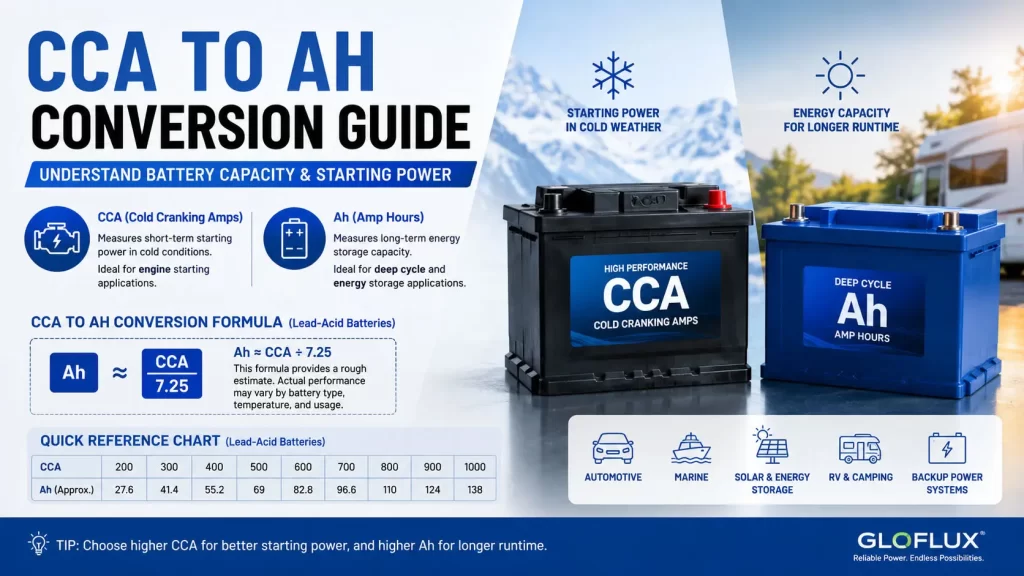
Cold Cranking Amps (CCA) measures how much current a battery can deliver during cold-temperature engine starting conditions. Specifically, CCA describes how many amps a 12V battery can provide for 30 seconds at 0°F (-18°C) while maintaining at least 7.2 volts.
CCA is mainly used for:
- Automotive starter batteries
- Trucks and heavy vehicles
- Marine starting batteries
- Backup generator batteries
- Powersports equipment
The higher the CCA rating, the easier it becomes for the battery to start an engine in cold weather.
For example:
- 300 CCA works for smaller vehicles in moderate climates
- 600–800 CCA is common for larger vehicles or colder regions
- Diesel engines usually require higher CCA ratings than gasoline engines
Low temperatures slow battery chemistry and increase engine resistance. Because of this, cold-weather starting requires significantly more current than warm-weather operation.
What Does Ah Mean?
Amp Hours (Ah) measures how much energy a battery can store and deliver over time. Instead of short bursts of power, Ah focuses on long-duration energy output.
A 100Ah battery theoretically delivers:
- 1 amp for 100 hours
- 5 amps for 20 hours
- 10 amps for 10 hours
Ah ratings are especially important for:
- Solar energy storage
- Portable power stations
- RV batteries
- Marine deep-cycle batteries
- Backup power systems
- Lithium battery packs
Unlike CCA, Ah reflects runtime and energy capacity rather than engine-starting capability.
CCA vs Ah: What Is the Difference?
Although both specifications describe battery performance, they measure completely different characteristics.
| Feature | CCA | Ah |
|---|---|---|
| Main Purpose | Engine starting power | Energy storage capacity |
| Measurement Duration | 30 seconds | Hours |
| Typical Applications | Cars, trucks, generators | Solar, RV, portable power |
| Temperature Testing | 0°F (-18°C) | Around 77°F (25°C) |
| Power Style | Short high-current burst | Long continuous discharge |
| Important For | Cold weather starts | Runtime calculations |
Think of it this way:
- CCA measures how hard the battery can “push” instantly
- Ah measures how long the battery can “keep working”
Can You Convert CCA to Ah?
CCA and Ah are not directly equivalent because they measure different battery behaviors. However, for many lead-acid batteries, there is a widely used estimation formula:
Ah≈7.25CCA
This formula provides a rough estimate rather than an exact calculation.
Example Conversion
If a battery has:
725÷7.25≈100Ah
A 725 CCA battery is roughly equivalent to a 100Ah lead-acid battery.
Again, this is only a guideline. Actual performance depends on:
- Battery chemistry
- Internal resistance
- Temperature
- Plate design
- Discharge rate
- Manufacturer specifications
Quick CCA to Ah Reference Chart
Here are common conversion estimates for lead-acid batteries:
| CCA Rating | Estimated Ah |
|---|---|
| 200 CCA | 27.6 Ah |
| 300 CCA | 41.4 Ah |
| 400 CCA | 55.2 Ah |
| 500 CCA | 69 Ah |
| 600 CCA | 82.8 Ah |
| 700 CCA | 96.6 Ah |
| 800 CCA | 110 Ah |
| 900 CCA | 124 Ah |
| 1000 CCA | 138 Ah |
These values should only be used for general comparisons.
Why Battery Chemistry Matters
The CCA-to-Ah relationship changes significantly depending on battery type.
Lead-Acid Batteries
Traditional flooded and AGM batteries commonly use CCA ratings because they are designed for engine starting. The 7.25 conversion estimate mainly applies to this category.
Lithium Batteries
Lithium batteries behave differently from lead-acid batteries. They typically:
- Deliver higher discharge efficiency
- Maintain more stable voltage
- Recover faster after discharge
- Provide better low-weight energy density
Many lithium batteries focus more on Ah, watt-hours (Wh), and continuous discharge rates rather than CCA alone.
For example, a lithium battery with lower Ah may still outperform a larger lead-acid battery during engine starts because lithium chemistry supports stronger instantaneous discharge performance.
At Gloflux Battery Solutions, lithium battery systems are increasingly used in:
- Portable power devices
- Smart electronics
- Emergency backup systems
- Replaceable battery applications
- Compact energy storage systems
When Should You Focus on CCA?
CCA matters most when starting performance is critical.
You should prioritize higher CCA if you use:
- Cars in cold climates
- Diesel engines
- Backup generators
- Boats operated in winter
- Outdoor equipment in freezing conditions
Insufficient CCA can cause:
- Slow engine cranking
- Hard starts
- Voltage drops
- Starter motor strain
- Battery failure in winter
Cold environments dramatically reduce available battery power, which is why northern climates often require higher CCA ratings.
When Is Ah More Important?
Ah becomes more important when runtime matters more than starting power.
Applications focused on Ah include:
- Solar systems
- RV power
- Portable energy stations
- Deep-cycle marine systems
- Off-grid backup power
- Lighting and communication devices
For example:
A portable refrigerator drawing 5 amps continuously from a 100Ah battery could theoretically operate for around 20 hours under ideal conditions.
This makes Ah one of the most important specifications for energy storage planning.
Factors That Affect Battery Performance
Even batteries with identical CCA or Ah ratings may perform differently depending on operating conditions.
Temperature
Cold weather reduces battery efficiency and slows chemical reactions. Hot weather can increase temporary performance but accelerate battery aging.
Battery Age
As batteries age:
- Internal resistance increases
- Sulfation develops in lead-acid batteries
- Capacity decreases
- CCA performance drops
Older batteries often fail during winter because cold temperatures expose weakened starting capability.
Charging Habits
Improper charging shortens battery life.
Common issues include:
- Overcharging
- Deep discharge cycles
- Long-term undercharging
- Inconsistent charging voltage
Maintenance
Corroded terminals and loose connections reduce performance and create unnecessary resistance.
Can a Higher CCA Battery Damage Your Vehicle?
In most cases, using a battery with higher CCA than recommended will not damage the vehicle.
A higher CCA battery simply means more available starting current when needed. The vehicle only draws the power it requires.
However, the replacement battery must still match:
- Voltage
- Physical dimensions
- Terminal configuration
- Charging compatibility
How to Choose the Right Battery
The best battery depends on how you use it.
Choose Higher CCA If You Need:
- Reliable winter starts
- Heavy engine cranking
- Commercial vehicle operation
- Outdoor generator systems
Choose Higher Ah If You Need:
- Longer runtime
- Deep-cycle energy delivery
- Portable energy storage
- Backup power systems
Consider Lithium Batteries If You Want:
- Lower weight
- Longer cycle life
- Faster charging
- Better energy density
- More compact systems
Why Battery Selection Is Changing in 2026
Modern energy systems are shifting toward lithium-based platforms and smart portable energy solutions.
In 2026, buyers increasingly prioritize:
- Lightweight battery designs
- Portable replaceable systems
- Longer cycle lifespan
- Smart battery management systems (BMS)
- Stable discharge efficiency
- Compact energy storage integration
As consumer electronics, mobility devices, and backup power systems continue evolving, understanding battery specifications becomes even more important.
Final Thoughts
CCA and Ah represent two very different sides of battery performance. CCA focuses on short-term starting power, while Ah measures long-term energy delivery.
Although rough conversion formulas exist, they should only be used as estimation tools. Real-world battery performance depends heavily on chemistry, design, temperature, and application requirements.
Before choosing a battery, ask yourself one important question:
Do you need instant starting power, or do you need longer runtime?
Understanding that difference helps you select a battery that performs reliably and efficiently in real-world conditions.
For more battery insights and energy storage solutions, visit Gloflux Official Website.
FAQ About CCA and Ah
What is a good CCA rating for winter use?
For colder climates, many vehicles perform best with batteries rated above 600 CCA.
Is higher Ah always better?
Not necessarily. Higher Ah provides longer runtime, but it may also increase battery size and weight.
Do lithium batteries use CCA ratings?
Some lithium starter batteries include CCA ratings, but many lithium systems focus more on Ah, discharge current, and watt-hour capacity.
Can I use a battery with higher CCA than recommended?
Yes, as long as the voltage and physical compatibility match your equipment requirements.
Which matters more: CCA or Ah?
It depends on the application. Starting batteries prioritize CCA, while energy storage systems prioritize Ah.
Talk to the Manufacturer
Resources & Insights

High Capacity Lithium Battery for Wearables: High-Voltage LiPo Cell Design
2026-10-19
Cylindrical Battery Packs for Laptops: 2S vs 3S vs 4S Battery Design
2026-10-19

Stage Lighting Battery Pack: Prevent Voltage Drop & LED Flicker
2026-10-19

Best Rechargeable Batteries for Smart Devices: Performance, Safety, and Selection Guide
2026-10-19


