


 Home /
 7.4V 5000mAh LiPo Replacement Battery for Bluetooth Speakers


Table of Contents
- Understanding the 7.4V 5000mAh Battery Specification
- Why LiPo Batteries Are Suitable for Portable Speakers
- Stable Power for Audio Performance
- Battery Protection and Operating Safety
- Customization for Speaker Replacement Projects
- Common Application Areas
- Testing Before Mass Production
- Conclusion
-
Frequently Asked Questions
- 1. Can a 7.4V 5000mAh battery replace any 7.4V speaker battery?
- 2. What is the fully charged voltage of a 7.4V LiPo battery?
- 3. Can the battery dimensions and connector be customized?
- 4. Will a 5000mAh battery provide longer speaker playback time?
- 5. What information is required to develop a replacement battery?
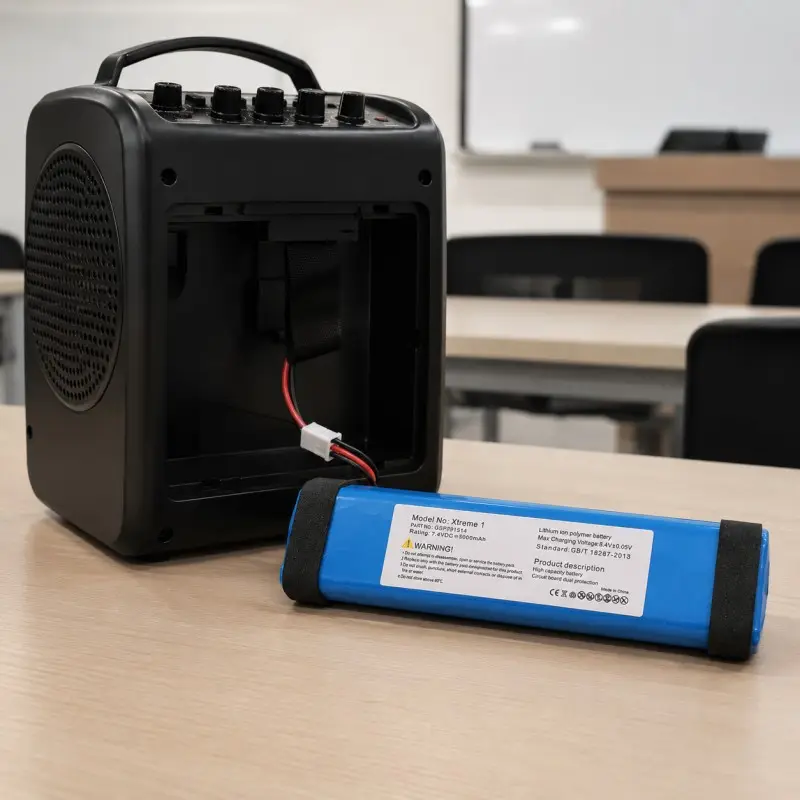
Portable Bluetooth speakers and rechargeable audio systems depend heavily on the condition and performance of their internal batteries. As the original battery ages, users may experience shorter playback time, unexpected shutdowns, slow charging, or difficulty operating the speaker at higher volume levels. A rechargeable 7.4V 5000mAh LiPo replacement battery can provide a practical power solution for compatible Bluetooth speakers, portable amplifiers, wireless audio systems, and compact PA equipment.
However, choosing a replacement battery involves more than matching the voltage and capacity printed on the original label. Battery dimensions, connector type, wiring polarity, discharge current, protection circuit, and charging system must all be evaluated before installation.
Understanding the 7.4V 5000mAh Battery Specification
A 7.4V lithium polymer battery pack normally uses two 3.7V cells connected in series, commonly described as a 2S configuration. Its nominal voltage is 7.4V, while the fully charged voltage is typically 8.4V.
The 5000mAh capacity represents the amount of electrical charge the battery can store under specified test conditions. In a compatible speaker, this capacity can support longer operating time than a lower-capacity battery of the same voltage. Actual playback time will still depend on several factors, including:
- Speaker output power
- Listening volume
- Amplifier efficiency
- Bluetooth connection activity
- Lighting and display functions
- Battery age and temperature
- Standby power consumption
A speaker operating at moderate volume may run considerably longer than the same device used continuously at maximum volume with strong bass and decorative lighting.
Why LiPo Batteries Are Suitable for Portable Speakers
Portable audio products often have limited internal space because the enclosure must accommodate speaker drivers, circuit boards, control panels, charging ports, wiring, and acoustic chambers.
Lithium polymer batteries offer flexible dimensions and a relatively lightweight construction. They can be designed in different lengths, widths, and thicknesses to fit the available battery compartment more efficiently than many rigid battery formats.
This flexibility is especially valuable for speaker manufacturers developing thin, curved, or compact enclosures. A customized LiPo battery can be designed around the internal structure of the audio product while maintaining the required voltage, capacity, and current output.
For replacement projects, the battery must fit the existing compartment without excessive pressure. Adequate clearance should remain for insulation, wire routing, connector placement, and normal battery expansion during service life.
Stable Power for Audio Performance
A portable speaker does not draw the same current at all times. Current demand changes according to volume, bass response, amplifier load, and additional functions.
During normal playback, the battery may supply a relatively stable current. When the volume increases or the speaker produces strong low-frequency sound, the amplifier may briefly require more power. A replacement battery must therefore support both the normal operating current and short-duration peak demand.
If the battery cannot provide sufficient current, the speaker may shut down, distort sound, restart unexpectedly, or trigger the battery protection circuit. For this reason, current capability should be confirmed using the actual speaker specification rather than capacity alone.
A 7.4V 5000mAh LiPo battery can be suitable for many portable audio products, but it is not automatically compatible with every 7.4V speaker. The maximum continuous discharge current and peak current must also match the device.
Battery Protection and Operating Safety
A properly designed replacement battery pack can include a protection circuit that helps manage common electrical risks. Depending on the project, protection functions may include:
- Overcharge protection
- Over-discharge protection
- Overcurrent protection
- Short-circuit protection
- Cell balancing
- Temperature monitoring
For a two-cell battery pack, monitoring the voltage of both cells is important. Significant imbalance between the cells can reduce usable capacity and affect battery reliability.
The protection circuit should be selected according to the speaker’s charging current, operating current, peak power demand, and low-voltage cutoff requirements. A protection board with an overly low current threshold may interrupt normal operation when the speaker is used at high volume.
Battery safety also depends on the charging circuit inside the speaker. A 7.4V battery pack requires a charging system designed for a two-cell lithium battery. It should not be connected to a charger intended for a single 3.7V cell.
Customization for Speaker Replacement Projects
Speaker manufacturers, repair companies, and audio equipment brands may require a battery that matches a specific enclosure and electronic design. A custom battery manufacturer can adjust several parts of the battery pack, including:
- Overall length, width, and thickness
- Nominal capacity
- Connector housing and terminal type
- Lead-wire length and wire gauge
- Positive and negative wire arrangement
- Protection circuit parameters
- Temperature sensor configuration
- Foam pads and insulation materials
- Labels and product identification
- Cable outlet position
Connector appearance alone is not enough to confirm compatibility. Two connectors may look identical while using different polarity arrangements. Reversed polarity can damage the speaker or battery circuit, so the wiring sequence must be checked carefully.
For an accurate replacement project, it is helpful to provide the original battery, battery label, connector photos, wire sequence, compartment dimensions, and speaker electrical specifications.
Common Application Areas
The rechargeable 7.4V 5000mAh LiPo battery pack can be developed for compatible products such as:
- Portable Bluetooth speakers
- Wireless multimedia speakers
- Portable voice amplifiers
- Teaching and tour-guide amplifiers
- Outdoor audio equipment
- Rechargeable karaoke speakers
- Compact public-address systems
- Portable musical instrument amplifiers
- Speaker repair and refurbishment projects
- OEM and ODM audio products
Every application should be reviewed individually. A replacement battery should only be approved after confirming both electrical and mechanical compatibility.
Testing Before Mass Production
Before placing a volume order, the battery should be tested inside the actual speaker. Sample testing can confirm whether the pack fits correctly, charges normally, supports the required playback time, and remains stable at different volume levels.
Important evaluation items include charging temperature, discharge temperature, high-volume playback, low-battery shutdown, connector reliability, standby time, and repeated charge-discharge performance.
For OEM projects, testing the complete speaker and battery system is more meaningful than evaluating the battery separately. The amplifier, charger, enclosure, wiring, and battery protection circuit must operate together as one system.
Conclusion
A rechargeable 7.4V 5000mAh LiPo replacement battery can restore operating time and provide dependable power for compatible Bluetooth speakers and portable audio systems. Its compact structure, flexible dimensions, and customizable connector design make it suitable for replacement, repair, and new product development projects.
Successful battery replacement requires careful verification of voltage, charging system, current demand, dimensions, connector polarity, and protection functions. By confirming these details and completing device-level sample testing, audio equipment manufacturers can reduce compatibility risks and develop a safer, more reliable battery solution.
Frequently Asked Questions
1. Can a 7.4V 5000mAh battery replace any 7.4V speaker battery?
No. The voltage may match, but dimensions, connector type, polarity, discharge current, protection circuit, and charging requirements must also be compatible.
2. What is the fully charged voltage of a 7.4V LiPo battery?
A standard two-cell 7.4V LiPo battery pack is typically charged to 8.4V. The speaker’s charging circuit must support this battery configuration.
3. Can the battery dimensions and connector be customized?
Yes. Battery size, wire length, connector model, polarity, protection circuit, insulation materials, and cable direction can be adjusted for compatible OEM projects.
4. Will a 5000mAh battery provide longer speaker playback time?
It may provide longer operation than a lower-capacity battery under similar conditions. Actual playback time depends on speaker power, volume, amplifier efficiency, lighting, and other functions.
5. What information is required to develop a replacement battery?
Useful information includes the original battery voltage and capacity, dimensions, connector photos, wiring polarity, maximum current, charging method, battery compartment size, and speaker model.
Talk to the Manufacturer
Resources & Insights
High Capacity Lithium Battery for Wearables: High-Voltage LiPo Cell Design
2026-10-19
Cylindrical Battery Packs for Laptops: 2S vs 3S vs 4S Battery Design
2026-10-19
Stage Lighting Battery Pack: Prevent Voltage Drop & LED Flicker
2026-10-19
Best Rechargeable Batteries for Smart Devices: Performance, Safety, and Selection Guide
2026-10-19


